


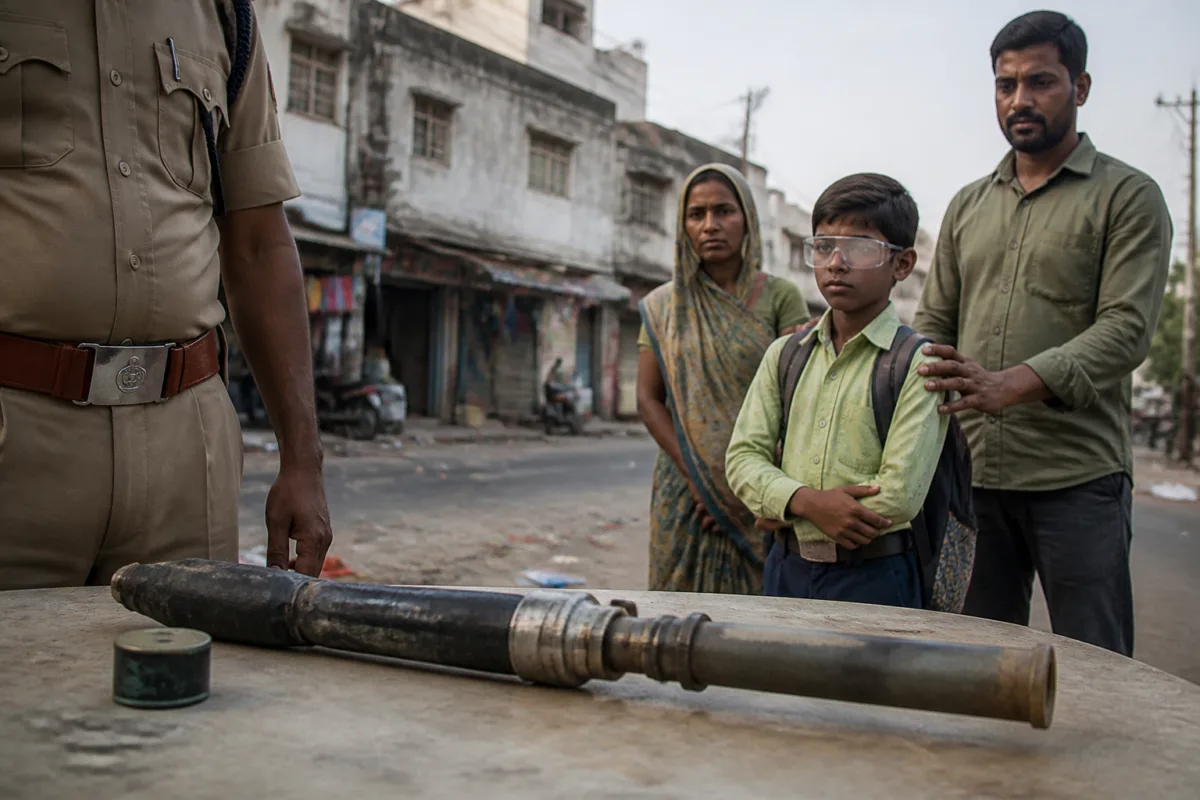
Carbide gun injuries in Madhya Pradesh have outlasted the festivities that produced them. A year after a carbide gun injured his right eye during Dhanteras celebrations in Ashta, 12-year-old Senu is back in school, but the injury continues to affect his health, his family’s finances and his educational plans. His case shows that the public-safety consequences of hazardous festival devices do not end when the immediate incident is over.
According to a report by the Times of India, Senu had been preparing for the Class VI entrance examination to Jawahar Navodaya Vidyalaya when the injury disrupted his studies. He had bought a Rs 500 application form and preparation books worth Rs 700. He is now studying in Class VI at a regular school and hopes to receive another opportunity to enter the residential school, while his father has sought a government exception to the admission process.
The educational setback is one part of a wider chain of consequences. Senu continues to wear protective glasses outdoors and sometimes experiences swelling in the affected eye, the report said. His father, Jitendra Verma, a farmer from Khamkheda Jatra, about 14 km from Ashta, said he spent nearly Rs 15,000 on treatment in Bhopal after initially seeking care locally. The family borrowed money for the treatment and, a year later, had received no compensation, according to his account.
The case brings together three systems that are often treated separately: regulation of dangerous products, emergency medical access and support for families after preventable injuries. When these systems do not connect, the burden moves from public authorities to households. In Senu’s case, the family had an Ayushman Bharat card, but his father still described continuing financial difficulty and the absence of compensation. The report does not establish why compensation was not provided or whether any formal compensation mechanism was activated.
The reported availability of carbide guns before and during the festivities also raises questions about enforcement. The Times of India reported that carbide guns were sold openly by the roadside in Bhopal, Gwalior and other cities, with viral reels helping promote them. The report further referred to early warning signs, including first information reports and a 2023 Indian Council of Medical Research report. These signals, it said, did not lead to effective action across the state before children were injured.
That sequence matters because a hazardous product sold in public spaces is not only a matter of individual behaviour. It is also an administrative question involving local enforcement, policing, market monitoring and public communication. The supplied report does not identify which agencies were responsible for preventing sales, whether seizures were carried out, or whether local administrations issued orders restricting the devices. Those unanswered questions are central to understanding how the risk reached children in multiple locations.
The medical effects described in the report add another layer to the problem. Dr Aditi Dubey, an ophthalmologist at Gandhi Medical College in Bhopal who treated such patients, said around eight to 10 children had suffered lasting effects on their vision. The report noted that these children were not necessarily blind, but that impaired eyesight could affect eligibility for some jobs and entrance examinations requiring 6/6 vision, depending on the applicable medical standards.
This distinction between blindness and lasting impairment is important for public policy. A child may return to school and appear to have recovered while still facing restrictions in examinations, occupations or everyday activities. The harm therefore cannot be measured only by hospitalisation, surgery or total loss of sight. It may also involve reduced educational choices, repeated medical expenditure, anxiety about future eligibility and the need for protective equipment over an extended period.
Senu’s disrupted Navodaya preparation illustrates how a short-term injury can alter a long-term opportunity. The residential school entrance process operates around a defined examination and admission cycle. Missing that cycle can have consequences that medical treatment alone cannot repair. His father’s request for an exception is consequently not just a plea for administrative flexibility; it reflects the absence of a clear pathway for children whose education is interrupted by a documented injury.
The financial burden described by the family shows why compensation and treatment access need to be considered together. The reported treatment cost of nearly Rs 15,000 may appear limited when viewed against the cost of specialised care, but it was significant enough for the family to borrow money. For a farming household already carrying other loans, even a single injury can affect spending on education, transport and daily needs. The report does not state whether the family’s medical expenses were reimbursed through any government or insurance process.
The events also reveal the limits of treating festival safety as a seasonal campaign. Carbide guns were reportedly promoted through viral reels and sold openly in several cities. If enforcement begins only after an injury, authorities are responding to an outcome rather than controlling the supply and use of the device. The reference to earlier FIRs and the 2023 ICMR report suggests that warnings were available before the reported injuries, although the supplied material does not provide details of the report’s recommendations or the action taken on them.
A more complete institutional response would require clear accountability across the chain. Local administrations would need to identify and stop sales; police would need to act on complaints and cases; health authorities would need to document injuries and follow up with patients; and education authorities would need a mechanism for children whose examinations or admissions are disrupted by such incidents. The report records the effects on one child and cites the ophthalmologist’s estimate of lasting vision effects among eight to 10 children, but it does not provide a statewide injury registry or a consolidated account of cases.
That data gap makes the problem harder to govern. Without a reliable record of injuries, treatment costs, affected districts, recovery outcomes and educational disruption, the official response can remain limited to individual cases. Families may then have to repeatedly explain their circumstances to hospitals, schools and departments without a standard process for assistance. The absence of publicly described compensation outcomes in Senu’s case further indicates that the administrative pathway remains unclear from the family’s perspective.
The central urban question is not confined to Bhopal or to the festival season. It is how cities and towns manage products that move quickly through informal markets, become popular through digital promotion and create risks that are borne by children and low-income households. Roadside sales, local enforcement and access to specialised medical care connect public space, commerce, policing and health infrastructure. The damage becomes visible in hospitals, classrooms and household borrowing long after the original sale.
The evidence in the report confirms lasting vision effects, educational disruption and financial strain in at least one family, while a treating ophthalmologist reports similar long-term effects among several other children. It also points to earlier warning signs and unresolved questions over compensation and enforcement. What remains unclear is the full number of affected children, the action taken against sellers, the status of compensation claims and whether education authorities have created any exception process. Those are the next facts needed to establish whether Madhya Pradesh has addressed the underlying safety failure or is only dealing with its aftermath.

