


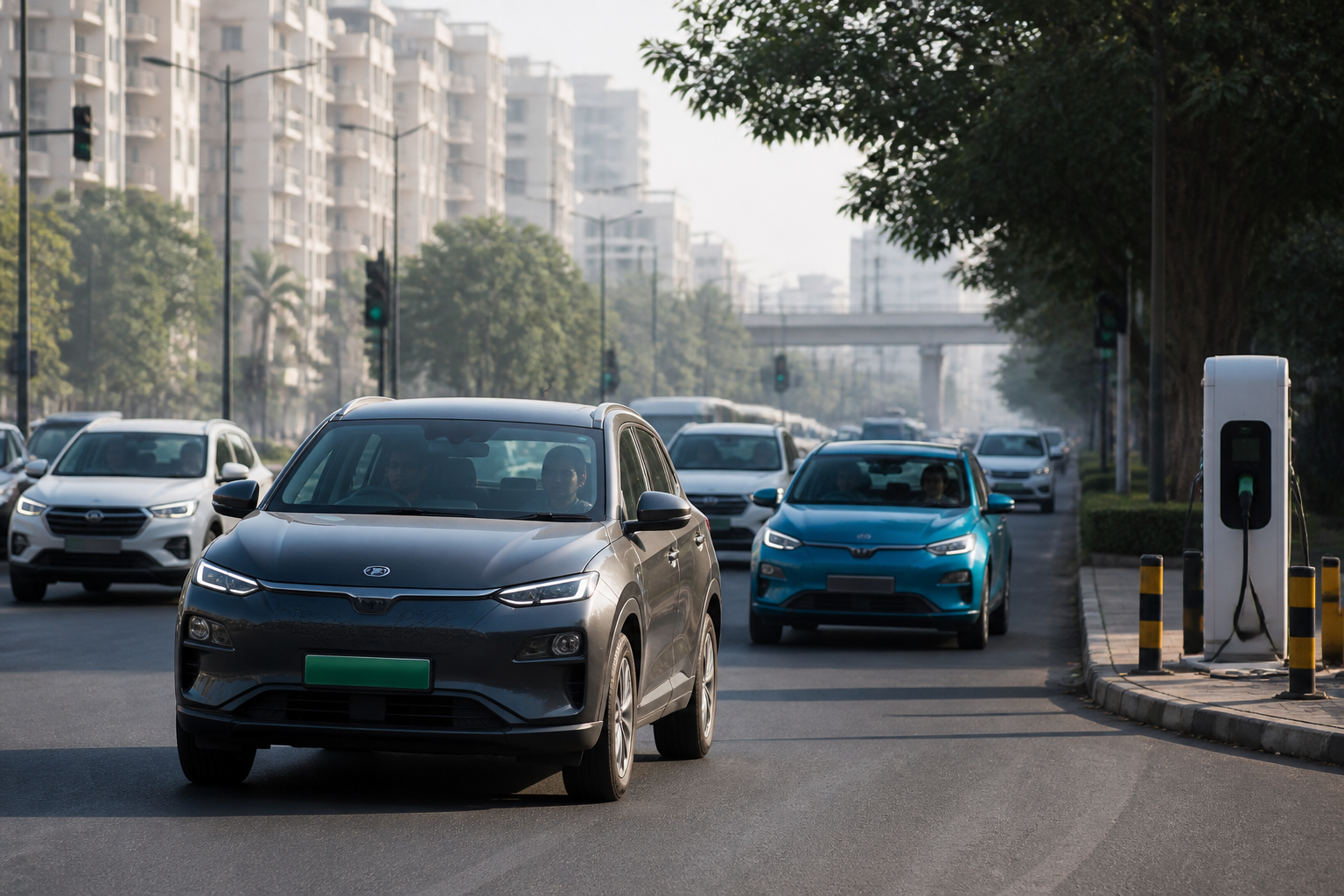
India’s next fuel-efficiency regime will make vehicle efficiency a stronger part of automakers’ product and pricing decisions, but it will not guarantee that every car sold after April 2027 is cheaper to run. CAFE III, which takes effect on April 1, 2027, will tighten fleet-average fuel-consumption targets for passenger vehicles until March 31, 2032, while giving manufacturers multiple routes to comply, including electric vehicles, hybrids, ethanol, CNG and a range of component-level technologies.
That distinction is important because CAFE III regulates the average performance of a manufacturer’s passenger-vehicle fleet rather than prescribing one efficiency standard for every model. A carmaker can therefore balance less efficient and more efficient vehicles within its portfolio, provided the combined performance meets the applicable target. The effect on buyers will depend on how companies change their model mix, which technologies they adopt and how those choices affect showroom prices.
The notified framework described in the supplied report sets a fleet-average benchmark of 3.996 litres per 100 km in 2027-28. That benchmark is scheduled to decline to 3.3273 litres per 100 km in 2031-32, representing an improvement of about 16.7% over the compliance period. The progression creates a tightening pathway rather than a single regulatory deadline. Manufacturers will have to improve performance progressively as the standards become more demanding.
This is a significant shift in the way the passenger-vehicle market may evolve. Instead of relying only on conventional engine improvements, companies can combine powertrain changes with electrification, alternative fuels and smaller efficiency gains from vehicle components. The framework expands the regulatory importance of technologies that may not be immediately visible to buyers but can collectively reduce fuel consumption or carbon dioxide emissions.
The policy also gives additional weight to certain cleaner technologies in fleet-compliance calculations through volume derogation factors, commonly referred to as super credits. Battery electric vehicles and range-extended electric vehicles receive a factor of 3.0, while plug-in hybrids receive 2.5. Strong hybrids running on flex-fuel ethanol receive 2.5, strong hybrid electric vehicles receive 1.6 and flex-fuel ethanol vehicles receive 1.1.
These factors do not mean that a vehicle will deliver three times the real-world efficiency of another vehicle. They affect how the vehicle contributes to the manufacturer’s fleet calculation. That distinction matters for consumers: a regulatory incentive can influence which models companies introduce, but it does not by itself determine the running cost, reliability or convenience of a particular car.
The same applies to the framework’s treatment of fuels. CAFE III introduces a Carbon Neutrality Factor for specified fuels and fuel combinations. The report states that ethanol-blended petrol vehicles receive an 8% factor, flex-fuel ethanol vehicles 22.3% and CNG vehicles 5% or the notified compressed-biogas blending percentage, whichever is higher. Diesel vehicles are assessed according to the applicable biofuel-blending percentage.
The inclusion of ethanol and CNG gives manufacturers compliance options beyond battery-electric vehicles. Dr CK Jain, president of the General Ethanol Manufacturers Association, described the recognition of ethanol as a route that could complement electrification, reduce dependence on imported crude oil and support demand for agricultural feedstocks. Those benefits, however, will depend on the availability of compatible vehicles, fuels, servicing networks and distribution infrastructure.
For cities, this is where the policy moves beyond laboratory efficiency figures. A technology is only practically useful when the surrounding system supports it. Electric vehicles require accessible and reliable charging, while CNG and ethanol-based options depend on fuel availability and compatible distribution networks. Pankaj Sharma, founder and managing director of K2 Infragen, said infrastructure would be important in determining whether a vehicle is convenient for users, particularly when charging or refuelling facilities are limited.
CAFE III also recognises 12 fuel-saving technologies that can be used to improve compliance. They include start-stop systems, tyre-pressure monitoring, regenerative braking, six-speed or higher transmissions, efficient alternators, motor-generators, exterior LED lighting, advanced glass and glazing, electric water pumps, high-efficiency air-conditioning, solar-reflective paint and pulse-width-modulated radiator fans.
Manufacturers can claim a reduction of 1 gram of carbon dioxide per kilometre for each eligible technology fitted to a vehicle, subject to a maximum reduction of 9 grams of carbon dioxide per kilometre. The Ministry of Road Transport and Highways is expected to develop the certification methods. The verification process will become stricter over time: self-declaration is permitted during the first compliance block, while validated test results will be required in the second.
This structure allows manufacturers to combine incremental improvements across a fleet. It also means that compliance does not necessarily require every company to shift immediately to one powertrain technology. Jyoti Prakash Gadia, managing director of Resurgent India Limited, said the framework would encourage efficient engines, electrification and alternative-fuel vehicles, but would not mean that all manufacturers would follow the same path or eliminate conventional engines.
The rules revise the role of vehicle weight in calculating fuel-efficiency targets. The reference weight will rise from 1,082 kg to 1,229 kg, an increase of about 13.6%. The applicable target will be calculated using a formula linked to the average unladen mass of vehicles manufactured or imported for sale in India. Under the revised approach, lighter vehicles will have relatively softer targets, while heavier vehicles will face tougher efficiency requirements.
This weight-linked structure is relevant to the continuing growth of sport utility vehicles and larger passenger vehicles in the Indian market. The framework does not prohibit heavier vehicles, but it makes their efficiency performance more consequential for a manufacturer’s fleet average. Automakers will therefore have to consider not only the demand for larger models but also how those vehicles affect their overall compliance position.
CAFE III includes a compliance market for manufacturers. Companies that outperform their targets can earn credits and carry them forward within the relevant compliance block. Those that fall short can use eligible credits, exchange credits with other manufacturers or purchase credits through the Bureau of Energy Efficiency’s buyout mechanism. The buyout price will increase from Rs 2,500 per gram of carbon dioxide per kilometre in 2027-28 to Rs 4,500 in 2031-32. Manufacturers selling fewer than 1,000 eligible vehicles in a reporting period will be exempt from fleet-average obligations.
These mechanisms create flexibility, but they also make the impact on prices difficult to generalise. More efficient engines, hybrid systems, batteries, software and testing can increase development and manufacturing costs. At the same time, competition and economies of scale could limit the price increase for some technologies. The effect will vary between manufacturers and vehicle categories rather than producing one uniform increase across the market.
For buyers, the more useful measure may be total cost of ownership rather than the initial showroom price. A vehicle with a higher purchase price could cost less to operate over several years if its fuel or electricity savings are large enough. But that outcome depends on annual mileage, energy prices, maintenance costs, financing, insurance, resale value and the period for which the vehicle is kept.
The calculation will also differ by user. A person driving long distances each year may recover a higher upfront premium more quickly through lower energy bills. A low-mileage user may take much longer to offset that premium. An electric vehicle may be suitable for a buyer with dependable home charging but less convenient for someone without access to a charger. Hybrid and alternative-fuel vehicles will similarly depend on fuel availability and service support.
CAFE III therefore creates a stronger regulatory push towards efficiency without settling the consumer’s final choice. It does not guarantee a particular real-world mileage figure, eliminate petrol engines or ensure that every vehicle with an efficiency-oriented technology will be cheaper to own. It changes the incentives facing manufacturers and expands the range of technologies that can contribute to fleet compliance.
The central urban question is whether vehicle efficiency improvements will develop alongside the infrastructure needed to make them usable. The framework can encourage cleaner and more efficient models, but the benefits will be uneven if charging, refuelling, maintenance and fuel distribution do not keep pace. From April 2027, the relevant comparison for buyers will therefore be broader than showroom price or claimed mileage: it will involve the vehicle, the energy system around it and the way each household travels.
