


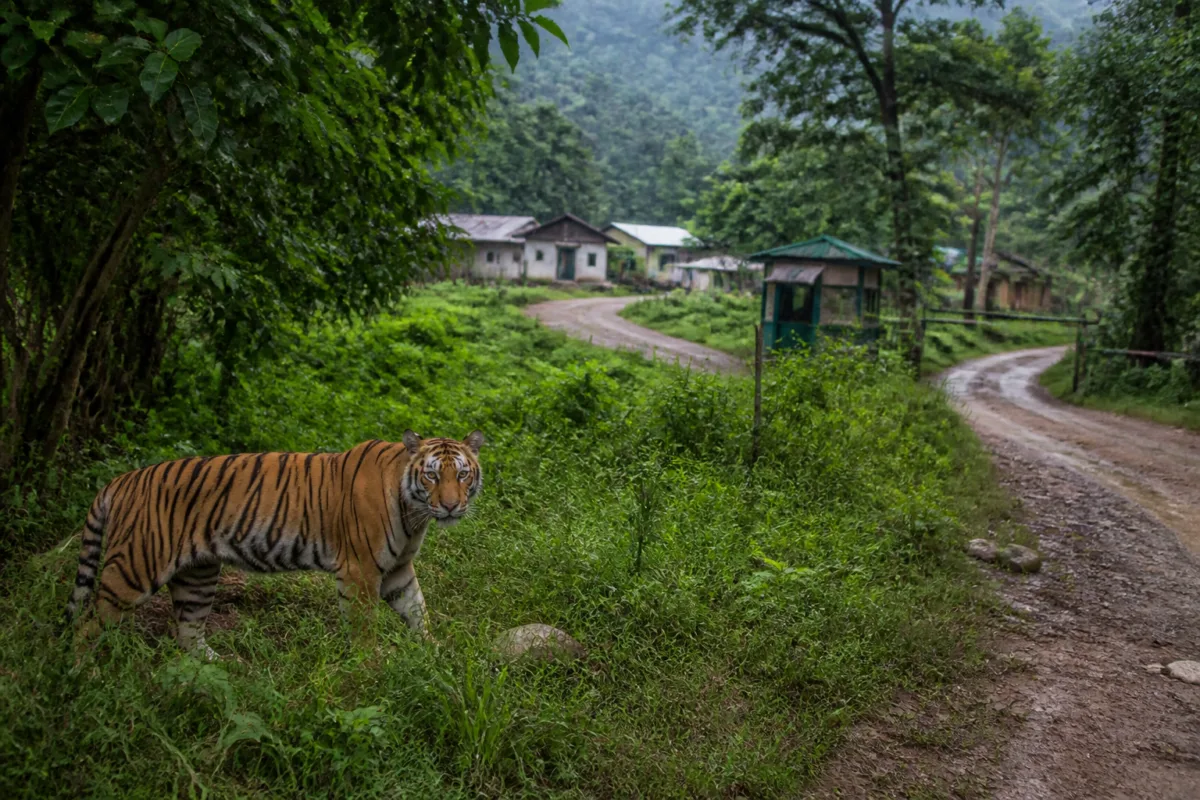
Buxa Tiger Reserve’s attempt to rebuild its tiger population has quickly become entangled with a far older question: whether conservation can succeed when the communities living inside and around a protected forest remain uncertain about their rights, livelihoods and future. A newly reintroduced tigress crossed into Assam on October 26, while villagers near Rajabhatkhawa continued a shutdown and sit-in demanding clarity on relocation, compensation and access to local economic opportunities.
The two developments are linked by the timing of the reintroduction programme. The tigress was released earlier this month at an event led by West Bengal chief minister Suvendu Adhikari and Union environment minister Bhupender Yadav. The initiative was presented as a milestone for Buxa, which was declared a tiger reserve in 1984 but had no verified big-cat activity for nearly two decades. The reserve’s only confirmed sighting since 1998 was a solitary adult male captured on a camera trap in December 2021.
The immediate response from the forest department has been to monitor the tigress rather than automatically bring her back. Forest minister Manoj Oraon, as quoted by The Telegraph Online, said a team had reached Assam and that tranquillisation would be considered only if the animal moved towards human settlements adjoining the Assam forest. For now, the tigress is being allowed to move freely.
That operational decision is separate from the political and social dispute unfolding in Buxa, but the animal’s departure has intensified questions among protesters and their supporters about the purpose and durability of the reintroduction programme. The state government has announced plans to release three more tigers into the reserve before the end of the year. The programme therefore faces a test that is not limited to whether individual animals can be brought into the forest. It must also establish whether the institutional arrangements around the reserve can accommodate the people who already live there.
### Conservation and resettlement are now inseparable
The protest at Rajabhatkhawa had completed 22 days when the report was published, with around 30 people from 18 neighbouring villages attending a sit-in. Protesters have demanded the withdrawal of the forest department’s checkpost, permission for tourists to stay overnight at homestays in Jayanti, and the resumption of car safaris from the area. These demands indicate that the conflict is not only about relocation documents. It is also about who controls access to the reserve and how local residents participate in the tourism economy built around it.
Some residents say they have been asked to leave and that those willing to relocate have already signed paperwork, but that the government has not assigned a resettlement site. Gautam Dey, a local tour guide quoted in the report, said the shutdown had continued while residents protested for their rights. For households that depend on guiding and tourism-related work, the location of resettlement is not a minor administrative detail. It determines whether their existing skills and networks remain economically useful.
The proposed relocation area is Kalchini block. Residents who have signed the documents have reportedly been promised lump-sum compensation of Rs 15 lakh. However, villagers fear that the move could reduce their livelihood options because forest access would be restricted in the new area and tourism infrastructure is limited. Jagdish Oraon, a tribal community leader involved in the protest, said residents had no right to agricultural or industrial use of the forest and were therefore heavily dependent on tourism.
This reveals the central planning problem in the dispute. Relocation is often treated as a transfer of households from one geographical site to another. For forest communities, however, a settlement is also an economic system: it includes access to work, transport, markets, social networks, common resources and public services. A cash payment may address one part of the transition, but it does not by itself recreate the livelihood ecosystem that residents say they would lose.
### The legal framework sets conditions, not just compensation
The report places the dispute within the Forest Rights Act, 2006. The law protects eligible forest-dwelling communities from eviction until their forest rights have been recognised and verified. Section 4(2), as summarised in the report, permits relocation from critical wildlife habitats only after forest rights have been recognised, scientific evidence establishes a threat to wildlife, reasonable coexistence options are found unfeasible, and informed consent and adequate resettlement arrangements are secured.
These conditions are important because they shift the administrative question from whether a reserve has conservation objectives to how those objectives are implemented. A protected-area designation does not eliminate the need for rights recognition, evidence-based decision-making or a credible rehabilitation plan. The existence of a tiger reintroduction programme also does not, on its own, establish that relocation is necessary or that all coexistence options have been exhausted.
The supplied report does not establish whether the required steps under Section 4(2) have been completed across the affected villages. It records competing positions instead. Oraon estimated that 8,000 to 10,000 people across 18 forest villages could be affected and claimed that around 30 per cent of forest dwellers were unwilling to sign resettlement documents. Kalchini MLA Bishal Lama said most forest dwellers were willing to be rehabilitated, had received compensation and that the process would be completed amicably.
The gap between these accounts is itself an administrative problem. A relocation process involving thousands of people cannot be judged only by the number of signed forms or the amount of compensation announced. It also requires a transparent record of whose rights have been verified, who has consented, what alternatives were considered, where households will move, and how their livelihoods will function after relocation. The report does not provide that complete record.
### Buxa’s tourism economy adds another layer
The demands for homestays and car safaris show why the future of Buxa cannot be reduced to a binary choice between conservation and settlement. The local economy appears to have developed around visitors, guides and access to forest destinations. Residents say tourism is one of the few viable sources of income available to them, while the proposed relocation site is seen as unsuitable for tourism.
The Association for Conservation and Tourism has appealed to the chief minister to resolve the impasse over tourism activities. Support for the agitation has also come from Jalpaiguri, Siliguri, Kurseong and Kalimpong. This wider support suggests that the dispute is being understood not only as a village-level resettlement issue but also as a question about the management of a regional tourism landscape.
At the same time, the source contains a competing conservation argument. Wildlife conservationist Avijan Saha pointed to the area’s history of mining and said the conservation initiative could become a pretext for displacing forest dwellers. He argued that Buxa had not historically supported a stable tiger population and that tigers had mainly migrated through the area before straying away. These claims are attributed to Saha and are not independently established in the supplied material, but they identify a critical evidence question: what ecological conditions make Buxa suitable for a sustained tiger population, rather than only occasional animal movement?
The answer matters for both conservation and local administration. If the programme is based on a long-term habitat strategy, the state must be able to explain how prey, territory, monitoring, human-wildlife conflict management and community participation will work together. If the programme is presented primarily through the symbolic return of tigers, the relocation dispute may deepen because residents could see conservation as a land-control project rather than a shared management framework.
### The administrative test is implementation, not announcement
The reintroduction programme has received high-level political backing. At a gathering in Alipurduar on October 3, Adhikari contrasted the initiative with earlier inaction, saying that Buxa had been a tiger reserve in name without tigers. The announcement of three additional releases before the end of the year gives the project a clear political timeline.
But the protest shows that wildlife targets and community milestones are not moving at the same pace. The government has a stated conservation objective, while villagers are waiting for clarity on resettlement sites, compensation, access and livelihood continuity. The scheduled November 1 meeting between forest representatives and the state, mentioned by Lama, is therefore an important administrative milestone—not because it resolves the dispute automatically, but because it can reveal whether the process will involve meaningful engagement or simply communicate decisions already taken.
The report also records claims that some residents faced measures including electricity disconnections after refusing to sign resettlement documents. These claims are attributed to residents and are not independently verified in the supplied material. Their presence in the dispute makes due process especially important. Where relocation is contested, coercive pressure—whether established or alleged—can undermine confidence in consent and make later implementation more difficult.
Buxa’s situation reflects a recurring challenge in conservation-led planning: authorities often define success through ecological indicators, while communities experience the project through access, income, public services and procedural fairness. Both dimensions are material. A reserve may gain formal protection and receive new wildlife, but the conservation model remains fragile if residents do not trust the institutions implementing it.
The evidence currently confirms three immediate facts: a reintroduced tigress has moved into Assam; the state intends to continue the tiger-release programme; and residents of forest villages are protesting over relocation, rights and tourism-linked livelihoods. It does not establish whether the full legal and administrative conditions for relocation have been met, nor whether the proposed resettlement arrangements can replace the economic role of the forest and local tourism. Those questions, along with the outcome of the November 1 meeting and the monitoring of the tigress, will determine whether Buxa’s revival becomes a durable conservation programme or remains divided between a wildlife announcement and an unresolved human settlement conflict.

