


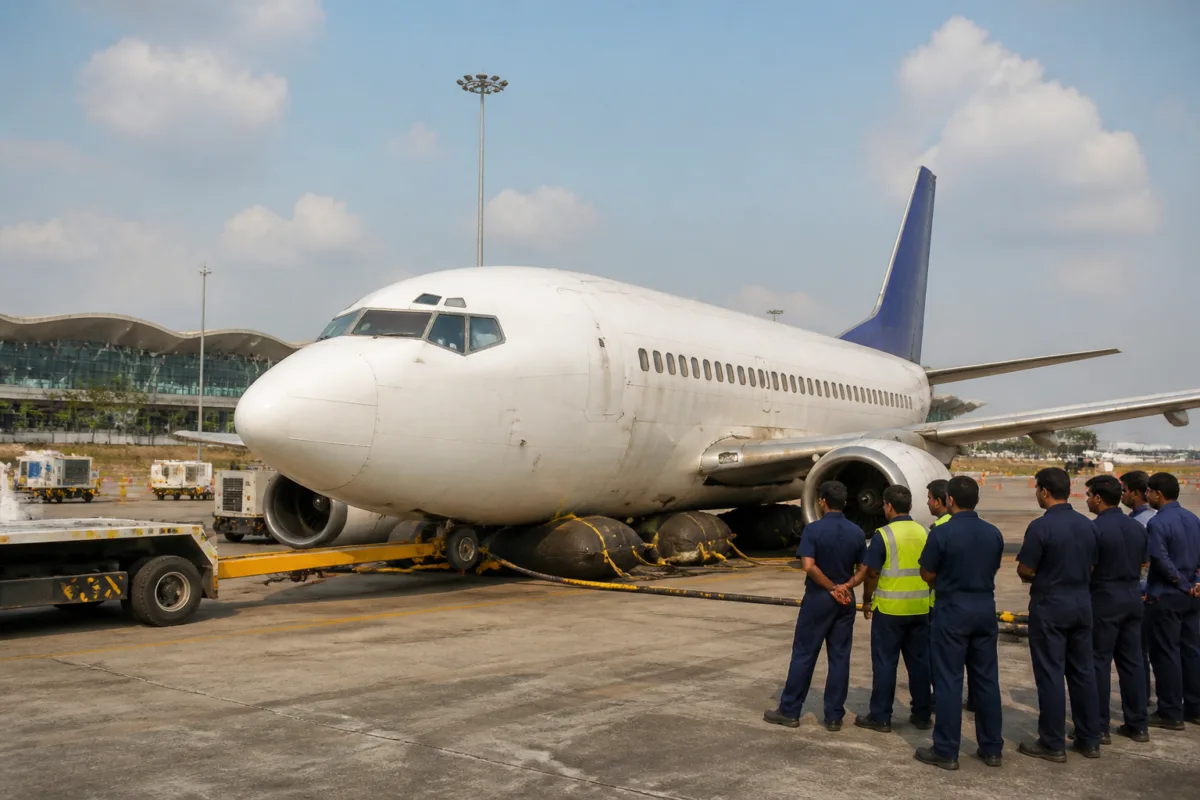
Kempegowda International Airport Bengaluru has added a full-scale Boeing 737-200 aircraft to its Aircraft Recovery Training School, creating a dedicated training platform for handling disabled aircraft on airport movement areas, according to a Deccan Herald report.
The aircraft, named Phoenix, has been repurposed for practical instruction in aircraft recovery. Bangalore International Airport Limited (BIAL), which operates BLR Airport, acquired the previously non-operational aircraft from Kolkata Airport. It was dismantled, transported to Bengaluru on four specialised trailers and reassembled at the airport during a 45-day logistical operation, the report said.
Phoenix retains its engines, avionics and cockpit. Its presence allows trainees to practise recovery procedures on a full-scale aircraft while using specialised equipment. These exercises cover situations including nose-wheel and landing-gear collapse, aircraft lifting and towing, ground preparation and the use of recovery systems.
Aircraft recovery is intended to remove an immobilised aircraft from a movement area without causing secondary damage. Such incidents can affect airport operations by obstructing aircraft stands, taxiways or runways, although the report does not provide data on previous disruptions at BLR Airport or quantify the expected reduction in recovery time.
BLR Airport’s Disabled Aircraft Recovery Equipment capability includes equipment described as compatible with Code F aircraft and a low-pressure inflatable lifting-bag platform. Together with the airport’s procedures and the Phoenix training aircraft, these resources form the practical base for the programmes offered by the Aircraft Recovery Training School.
The school was initially established to build in-house expertise but is now opening its programmes to aviation professionals from across the industry. The training is being conducted in collaboration with KUNZ of Germany and BIAL’s certified trainers. Courses include a five-day advanced hands-on programme, a three-day basic hands-on programme and a one-day familiarisation session. Batches are designed for approximately 16 participants, with certificates issued under the KUNZ-BIAL training-school framework.
BIAL Chief Operating Officer Girish Nair said the expansion of India’s aviation sector would require stronger operational resilience and sustained investment in specialised capabilities. He also described knowledge-sharing among airports, airlines, regulators and industry partners as important to operational readiness.
The development positions BLR Airport as a training hub for a specialised aspect of airport operations rather than merely adding another piece of equipment to its recovery inventory. The report describes the school as South Asia’s only dedicated disabled-aircraft recovery training school, but does not provide comparative evidence or details of how the claim was assessed. It also does not specify the investment involved, the number of personnel already trained or the regulatory framework governing the courses.

