


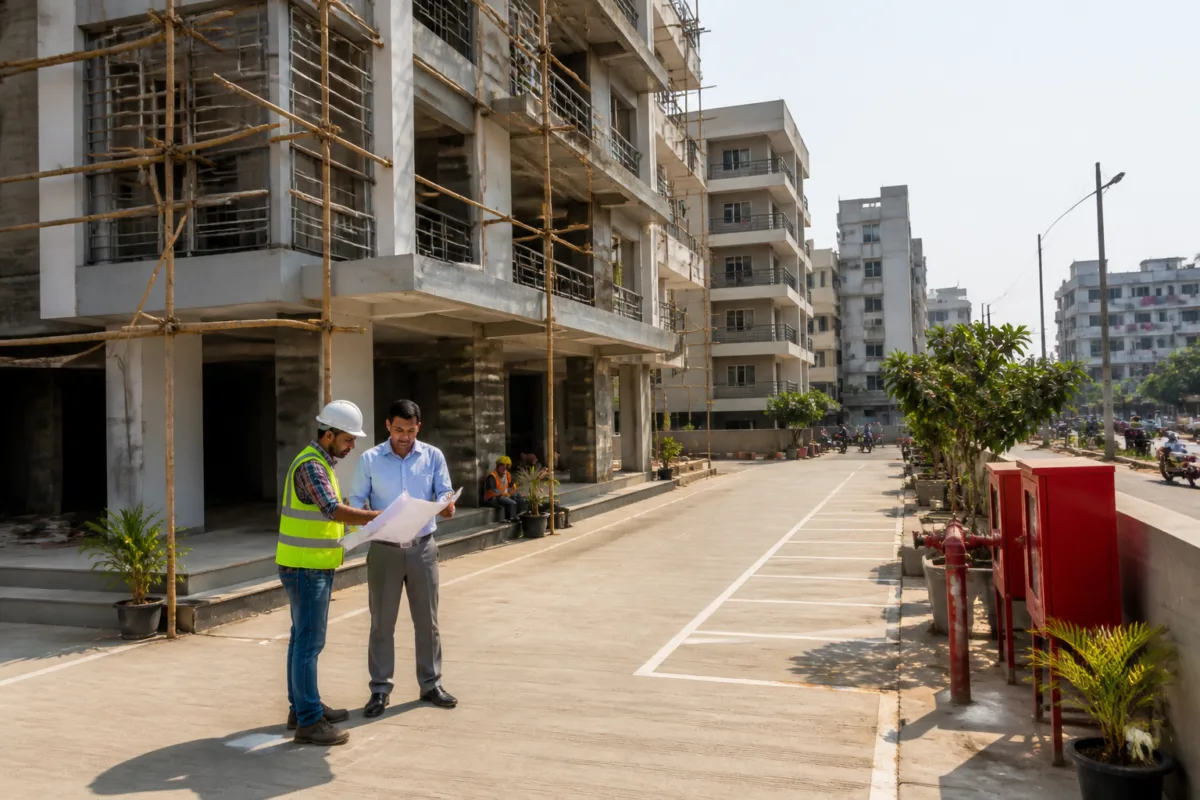
The Bihar cabinet has approved the Building Bylaws 2026, introducing deemed approval of building maps if local urban bodies do not clear applications within 30 days and replacing the rules framed in 2014.
The new regulations were approved on Tuesday following a proposal from the urban development and housing department, Cabinet secretariat additional chief secretary Arwind Kumar Choudhary said, according to a report by the Times of India. The rules classify residential and commercial buildings according to risk, introduce restrictions through a negative list for builders and set out provisions linked to floor area ratio (FAR).
Buildings up to 10 metres in height have been classified as low risk, those between 10 metres and 24 metres as medium risk, and structures above 24 metres as high risk. The classification is intended to establish different regulatory requirements based on the scale and potential risks associated with a building.
The bylaws allow an approach road of up to 3.7 metres and require a setback on only one side in specified circumstances, enabling emergency vehicles to access a building from the rear. Parking space will be calculated at 15 square metres per vehicle. The rules also allow building map approvals to be revalidated for five years, with automatic revalidation on payment of the prescribed fee.
Owners of existing buildings will be able to obtain permits by paying the prescribed fee and submitting building maps. The cabinet decision also incorporates fire safety provisions into the building permit process, making fire-related compliance part of the approval framework.
The regulations offer additional development potential for buildings that secure green-building certification. Buildings with three-star certification will be eligible for an additional 5% FAR, while four-star and five-star buildings will receive 10% and 15% additional FAR, respectively. FAR determines the total floor area that can be constructed on a plot relative to its size.
The deemed approval provision could reduce delays for applicants where local urban bodies do not decide applications within the 30-day period. Its operation will depend on how applications are received, scrutinised and recorded, and on the procedures that urban bodies adopt for enforcing the new rules. The cabinet announcement, as reported, did not specify how disputes or incomplete applications will be handled under the deemed-clearance mechanism.
The cabinet also approved decisions outside the building regulations. Dearness allowance for government employees, pensioners and family pensioners covered by the fifth, sixth and seventh pay commissions was increased retrospectively from July 1. The revisions raise the rates from 483% to 497% for the fifth pay commission, from 262% to 269% for the sixth and from 60% to 63% for the seventh. The changes will impose an additional annual burden of Rs 1,088 crore on the state exchequer.
In another decision, the cabinet approved the Bihar Artificial Intelligence Mission. Global Finance and Technology Network, Singapore, was selected to develop the state’s AI ecosystem through skill training and innovation. The cabinet also cleared the Bihar Ki Beti Startup Challenge for highly educated girls, covering 2,100 students over four years from the current fiscal year with an allocation of Rs 88 crore.
The cabinet further sanctioned Rs 1,399 crore from the contingency fund for the rural development department to meet expenditure under the Pradhan Mantri Gramin Awas Yojana. The approved building bylaws will now form the regulatory framework for building-map approvals and related construction permissions in Bihar in place of the 2014 rules.

