


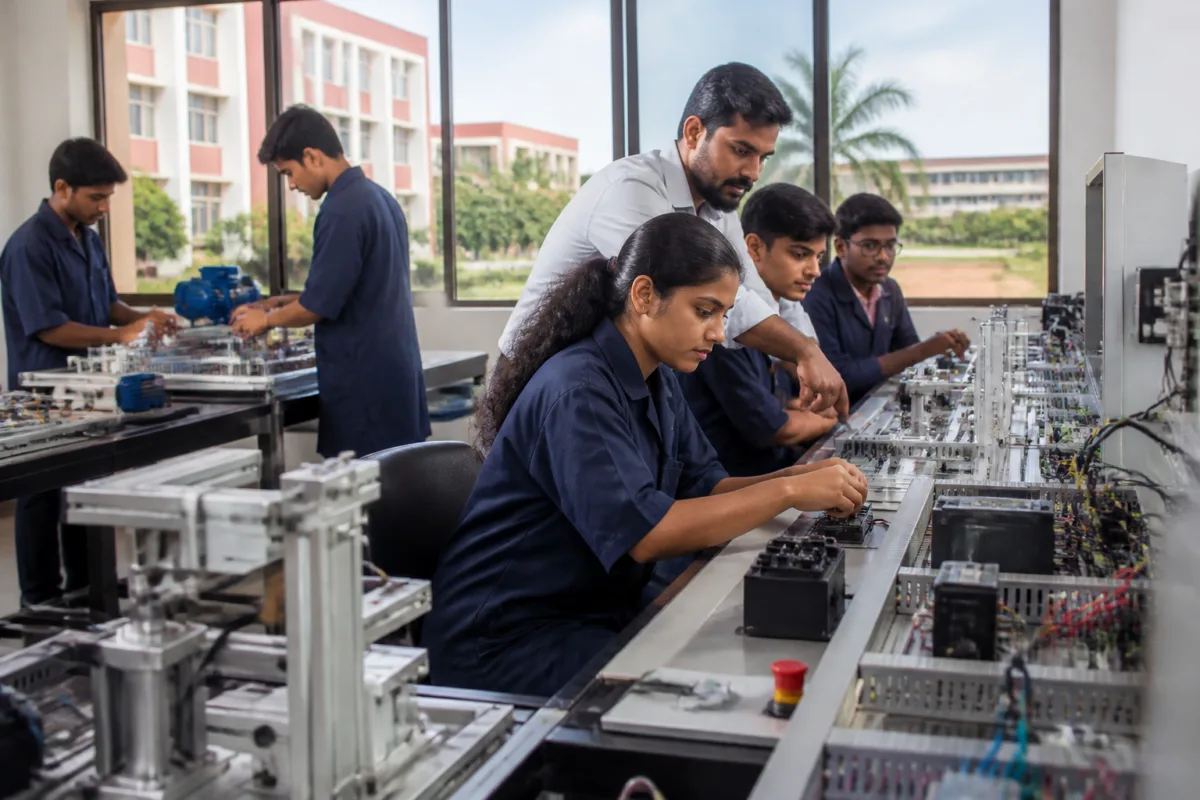
The Bicholim skill centre at Government Polytechnic, Bicholim, was launched on Tuesday to provide technical students with hands-on training in industry-relevant technologies and improve their employment prospects. The Energy4Good Technology Centre has been established with assistance from Siemens Energy India Limited and is expected to train up to 200 students annually.
Goa Chief Minister Pramod Sawant launched the facility, which is intended to bridge skill gaps between technical education and industrial requirements. The centre will offer practical exposure to technologies used in modern industrial workplaces, while strengthening the capacity of the polytechnic to deliver applied technical education.
The curriculum covers programmable logic controllers and drives, hydraulics and pneumatics, mechatronics, sensor technology and computer-aided design. It also includes productivity and quality improvement methods, workplace safety, environmental health and safety, Microsoft Office applications and industry exposure.
According to the report, the curriculum was designed after consultations with industry, academia and other stakeholders. This approach is intended to align classroom training with the competencies expected by employers, while giving students access to equipment and practical learning that may not be available through conventional classroom instruction alone.
Guilherme Mendonca, managing director and chief executive officer of Siemens Energy India, said the initiative aims to develop industry-ready talent by strengthening technical competencies and building long-term training capabilities within educational institutions. The programme is therefore structured not only as a training facility but also as an institutional capacity-building effort.
The centre is part of three similar facilities established by Siemens in 2026. The other two are located in Maharashtra and Gujarat, and the three centres together have the capacity to train more than 600 students each year. The wider programme links technical education with the availability of industrial skills across states.
The Bicholim programme will be implemented over three years. Its components include infrastructure development, curriculum delivery, faculty capacity-building and integration with regular academic programmes. The phased implementation is intended to allow the institution to operate the centre independently over time.
For students at Government Polytechnic, Bicholim, the immediate change will be access to structured training in industrial automation, mechanical systems, design and workplace practices alongside their regular academic programmes. The centre’s longer-term progress will depend on how effectively the new infrastructure, faculty training and industry-linked curriculum are integrated into the institution’s ongoing teaching system.

