


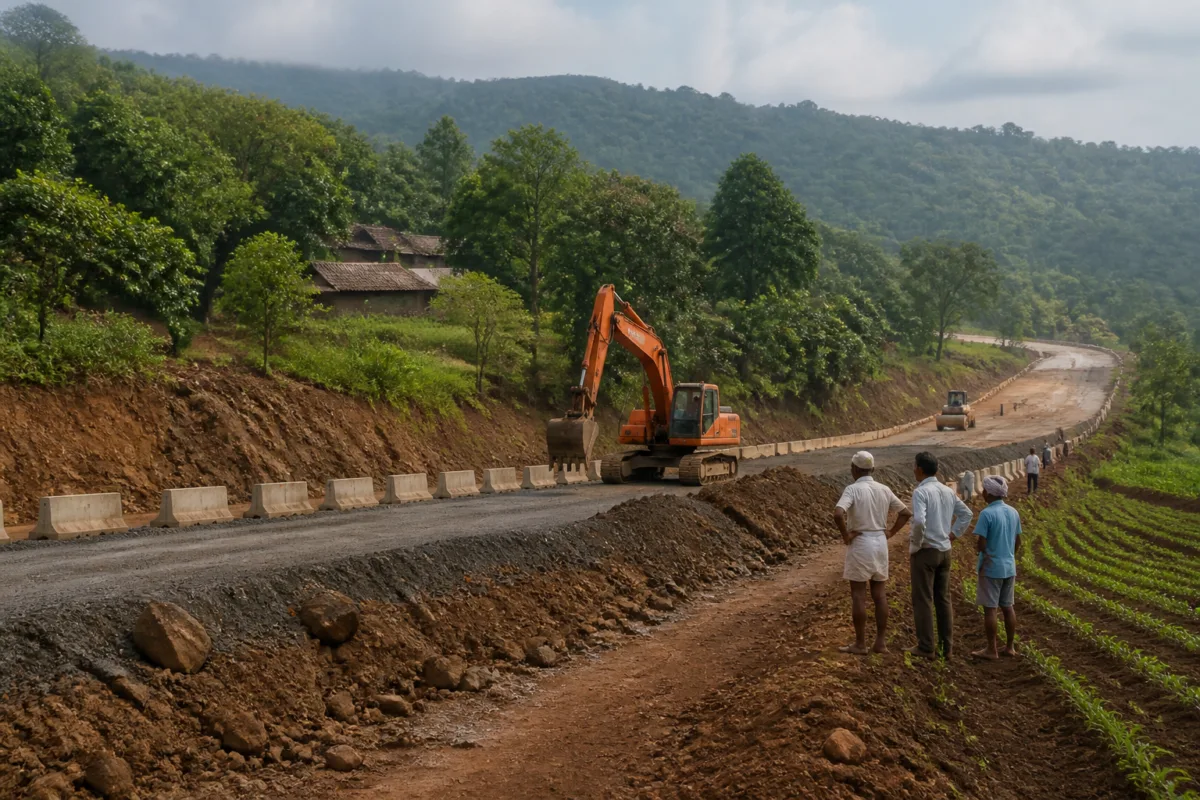
Work on National Highway 61 between Banker Phata and the Bhimashankar area has begun in parts of Pune district, but some tribal farmers whose land is reportedly affected say they have not received land-acquisition notices or compensation. The concerns have emerged in the western tribal region of Ambegaon taluka, where the road is planned to pass through about 16 villages covered by the Panchayats (Extension to Scheduled Areas) Act, or PESA.
According to a report by Lokmat – Pune, affected residents allege that the formal measurement and acquisition process for some parcels has not been completed, even though roadwork has started on the ground. They are asking whether the rights of landowners and cultivators should be settled before construction proceeds.
The highway is being developed as part of a government policy to connect religious destinations. The Banker Phata–Junnar–Ghodegaon–Taleghar–Bhimashankar corridor is expected by local residents to improve connectivity, tourism and development in the western tribal belt. The reported dispute is not framed as opposition to the highway itself. Instead, residents are seeking a transparent acquisition process, lawful compensation and participation in decisions affecting their land and livelihoods.
For privately owned land affected by the project, residents have said that the relevant procedure should include formal notices, official measurement, completion of acquisition proceedings and determination and payment of compensation under applicable government rules. Some farmers allege that work began before these steps were completed in their cases. The report does not provide the number of affected parcels, the amount of compensation pending or the precise length of the section currently under construction.
The concerns also relate to the role of village institutions in Scheduled Areas. At an earlier meeting in Taleghar chaired by Sub-Divisional Officer Govind Shinde, affected farmers, residents, social workers and officials discussed PESA implementation, Gram Sabha powers and issues connected with the highway. The administration reportedly said that Gram Sabhas would be held in each village and that government representatives would provide detailed information about the project.
Residents now say that construction has revived questions about whether those commitments have been implemented. They have sought compliance with PESA, the Forest Rights Act, 2006, and applicable provisions of the Right to Fair Compensation and Transparency in Land Acquisition, Rehabilitation and Resettlement Act, 2013. Their demands include information about the project, a transparent process for affected land and respect for local legal rights.
The report also records environmental concerns. Residents and environmentalists fear that widening and construction could affect old trees, biodiversity and natural resources in the Sahyadri ranges. They have called for environmental assessment and alternative measures if mature trees are likely to be removed. The report does not identify the number of trees at risk or cite an environmental clearance, assessment or tree-felling permission.
Sub-Divisional Officer Archana Tambe said that National Highway 61 is important for connectivity and development in Ambegaon’s western tribal region, but that the process must take account of the interests and difficulties of local residents because the route passes through PESA villages. She said documents received from affected farmers had been uploaded to a portal in Delhi and that further action would be taken in coordination with the concerned departments. She also said that a talathi and a circle officer would visit the relevant locations to inquire into notices, land acquisition and pending documents.
The administrative response, as reported, indicates that further field-level verification is expected. It does not establish that compensation has been paid to all affected landowners or that acquisition proceedings have been completed for every parcel. Those points remain central to the dispute.
Local farmer and resident Sitaram Joshi said residents supported the highway and other development works but opposed construction without compensation or completion of the legal process. He also called for Gram Sabha powers under PESA to be respected, accurate land measurement to be carried out and protection of old trees to be ensured. Residents have warned of protests if the work continues without addressing these issues.
The case illustrates the implementation challenge facing infrastructure projects that pass through Scheduled Areas: improving regional access while ensuring that land rights, local decision-making and environmental safeguards are addressed before construction affects livelihoods. The immediate unresolved questions are whether all affected farmers have received notices, whether measurements and compensation determinations are complete, how Gram Sabha participation has been recorded, and what safeguards are in place for the Sahyadri landscape.

