


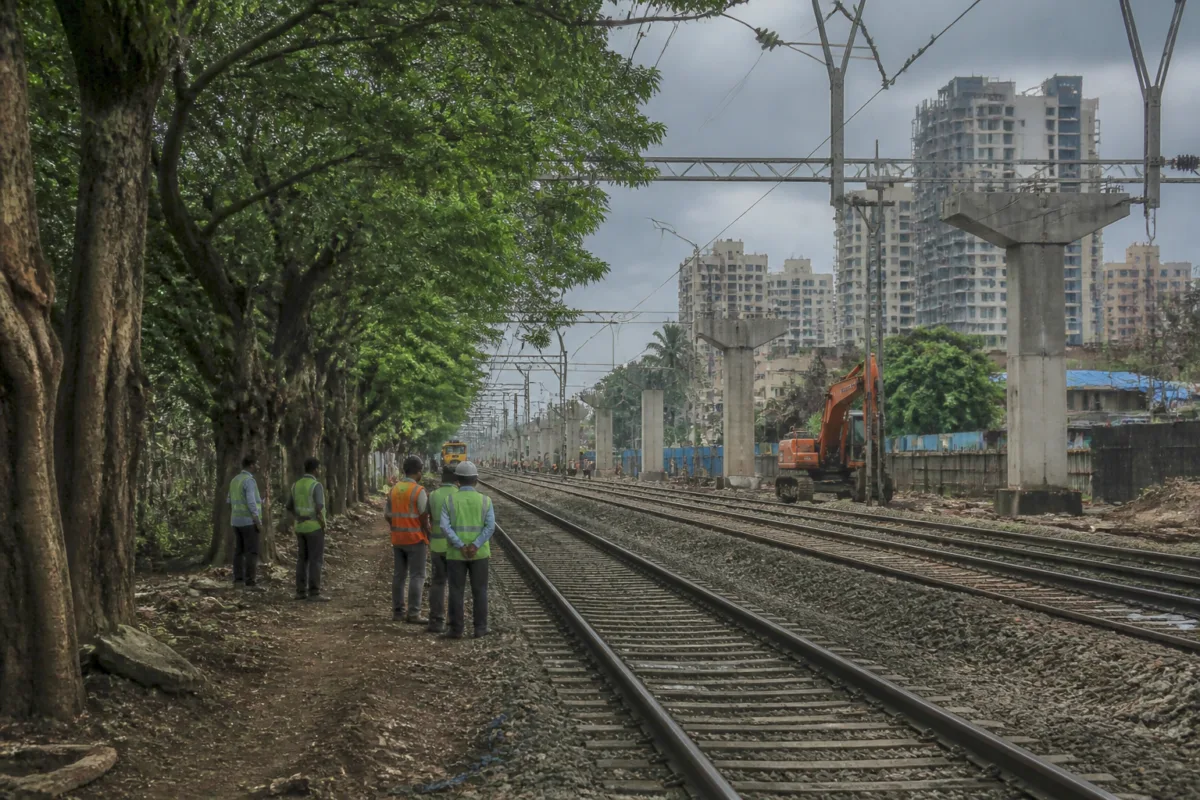
The Borivali–Virar fifth and sixth railway line expansion has brought a significant tree-removal proposal in Bhayandar under scrutiny, with the supplied report stating that 162 trees may be uprooted while only 27 are proposed for transplantation. The same report, however, says the Mumbai Rail Vikas Corporation (MRVC) sought permission from the municipal corporation for 189 trees, creating a discrepancy that must be resolved before the proposal can be reported as a settled figure.
The project is being implemented under Mumbai Urban Transport Project 3A to expand railway capacity and improve the speed of services on the Western Railway corridor. The works proposed between Bhayandar railway yard and Vasai Creek include new railway tracks, sidings, platforms and station buildings.
According to the report, the trees identified for removal are located within railway land between Bhayandar West railway station and Vasai Creek. It states that 162 trees are expected to be removed with their roots, while only 27 would be transplanted by the municipal corporation. The report also says that MRVC wrote to the civic body on November 4 seeking permission for the tree removal under the Maharashtra (Urban Areas) Protection and Preservation of Trees Act, 1975.
The difference between the two figures is significant. The report’s summary and main description refer to 162 trees being removed, but its account of MRVC’s application says permission was sought for 189 trees. It does not explain whether the larger number includes additional trees, a revised project assessment or a separate category of trees affected by the work. The municipal permission document and the final approved tree list are therefore necessary to establish the exact scope of the proposal.
The report says the application includes conditions linked to the tree-protection law. If permission is granted, tree removal would not begin for 15 days. It further states that two new trees would be planted for every tree removed within 30 days of the cutting, and that the new plantations would be maintained for three years. A report on the plantations would also be submitted every six months.
The proposed railway works illustrate the administrative trade-off involved in expanding transport infrastructure through built-up suburban corridors. The project requires additional track and station-related space, while the tree-protection process determines how the civic and railway authorities document, approve and compensate for the environmental impact. In this case, the available report establishes the broad project and the proposed mitigation conditions, but not the final permission, the approved number of trees or the status of the transplantation plan.
The tree question is also connected to how infrastructure agencies account for land within railway boundaries. Although the trees are located on railway land, the report indicates that permission was sought from the municipal corporation under state tree-protection legislation. This places the municipal authority in the approval and monitoring chain while MRVC remains the project agency seeking clearance for the works.
The next verifiable milestones are the municipal corporation’s decision on MRVC’s application, the final tree inventory and the approved method of removal or transplantation. Until those records are available, the number of trees affected should not be treated as conclusively established. The project’s implementation will also need to be assessed against the stated requirements for replacement planting, three-year maintenance and six-monthly reporting.

