


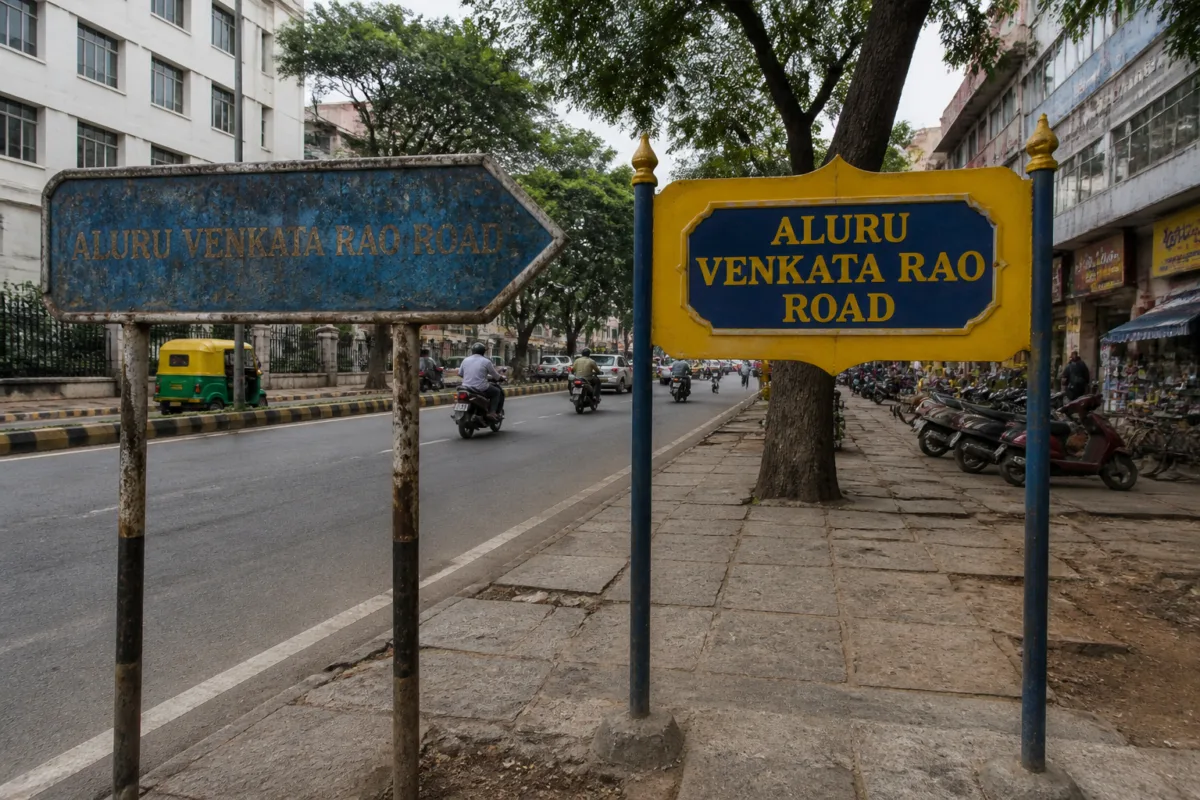
Aluru Venkata Rao Road in Bengaluru is officially marked, locally remembered and commercially addressed by several different names. The mismatch on this Chamarajpet artery is more than a question of old signboards: it shows how renaming a public street can remain incomplete when administrative records, civic signage, business addresses and public memory do not move together.
Two signs placed side by side on a footpath announce the road’s competing identities. One is an arrow-shaped steel board installed by the Bruhat Bengaluru Mahanagara Palike, now the Greater Bengaluru Authority, with paint peeling at the edges. The other is an ornate concrete slab installed by a pro-Kannada organisation, painted yellow and blue with handwritten lettering. Neither sign, however, settles how the road is actually known and used.
Along the tree-covered stretch, establishments continue to use Albert Victor Road or the shorter A V Road on their address boards. Others use 1st Main Road, Chamarajpet, while two or three refer to Tippu Sultan Palace Road, reflecting the presence of the 18th-century palace along the route. The road connects Kalasipalya to Mysore Road and passes medical institutes, a bank, a trust, religious sites, eateries, logistics firms and demolition businesses.
That variety is significant because street names are not only markers of identity. They are working components of urban systems. They appear on shopfronts, delivery instructions, institutional records, postal addresses and directions. When multiple names remain in circulation, residents and businesses develop practical substitutes, even when a formal name exists. In this case, A V Road became a particularly efficient workaround because it could refer either to Albert Victor Road or Aluru Venkata Rao Road.
The original name emerged from the colonial practice of naming important roads and buildings after visiting royals. Historian Suresh Moona told Deccan Herald that the road was named after Prince Albert Victor, a grandson of Queen Victoria, who visited Bangalore during a seven-month tour of India in 1889. The prince laid the foundation stone of the Glass House at Lalbagh on November 30 that year. The road acquired his name a few years after the visit.
The road itself runs through Chamarajpet, Bengaluru’s first extension, established in 1892 as an agrahara for Brahmins. Heritage walk organiser Mansoor Ali described it as one of the main arterial roads through the area. Its present role therefore combines several layers of the city’s development: an early planned extension, a colonial-era naming practice, post-Independence regional identity-building and contemporary commercial activity.
The change to Aluru Venkata Rao Road belongs to the period when Bengaluru began replacing colonial road names with those of regional figures. One source cited in the report places the renaming in 1978, while the broader shift began in the 1960s. The uncertainty over the precise timing is itself revealing. The report says that during a later controversy, neither the BBMP nor the postal department had records showing when the road was renamed after Rao.
Aluru Venkata Rao was associated with the Karnataka Ekikarana movement, which sought to unite Kannada-speaking communities spread across princely states and British presidencies. He wrote Karnataka Gatha Vaibhava and Karnatakatwada Sutragalu and founded the magazine Jaya Karnataka. He was also known as the “high priest” of the unification movement. The renaming therefore connected a colonial-era road to a figure associated with Karnataka’s linguistic and political consolidation.
The choice of Chamarajpet was also linked, according to Suresh Moona, to the presence of the Kannada Sahitya Parishat headquarters in the area. The institution, like Rao, had been involved in the unification movement. The road’s name consequently carries a local institutional logic rather than being an isolated replacement of one commemorative figure with another.
Yet the administrative act did not fully become an everyday urban fact. Businesses that had already installed A V Road signs could retain them without incurring the cost of replacing boards. The abbreviation also remained useful because it worked for both the former and current names. This is a small example of how private actors absorb the practical consequences of public naming decisions. A government resolution may change the official label, but the transition costs are often borne by shops, offices, residents and service providers.
The problem is not limited to the price of a signboard. A road name exists across several systems that may not update simultaneously. Civic signage, postal records, business addresses and local usage each operate through different institutions and routines. If one system adopts the new name while another retains the old one, the city develops a layered address system. Residents navigate through landmarks, abbreviations and alternate road descriptions rather than relying on one consistent civic reference.
The history of the road also demonstrates why renaming can become politically contested. Between 2015 and 2017, the BJP-led BBMP council passed a resolution to rename the stretch after Tipu Sultan, but withdrew the plan after opposition. The episode added another proposed identity to an already complicated naming history. It also brought attention to the unresolved question of when the road had officially acquired the Aluru Venkata Rao name in the first place.
That sequence places the road within a wider governance problem: the difference between symbolic decisions and administrative completion. Renaming is often treated as a cultural or political announcement, but implementation requires a coordinated update across civic departments and public-facing systems. Without that follow-through, the renamed street may exist formally while its older identity continues to dominate business signage and everyday speech.
The road’s competing signs also show how public space becomes an arena for different forms of authority. The BBMP sign represents municipal administration. The concrete sign installed by a pro-Kannada organisation represents community assertion and linguistic pride. Businesses display names that serve continuity and practical recognition. Historical references to Albert Victor, Aluru Venkata Rao and Tippu Sultan coexist along the same corridor, each tied to a different understanding of the city’s past.
For users of the road, this is not necessarily experienced as a debate about history. It is encountered as a navigation problem, an address choice or a question of which name to write on a document. For institutions, it can become a records issue. For businesses, it can involve the cost of replacing signage and the risk that customers may not recognise a newly adopted name. For the city, it becomes evidence that public memory and municipal administration do not change at the same speed.
The available account does not establish a complete map of which departments, databases or private records continue to use each name. It also does not resolve the exact date of the Aluru Venkata Rao renaming. What it does establish is that the road remains visibly and commercially divided between its official name, its former name, abbreviations and alternative location-based references.
Aluru Venkata Rao Road therefore offers a compact case study in how Bengaluru manages urban identity. Its signboards record an official decision, a community response and a practical business workaround, while the road itself carries the history of colonial patronage, Karnataka’s unification movement and the city’s continuing growth. The unresolved question is not simply which name should prevail, but whether civic institutions can make one name legible across the systems through which a city is used.

