


Subheadline: Ageing distribution lines and reservoirs are turning routine water losses into a wider urban infrastructure problem.
Standfirst: Bengaluru’s water network is carrying the physical legacy of decisions made decades ago. According to figures cited by the Bengaluru Water Supply and Sewerage Board, 4,800 km of the city’s roughly 10,000-km water-supply pipeline network was laid 50 to 80 years ago, while 57 of its 83 Ground Level Reservoirs are between 40 and 70 years old. The consequences extend beyond leakage complaints: old pipes have been linked to repeated road repairs, contamination concerns and road cave-ins. The BWSSB is now combining phased replacement, robotic inspection and proposed artificial-intelligence tools with a citywide assessment of reservoirs. The evidence available so far points to a difficult infrastructure problem: the network must be renewed while continuing to serve a dense core city where simultaneous excavation would disrupt traffic and daily life.
The immediate issue in Bengaluru is not the absence of a water network, but the age and condition of the system that distributes water after it enters the city. A large share of the network was installed several decades ago. Of the approximately 10,000 km of water-supply pipelines in the city, about 4,800 km were laid 50 to 80 years ago, according to information cited by the BWSSB. The city’s storage infrastructure shows a similar pattern. Fifty-seven of Bengaluru’s 83 Ground Level Reservoirs are reported to be 40 to 70 years old.
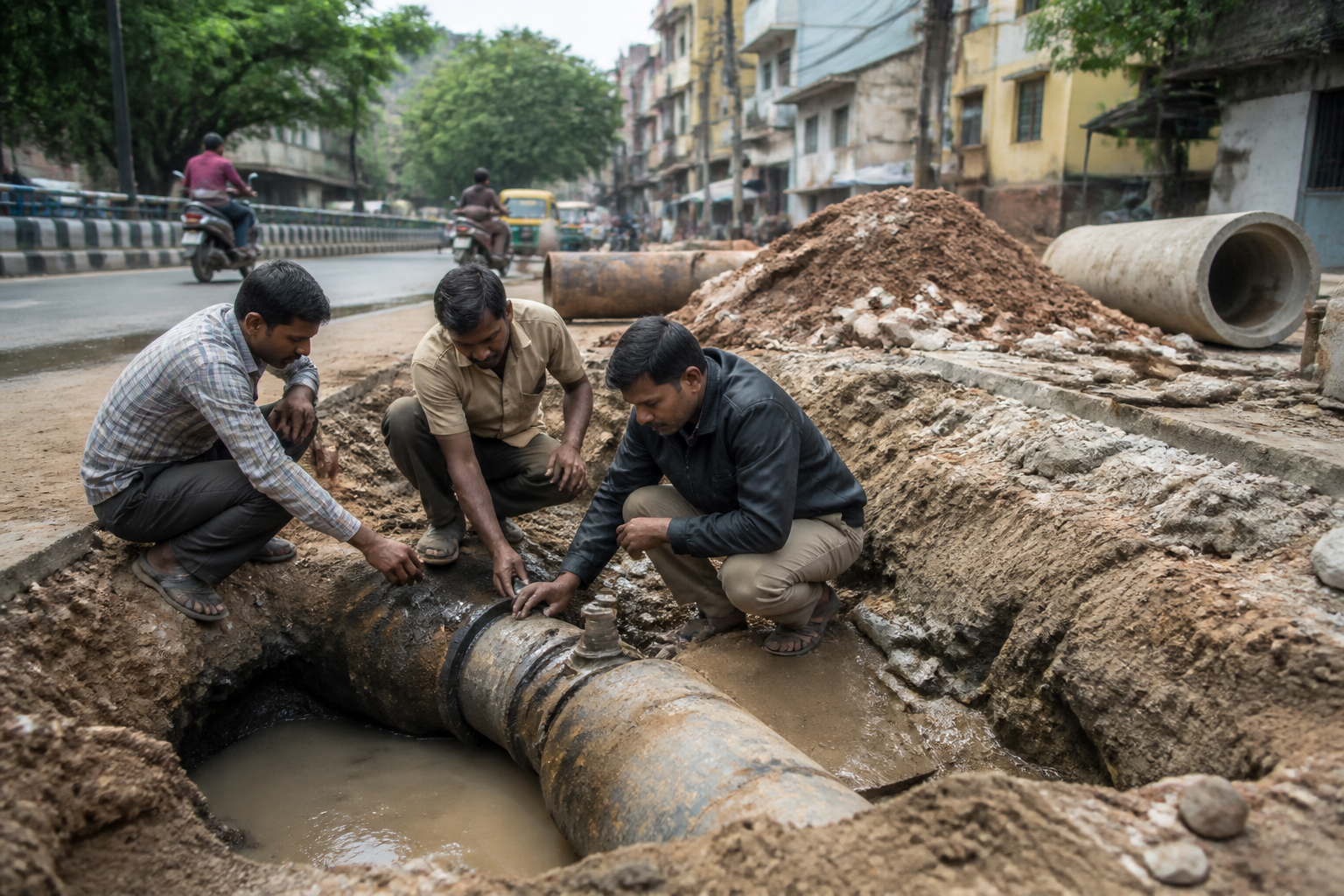
That age profile matters because failures in an underground network rarely remain confined to the pipe itself. A leaking line can weaken the ground below a road, require repeated repairs and disrupt the surface repeatedly. The report cites multiple instances in which roads have caved in because of leaking pipelines underneath. Water quality can also be affected when faults in old pipes allow sewage to enter the network.
A senior BWSSB official said some pipelines are as old as 80 years and that leakage complaints are common. The official specifically pointed to old cast-iron pipes, explaining that sewage can enter leaks and mix with the water in some cases. This is an operational risk as well as a public-health concern: the same defect that causes water loss can also compromise the integrity of the supply reaching consumers.
The scale of the loss is reflected in Bengaluru’s Unaccounted for Water figure. UfW has remained at 30-35% for years, meaning that the city may be losing about one-third of the Cauvery water it receives before it is accounted for through the distribution system. The figure does not describe one single failure or identify every reason for the loss, but it establishes the persistence of the problem. The city is receiving water through a network in which a substantial share is not being accounted for at the point of delivery.
The distinction between transmission and distribution is central to the response. BWSSB Chairperson Dr Manjula N said there is no water leakage at the transmission level and that losses are occurring at the distribution level. This shifts the infrastructure challenge away from the main movement of water into the city and towards the pipes and reservoirs that carry and hold it within urban neighbourhoods.
That distinction also explains why replacing the network cannot be treated as a single construction project. The older pipes are located largely in Bengaluru’s core areas, according to officials. A complete overhaul would therefore require extensive excavation across established parts of the city. Officials have said that simultaneous replacement would significantly affect traffic movement. The constraints are physical and administrative at the same time: the water system must be renewed beneath roads that are already carrying daily traffic and supporting commercial and residential activity.
The BWSSB has already replaced at least 1,000 km of old water pipelines over the years. The work, however, has not amounted to a complete renewal of the ageing network. Officials describe a phased approach because replacing every old line would be capital-intensive and difficult to execute without major disruption.
Phasing creates a question of priority. If all old pipes cannot be replaced together, the utility must decide which sections present the greatest risk to water supply, public safety and road infrastructure. The board is responding by using robotics to identify leakages and locate them more precisely. Dr Manjula said the technology helps pinpoint where leakage is occurring and that cast-iron pipes are being replaced on priority.
The use of robotic inspection is significant because underground failures are difficult to identify through surface observation alone. A visible road failure may be a late sign of a problem that has already been affecting the network. Locating leaks more accurately can help the utility direct limited replacement resources towards sections where intervention is most urgent. The supplied information does not establish how widely the robotic system is being deployed or how much leakage it has identified, but it shows a move towards condition-based detection rather than relying only on complaints and visible damage.
The BWSSB is also attempting to develop a model using artificial intelligence and other technologies to predict future leakages and identify pipelines that should receive priority replacement. That proposal introduces a second layer to the maintenance strategy. Robotics is being used to detect existing failures, while the proposed predictive system would seek to identify parts of the network that may require attention before a failure occurs.
The effectiveness of such a model will depend on the quality and completeness of the underlying network data, but the available account does not provide details on the proposed system’s design, testing or implementation timeline. At this stage, it is best understood as an intended tool within the board’s broader effort to prioritise work, rather than as an operational solution already demonstrated at city scale.
The reservoirs are a parallel concern. BWSSB is conducting a complete inspection of all 83 Ground Level Reservoirs to determine their condition and prepare a proposal to rebuild some of them. The board’s position is that reservoirs that require rebuilding must be rebuilt. The inspection is important because a distribution network can lose reliability at storage points as well as along pipelines. Yet the information available does not specify how many reservoirs are expected to require reconstruction, what their structural deficiencies are or what the proposed rebuilding programme would cost.
This lack of detail points to the next stage of the problem: assessment must be converted into a funded and sequenced renewal programme. The available evidence establishes the age of the assets, the persistence of water losses and the operational risks associated with leaks. It does not yet establish the final replacement list, a citywide budget, a completion date or the precise order in which pipelines and reservoirs will be rebuilt.
The institutional responsibility is clear. The BWSSB is responsible for assessing the condition of the distribution network, detecting leaks, replacing old pipelines and evaluating the reservoirs. But implementation will necessarily interact with roads and traffic because much of the network lies under the city’s existing streets. Every major replacement programme will therefore have an operational interface with road maintenance and traffic management, even though the supplied material does not specify how those agencies will coordinate.
Bengaluru’s infrastructure problem is consequently one of renewal under constraint. The city cannot simply abandon the old network while a new one is built elsewhere. It must continue supplying water through ageing assets while replacing them in sections. Nor can it treat leakage solely as a water-management issue. The reported effects include road damage, repeated repairs and contamination complaints, linking the performance of the underground network to several visible aspects of urban life.
The numbers make the challenge difficult to dismiss as a collection of isolated breakdowns. Nearly half of the reported pipeline network—4,800 km out of approximately 10,000 km—was laid 50 to 80 years ago. About 69% of the city’s Ground Level Reservoirs—57 out of 83—are reported to be 40 to 70 years old. UfW has remained at 30-35% for years. Together, these figures describe a system in which ageing assets, persistent losses and limited replacement capacity overlap.
What remains uncertain is equally important. The report does not provide a detailed map of the oldest pipelines, a public ranking of high-risk sections, the number of contamination incidents, the annual cost of leakage-related repairs or a timetable for replacing the remaining old lines. It also does not establish the technical performance of the proposed predictive model or identify which reservoirs are likely to be rebuilt.
For now, the BWSSB’s stated response consists of phased pipeline replacement, priority action on cast-iron lines, robotic leakage detection, an attempted AI-based prediction model and a complete inspection of the city’s reservoirs. These steps acknowledge that Bengaluru’s water challenge is concentrated in the distribution system and storage network. The next significant developments will be the outcome of the reservoir assessment, the board’s replacement priorities and the implementation details of any programme that emerges from them.
