


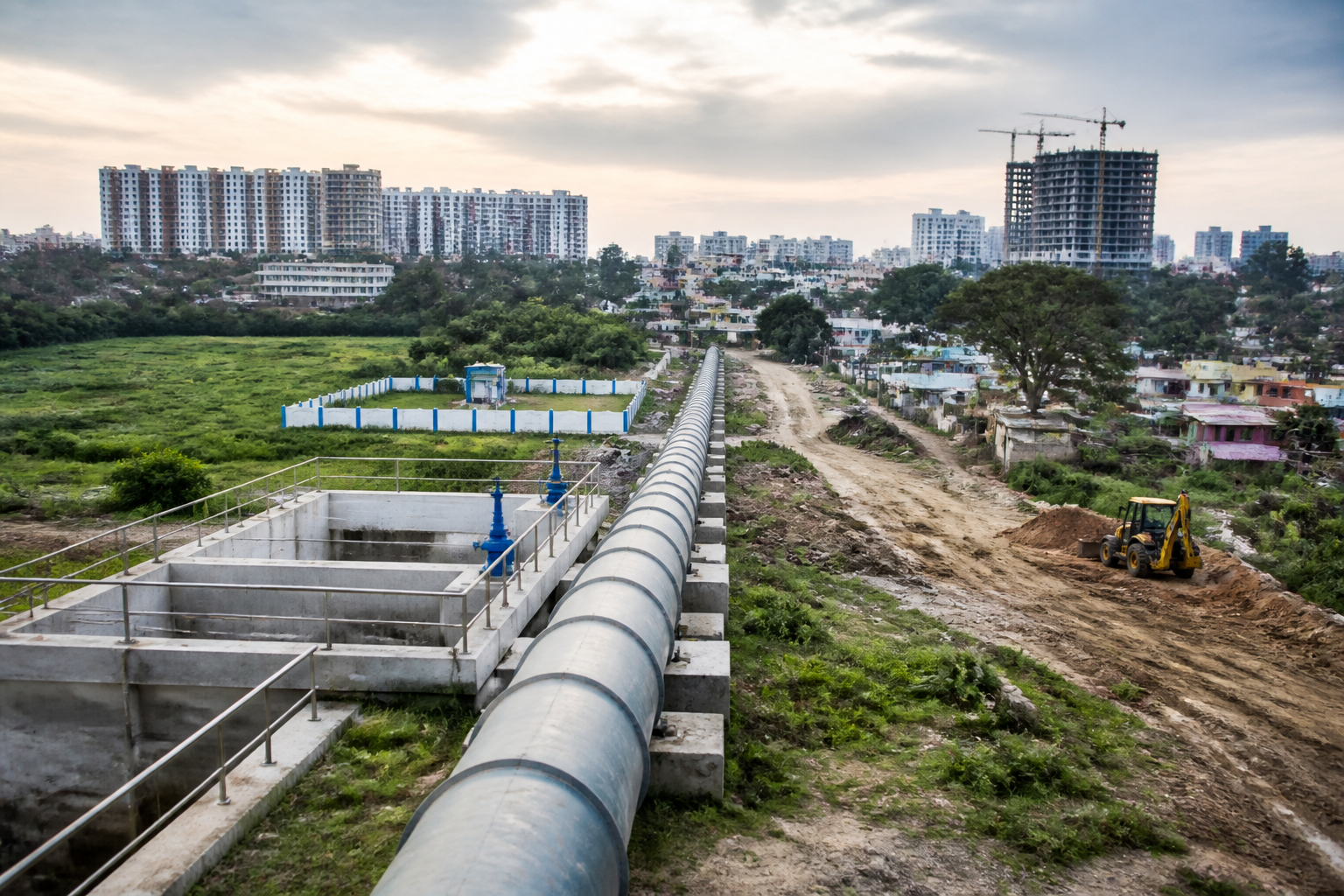
The Bengaluru water board jurisdiction has been extended across Bengaluru Urban district, bringing a much larger geography under the Bengaluru Water Supply and Sewerage Board (BWSSB) for drinking water supply, sewerage infrastructure and treated wastewater disposal. The move formally recognises a reality that has been developing for years: Bengaluru’s urban expansion has moved beyond the boundaries of the Greater Bengaluru Authority (GBA), while infrastructure provision remains uneven across the city’s outer areas.
The Karnataka Urban Development Department issued the order on September 24. Until now, BWSSB operated across the seven former city municipalities, one municipality and 110 villages within the GBA area, covering about 800 square kilometres. The expanded jurisdiction includes the wider Bengaluru Urban district, including areas in the Bengaluru North, East, South, Yelahanka and Anekal taluks.
The order assigns BWSSB responsibility for drinking water supply, sewerage facilities, sewerage treatment and the planning, implementation, operation and maintenance of related projects across the district. However, the immediate effect on residents will be limited. The source report states that it will take several years to establish and maintain water supply projects in the newly included areas.
That distinction is important. Administrative jurisdiction can be extended through a notification, but networks, reservoirs, treatment plants and distribution systems require long-term planning, funding and construction. The notification changes who is responsible for planning and delivering the infrastructure; it does not mean that every newly included locality will receive a fully functioning BWSSB system immediately.
## A jurisdiction change that follows urban growth
The inclusion of 110 villages in BWSSB’s area dates back to 2007. Yet the arrangement between administrative inclusion and physical infrastructure has developed gradually. According to the source report, Cauvery water supply to these areas began only in 2024. This gap illustrates the difficulty of expanding a metropolitan water system into settlements that have already experienced rapid urbanisation.
Several of the areas now included in the expanded jurisdiction are already closely connected to Bengaluru’s metropolitan economy. They include Kumbalgodu, Soladevanahalli, Makali, Dasanapura, Hesaraghatta, Doddajala, Bettahalasuru, Sarjapur, Bommasandra, Hebbagodi, Anekal, Jigani, Chandapura, Attibele, Kaggalipura, Talaghattapura and Bannerghatta.
These locations include a mix of villages, peripheral settlements, industrial areas, residential developments and fast-growing corridors. Their inclusion indicates that the practical water and sewerage footprint of Bengaluru is no longer defined only by the core municipal area or the existing GBA boundary. The institutional system is being asked to respond to a metropolitan region that is expanding through multiple forms of development at the same time.
Greater Bengaluru Minister Krishna Byre Gowda said the city’s growth had already crossed the GBA boundary and that municipalities and gram panchayats around the authority were undergoing urbanisation. He said experts had advised the government to treat areas outside the GBA as urban areas and as extensions of Bengaluru for practical purposes.
The statement points to a structural problem in urban governance: built-up areas, administrative boundaries and infrastructure responsibilities do not always expand together. When they diverge, residents may live in an urban environment while relying on fragmented or incomplete systems for essential services.
## The water challenge behind the notification
BWSSB officials said Bengaluru currently requires about 2,750 million litres per day (MLD) of water. Of this, around 1,950 MLD comes from the Cauvery, while 800 MLD is sourced from groundwater. The figures show that the city’s water system already depends on two major sources, with groundwater continuing to play a significant role.
The expanded jurisdiction adds a new planning challenge: future demand must be estimated not only for existing consumers but also for areas undergoing conversion from rural or semi-rural settlements into urban neighbourhoods. The source report states that BWSSB has been asked to assess drinking water requirements for the next five years, ten years and beyond.
This longer planning horizon matters because water supply projects cannot be built in response only to present demand. Pipelines, ground-level reservoirs and treatment facilities require land, design, approvals, financing and construction time. By the time a project is commissioned, the population and built-up area it was designed to serve may already have changed.
BWSSB chairperson Dr N. Manjula said the board had begun work on a master plan for the new jurisdiction. The plan will cover network creation, construction of ground-level reservoirs, sewerage treatment plants and other action programmes. The board also requires information on population growth over the next decade before the technical work can be taken forward.
The emphasis on a master plan suggests that the expansion is being treated as a phased infrastructure programme rather than as an immediate service transfer. It also indicates that water supply and sewerage will have to be planned together. Extending only drinking water networks without matching sewerage and treatment capacity would shift pressure from one part of the urban system to another.
## From service expansion to joint planning
Minister Krishna Byre Gowda said meetings had been held with BWSSB, the Bengaluru Metropolitan Region Development Authority (BMRDA) and the Irrigation Department to discuss infrastructure requirements outside the GBA. The government plans to prepare a joint master plan for the entire Bengaluru Urban district outside the GBA, with phased implementation aligned to actual urban expansion.
This institutional arrangement is significant because the newly included areas do not sit within a single type of urban context. Some are connected to established city corridors, some are developing around industrial and employment centres, and others remain more dispersed. A common plan will have to coordinate agencies whose responsibilities cover water, irrigation, regional planning and urban development.
The need for coordination also reflects the way Bengaluru has grown. Peripheral urbanisation often occurs through a combination of plotted development, apartment construction, industrial activity and the expansion of existing villages. Each form creates different demands on water supply, sewerage collection, road access and treatment capacity. A district-wide plan is intended to bring these demands into a common infrastructure framework.
The source material does not specify the total financial requirement, the funding model, project-wise timelines or the sequence in which localities will receive network upgrades. It also does not establish whether all newly included areas currently have the same level of water access or sewerage provision. Those details will become important as the master plan moves from preparation to implementation.
## The implementation gap remains the central issue
The jurisdiction expansion creates administrative clarity, but the source report makes clear that physical service delivery will take time. Residents in the newly included areas should therefore distinguish between being brought under BWSSB’s responsibility and receiving immediate access to a complete urban water and sewerage system.
The earlier history of the 110 villages demonstrates this implementation gap. They were added to the board’s jurisdiction in 2007, while Cauvery water supply began in 2024. The time taken does not by itself establish failure, since large infrastructure projects involve multiple technical and administrative stages. It does, however, show that formal inclusion and actual network delivery can be separated by many years.
That gap becomes more consequential as peripheral development accelerates. If population growth outpaces trunk infrastructure, residents and new developments may continue to depend on groundwater or local arrangements while waiting for centralised systems. At the same time, the absence of sewerage networks can increase reliance on local disposal systems and make wastewater management more difficult to coordinate.
The available figures also show why expansion cannot be assessed only by counting newly covered villages or extending a boundary on a map. Bengaluru already requires approximately 2,750 MLD of water, including 800 MLD from groundwater. The additional demand from the wider district will need to be estimated against the availability and reliability of future sources, as well as the capacity of distribution and treatment infrastructure.
The government has said that additional resources for supplying the new areas are being examined. The source does not provide details of those resources or identify a final project pipeline. Consequently, the next substantive test will be whether the proposed joint master plan translates the new responsibility into identified projects, estimated demand, implementation phases and accountable agencies.
## What the expansion changes for Bengaluru
The decision moves Bengaluru towards a more metropolitan approach to essential infrastructure. Instead of treating the city’s outer settlements as separate from Bengaluru’s urban system, it places the wider district within the planning and operational ambit of BWSSB. This is consistent with the government’s position that urbanisation has already extended beyond the GBA boundary.
The larger urban question is whether governance boundaries can keep pace with the geography of growth. Bengaluru’s expansion has created a city that functions across municipal, village and regional jurisdictions. Water supply and sewerage, however, require networks that cross those boundaries. Their effectiveness depends on continuous planning, adequate treatment capacity and long-term maintenance rather than on isolated projects.
The notification is therefore an important institutional step, but not the completion of the infrastructure transition. The evidence currently confirms the expanded responsibility, the broad geography involved, the existing water requirement and the government’s intention to prepare a joint master plan. It does not yet establish when each area will receive upgraded services, how the work will be financed or whether the available water sources will meet future demand.
The next developments to watch are the publication of the master plan, the population and demand assessments for the five-year and ten-year periods, the identification of new water resources, and the project timelines for distribution networks, reservoirs and sewerage treatment plants. Those milestones will determine whether the jurisdiction expansion becomes a functioning metropolitan service system or remains primarily an administrative reclassification.
