


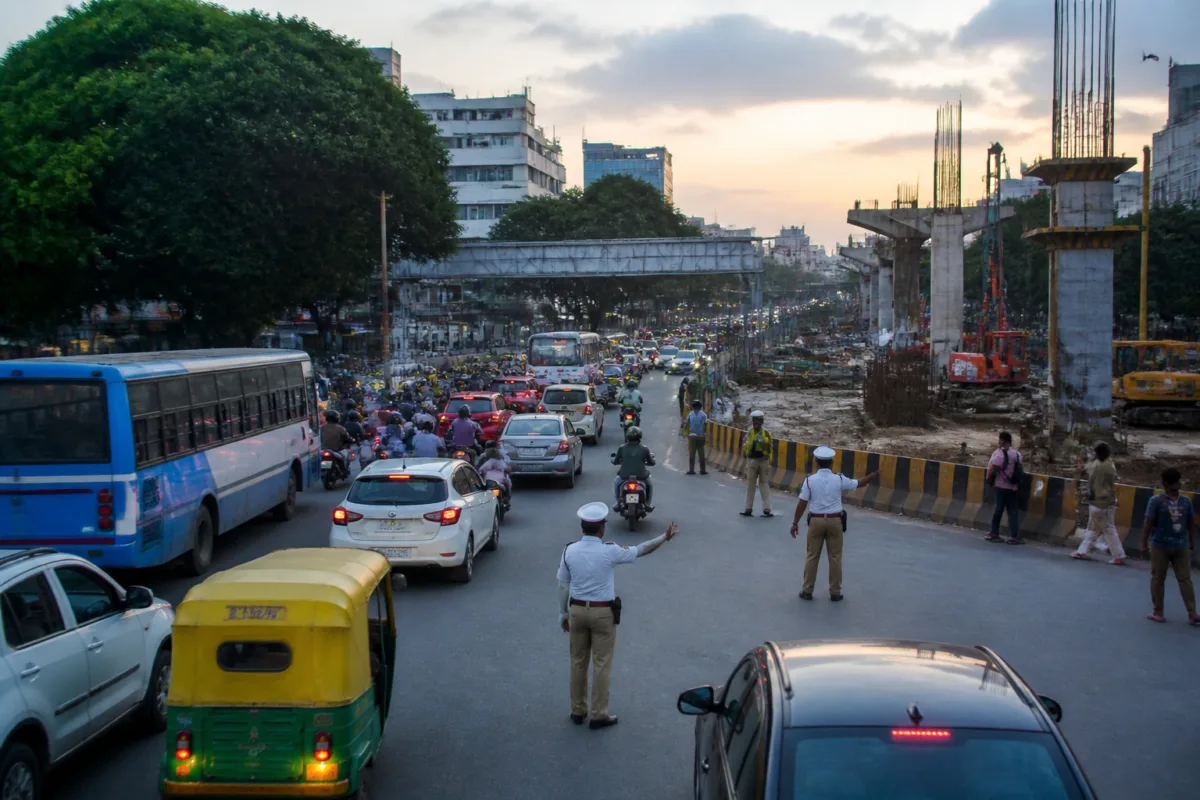
Bengaluru Traffic Police has identified 102 junctions and black spots prone to accidents and recurring congestion, with plans to deploy senior officers during peak hours and use data-driven interventions to manage traffic movement.
Hemant N Nimbalkar, Commissioner of Police for Traffic, Anti Rowdy Squad and Crime Prevention, said in an interview with Deccan Herald that he had directed five commissioners and five deputy commissioners of police to prepare junction charts. These would be similar to the night-round charts used by the law-and-order wing of the police and would assign officers to the identified locations on a rotational basis.
The proposed charts would focus on peak-hour management at prominent junctions. On weekends, the deployment would shift towards areas near bars, restaurants and popular gathering spots, according to Nimbalkar. The stated objective is to manage existing vehicle movement more effectively rather than reduce the number of vehicles on Bengaluru’s roads.
The commissioner said artificial-intelligence-driven data would be combined with interventions on the ground. The interview did not specify the data systems to be used, the performance indicators for the programme or a timeline for publishing the junction charts.
Coordination around infrastructure projects is another focus of the plan. Nimbalkar said he was in discussions with the Bangalore Development Authority, the Greater Bengaluru Authority and other agencies implementing major projects across the city. He has asked for a calendar covering the projects being executed, which the traffic police would use to prepare a longer-term traffic-management plan around construction zones.
The proposed approach includes clearly demarcating and barricading work areas so that construction activity does not spill onto roads. Keeping carriageways free for traffic, the commissioner said, could deliver significant benefits through relatively small interventions.
The plan places traffic police at the intersection of junction management and construction coordination. Its effectiveness will depend on how consistently officers are deployed, whether project agencies share timely information and whether barricading and work-zone standards are enforced at sites.
The interview also outlined wider policing priorities, including faster investigations, technology-led policing and stronger intelligence networks. The police said programmes such as ‘Mane Manege Police’, which provides doorstep access, and ‘Aasare’, aimed at senior citizens living alone, would be assessed using service data. These initiatives are separate from the junction-management plan but reflect the department’s stated intention to use operational data to review public services.

