


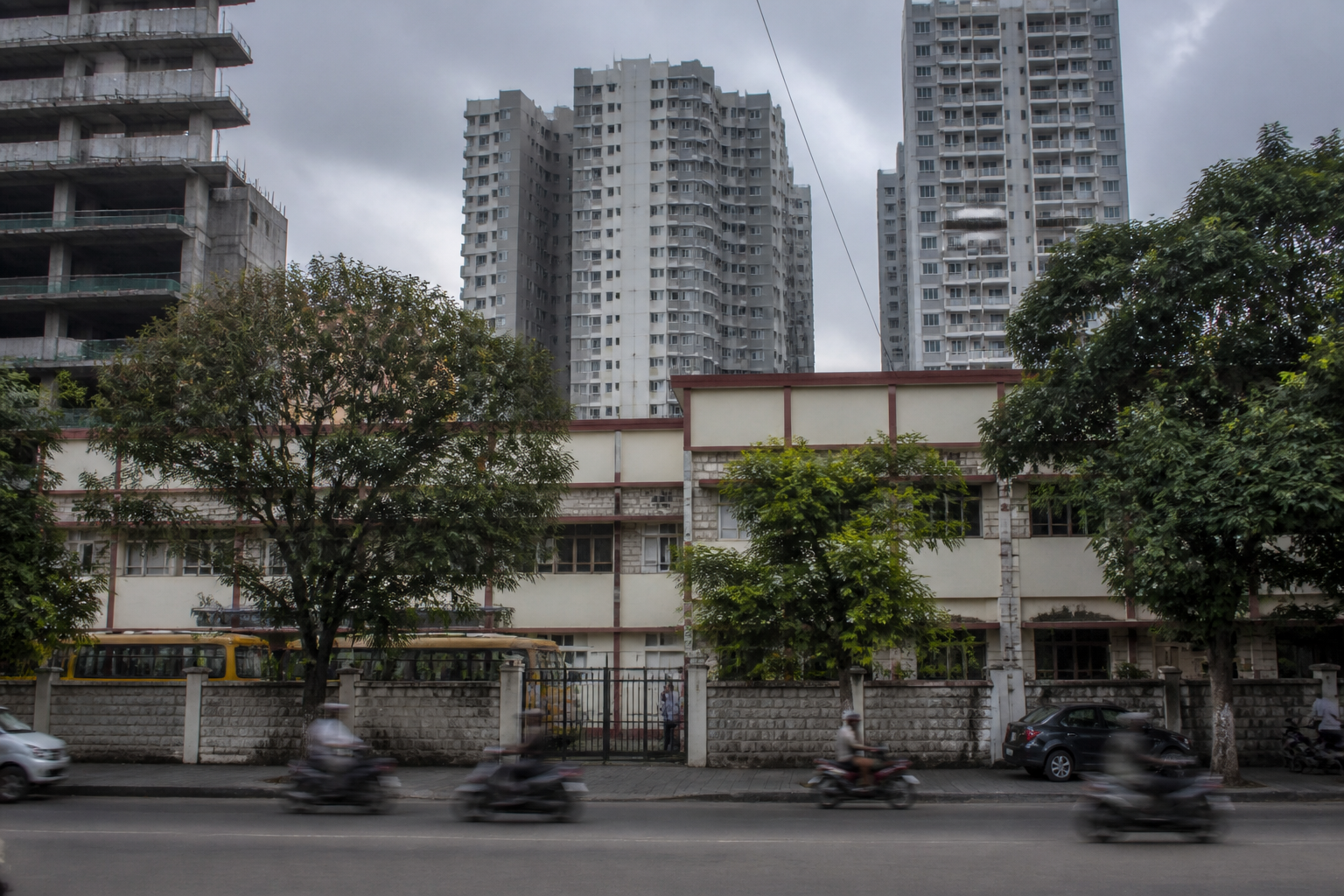
More than 200 private school buildings in Bengaluru are reportedly being offered for sale or lease as smaller and budget schools struggle with falling enrolment, rising operating costs, competition from large school chains and difficulty meeting recognition-renewal standards. The development is not simply a story about struggling education businesses. It also shows how changes in household choices, school economics, regulation and land values are reshaping neighbourhood infrastructure in the city.
According to a report by Vijay Karnataka, school owners in different parts of Bengaluru are seeking buyers or tenants for buildings that are no longer financially sustainable as schools. Some properties are reportedly being offered for sale at values running into crores, while others are being leased for monthly amounts between Rs 5 lakh and Rs 40 lakh. These figures and the reported number of properties have not been independently confirmed in the supplied material, but the account identifies a clear pressure point in Bengaluru’s private-school market.
The immediate trigger described by school owners is a decline in enrolment after the Covid-19 pandemic. The report says that many private schools following the state and central curricula have experienced a fall in student numbers. D. Shashikumar, general secretary of the Coordinating Association of Majority of Schools, or CAMS, is quoted as saying that enrolment in many private schools has declined by between 100 and 200 students since the pandemic. He said that the fees collected by schools are no longer sufficient to cover operating expenses, encouraging owners to consider selling their buildings.
That change has a direct effect on the economics of low-fee schooling. A school building carries expenses regardless of the number of students enrolled. Salaries, electricity, water, maintenance, transport and regulatory compliance costs continue even when classrooms are only partly occupied. The report says that many smaller schools have fewer than 100 students, leaving them with a narrow financial base from which to fund staff and infrastructure.
The pressure is intensified by competition between different types of private schools. The report says that families are moving children from smaller state-syllabus schools to better-known institutions, including schools offering the Central Board of Secondary Education and Indian Certificate of Secondary Education curricula. It also describes competition from large or corporate-backed schools that can spend heavily on facilities and offer transport over wider areas.
The difference in transport capacity is one visible measure of that competition. According to the report, prominent schools provide bus services across a radius of up to 50 kilometres, while smaller schools generally limit their transport coverage to around 15 kilometres. The comparison does not establish that transport alone is driving enrolment decisions, but it shows how the location and service area of a school can become part of the competition for families in a dispersed metropolitan region.
The school property market is therefore connected to the geography of Bengaluru’s growth. A building that was developed for education may now appear more valuable as a real-estate asset if the surrounding area has experienced strong land-price growth or new residential development. For owners facing continued losses, selling or leasing can offer a way to recover capital or generate income. The report says that some owners are considering real-estate investment after exiting school operations.
This shift raises an important land-use question. Schools are not ordinary commercial premises. They are neighbourhood institutions that provide education close to homes, reduce travel for children and often serve families who cannot access high-fee alternatives. If school buildings disappear and are replaced by other uses, the effect may not be immediately visible in city-level infrastructure statistics. It may instead appear through longer commutes, higher fees, greater dependence on school buses and reduced choice for families living in areas where smaller schools once operated.
At the same time, the pressures described in the report cannot be understood only as a case for preserving every existing school. Recognition and renewal standards exist because school buildings must meet requirements relating to classroom size, basic infrastructure, safety and service quality. Vijay Karnataka reports that many smaller institutions have struggled to meet these requirements because they operate with limited resources. The report also says that around 5,500 private schools across Karnataka did not complete recognition renewal last year. The supplied material does not provide the department’s classification of these schools or confirm how many remain operational, so the number should be treated as a reported figure rather than a complete measure of school closures.
The regulatory issue is significant because recognition is the administrative bridge between private operation and public accountability. When a school fails to renew recognition, the consequences may extend beyond the owner. Parents need clarity on whether their children can continue studying there, staff need certainty about employment and the education system needs a reliable record of institutions that meet minimum standards. The report does not detail how the education department is handling each of the schools that have not renewed recognition, leaving an important part of the governance picture unresolved.
The property transition also creates its own obstacles. The report says that some school buildings lack complete official documentation, carry outstanding loans or are involved in court disputes. Such properties may be difficult to sell even when the owner wants to exit. This creates a financial trap: the school may not generate enough income to remain viable, while legal, title or debt problems prevent a clean transfer to another use.
For Bengaluru’s urban administration, that distinction matters. A school property is shaped by planning permissions, building standards, access roads, parking, safety arrangements and the surrounding residential pattern. If the use changes, the implications may include additional traffic, altered demand for public services or the loss of a local facility. The supplied report does not state how many of the properties have received approval for a change of use, nor whether any municipal or education authority has mapped the proposed conversions.
The reported shift also reveals the uneven financial structure of private education. Large institutions can spread investments in facilities, branding, transport and technology across a larger student base. Smaller schools may have lower fees and closer neighbourhood access, but they lack the same ability to absorb fixed costs or fund major upgrades. When families shift towards schools perceived as more prestigious or better equipped, the resulting decline in enrolment can become self-reinforcing: fewer students reduce revenue, reduced revenue limits investment, and weaker facilities make it harder to attract new students.
There is also a wider question about what happens to affordability when smaller schools exit. The report does not provide comparative fee data or establish that fees at larger schools are higher in every case. However, the movement of students towards prominent institutions, combined with rising operating and compliance costs, suggests that families may increasingly have to choose between paying more for a larger school or accepting longer travel distances. The impact will vary by neighbourhood and household income, and the available material does not quantify it.
Bengaluru’s case should therefore be monitored through three linked indicators: school enrolment, recognition status and land-use change. Enrolment data would show whether the decline is concentrated in particular boards, neighbourhoods or fee categories. Recognition records would clarify how many institutions are unable to meet standards, how many are closing voluntarily and how many are continuing without renewal. Property and planning records would show whether former school sites are being sold, leased or converted, and what uses are replacing them.
The report confirms a visible market response to pressure on smaller private schools, but it does not establish the full scale of closures or the final use of the properties reportedly on the market. What is clear is that Bengaluru’s school network is being affected by more than parental preference. It is also being shaped by fixed operating costs, unequal institutional capacity, regulatory requirements and the financial attraction of urban land. The next significant evidence will come from education-department recognition data, verified property records and information on how affected families and staff are being supported.

