


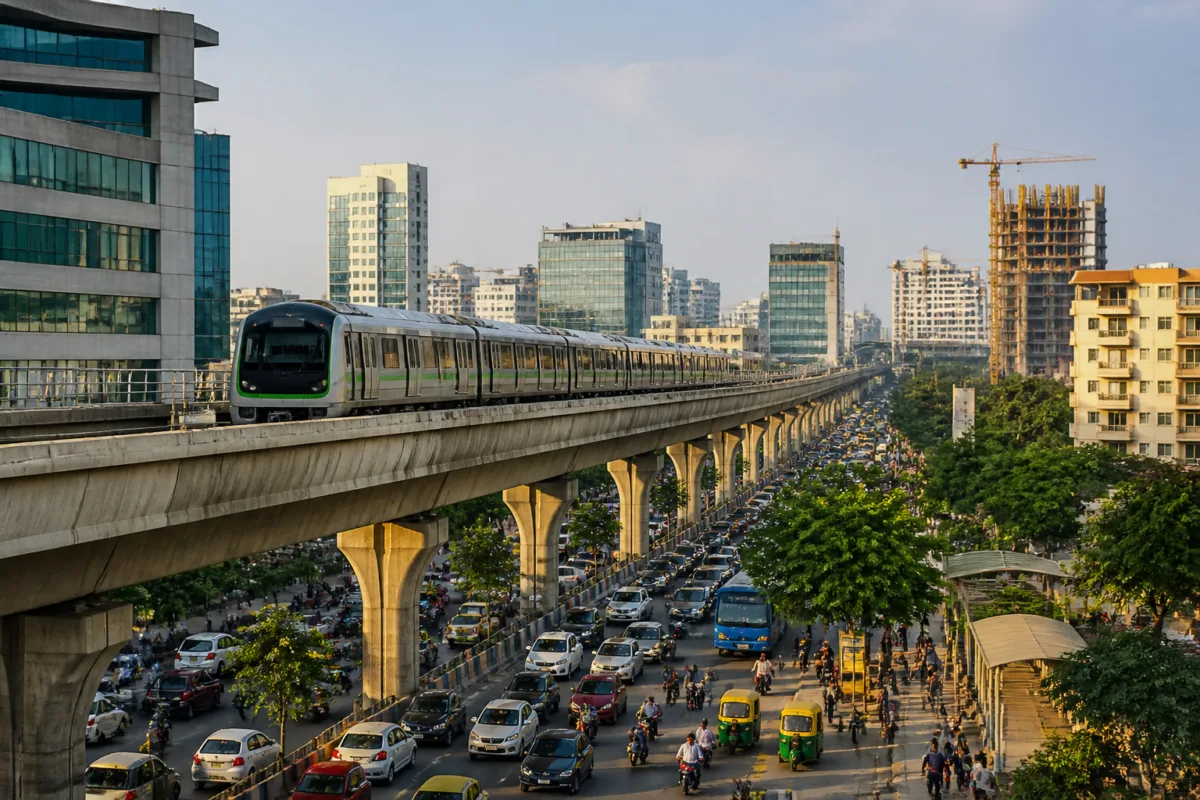
The Karnataka government’s latest account of Bengaluru Metro funding points to a structural shift in how the city’s largest transport expansion is being financed. Across Metro Phases I, II, IIA, IIB and the estimated cost of Phase III, Karnataka says it is responsible for about 84% of a combined investment of Rs 77,891 crore, while the Centre’s contribution stands at roughly 16%. The figures turn a routine project-financing question into a larger debate over who should pay for metropolitan infrastructure in one of India’s most economically important cities.
The figures were presented by Bengaluru development minister Krishna Byre Gowda, who said the Centre’s contribution to Namma Metro’s capital investment had progressively declined over the years. Karnataka’s estimated contribution across the phases was placed at Rs 65,291 crore, compared with Rs 12,600 crore from the Centre. That produces a ratio of nearly five to one: for every rupee contributed by the Centre, the state says it is investing almost five rupees.
The immediate significance of the disclosure is not only the size of the investment, but the changing balance behind it. Gowda contrasted the current 84:16 split with an earlier 50:50 arrangement. The comparison suggests that the expansion of Bengaluru’s metro network has increasingly become a state-led financial responsibility, even though the system serves a metropolitan economy whose impact extends beyond the boundaries of a single state government.
That distinction matters because metro systems are not ordinary construction projects. They require large upfront capital commitments, long implementation periods and coordination between multiple public institutions. When the public funding mix changes, the consequences are felt through the state budget, the pace at which new phases can be taken forward and the financial room available for other urban infrastructure priorities. The supplied figures do not establish that any specific phase has been delayed because of the funding split, but they do show the scale of the fiscal responsibility Karnataka says it is carrying.
The cost numbers also make clear why the funding debate has become politically and administratively important. A combined estimated investment of Rs 77,891 crore across five phases represents a long-term commitment rather than a single annual expenditure. The state’s claimed share of Rs 65,291 crore is more than five times the Centre’s stated contribution. This means that decisions about metro expansion are closely tied to Karnataka’s ability to sustain capital spending over several project stages.
Bengaluru’s transport needs provide the urban context for the dispute. The city has expanded around a highly productive economic base, but the report does not provide passenger numbers, congestion data or details of travel-time savings from the existing metro network. What it does establish is the government’s argument that Bengaluru is among India’s highest income-tax-paying and GST-generating cities and contributes significantly to foreign exchange earnings. Karnataka is using that economic contribution to make a case for a greater reinvestment of nationally collected revenue into the city’s infrastructure.
This is a question of fiscal geography as much as transport policy. Bengaluru generates revenue through activities that are connected to national taxation and trade, while the infrastructure required to support that economy is largely experienced locally. The state government’s position, as reported, is that the Centre should return a greater share of the revenue generated by Bengaluru through investment in the city’s transport system. That argument does not by itself determine the appropriate funding formula, but it identifies the central tension: the benefits of the city’s economic output are broad, while the immediate capital burden of metro construction is being carried primarily by Karnataka.
The earlier 50:50 arrangement cited by Gowda is important because it provides a benchmark for assessing the change. A funding partnership in which the Centre and state contribute equally distributes the initial capital burden differently from an 84:16 model. Under the current figures, Karnataka is exposed to a much larger share of cost escalation and financing pressure, although the supplied report does not specify whether the figures represent sanctioned amounts, committed expenditure, revised estimates or projected contributions at different stages.
That distinction will matter in evaluating the final burden. The report describes the combined figure as the total investment across completed, ongoing or planned phases, including the estimated cost of Phase III. It does not provide a phase-by-phase breakdown of the Centre’s commitments, the timing of payments, land acquisition costs, borrowing arrangements or the treatment of other project revenues. Without those details, the reported 84:16 ratio should be understood as the government’s consolidated account of the funding commitments rather than a complete financial audit of the metro programme.
The institutional question is equally important. Namma Metro expansion involves the state government and the Union government, but the funding debate is being framed around the wider relationship between Bengaluru’s economic role and the public investment it receives. Gowda’s statement opens a new line of argument: that national revenue collection from a city should have a stronger connection with the infrastructure required to keep that city functioning and productive.
This creates a difficult policy balance. A larger central contribution could reduce the pressure on Karnataka’s finances, but the report does not indicate whether the Centre has accepted the state’s calculation or whether a revised funding arrangement is under consideration. Nor does it specify the principles used to determine the Centre’s share across the different metro phases. Those unanswered questions are central to understanding whether the reported decline reflects a formal policy change, the structure of individual project approvals, differences in phase design or a broader shift in Centre-state infrastructure financing.
The numbers also show why headline project costs can conceal the distribution of responsibility. The Rs 77,891-crore figure describes the scale of the overall programme, but the public consequence depends on how that cost is divided and when the money is required. A state carrying Rs 65,291 crore may have to align metro spending with other obligations, including roads, water, housing and civic services. The supplied material does not quantify those competing demands, but the funding ratio establishes that metro expansion is not financially neutral for the state government.
For Bengaluru residents, the dispute is ultimately connected to the delivery of transport capacity. The report does not announce a new fare, route change, construction stoppage or opening date. Its importance lies in revealing the financial structure behind the network’s expansion. Every additional corridor requires not only engineering and construction but also a durable agreement over who will finance the capital cost. If that agreement becomes more state-heavy, the political and budgetary stakes of each future phase increase.
The episode also highlights a limitation in assessing infrastructure through project announcements alone. A corridor may be presented as a mobility solution, but its implementation depends on funding commitments that remain viable across several years. In Bengaluru’s case, Karnataka says it is financing the overwhelming majority of the programme represented in the five-phase total. That makes the funding formula a core part of the metro story, not a technical detail to be considered after route planning and construction decisions.
What the available evidence confirms is clear: Karnataka has presented a consolidated estimate of Rs 77,891 crore for Namma Metro Phases I, II, IIA, IIB and Phase III, with Rs 65,291 crore attributed to the state and Rs 12,600 crore to the Centre. The government says the resulting 84:16 split marks a decline from an earlier 50:50 arrangement. What remains to be established is how the ratio is calculated phase by phase, how the commitments are scheduled and whether the Centre will respond to the state’s demand for greater reinvestment. Those details will determine whether Bengaluru’s metro financing dispute remains a political exchange or becomes the basis for a revised infrastructure partnership.

