


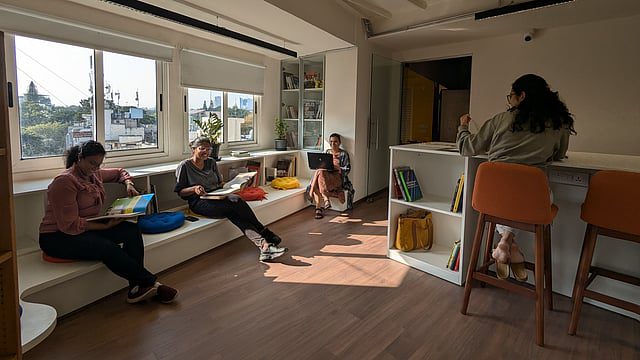
In Bengaluru, the reopening of a refurbished library at Alliance Française marks a renewed focus on cultural infrastructure as an integral part of urban development.
The upgraded facility is expected to serve as a contemporary knowledge and community space, reflecting evolving demands for accessible learning environments in rapidly growing cities.Libraries in metropolitan areas are increasingly being reimagined as multifunctional spaces that go beyond book lending. Urban planners highlight their role in fostering community engagement, supporting lifelong learning, and providing inclusive environments for diverse groups. In Bengaluru, where demographic growth and a young population are reshaping civic needs, such spaces are becoming essential social infrastructure.The revamped facility incorporates modern design elements aimed at improving usability and accessibility. Experts note that well-designed public and semi-public spaces can enhance urban liveability by offering residents areas for quiet study, collaboration, and cultural exchange.This aligns with broader efforts to create people-centric cities where social and intellectual needs are integrated into planning frameworks.
From an urban policy perspective, investment in cultural infrastructure is often overshadowed by priorities such as transport and housing.However, analysts argue that knowledge spaces like libraries contribute to economic development by supporting education, skill-building, and innovation ecosystems. They also play a role in reducing social disparities by providing free or low-cost access to information and resources.The reopening also reflects a shift towards adaptive reuse and upgrading of existing infrastructure rather than relying solely on new construction. This approach can be more sustainable, reducing resource consumption while preserving cultural identity. In dense urban settings like Bengaluru, optimising existing assets is increasingly seen as a practical strategy for balanced growth.There are also environmental considerations.Modern library designs often incorporate energy-efficient lighting, natural ventilation, and digital resources that reduce reliance on physical materials. Such features contribute to the broader goal of creating low-impact urban spaces that align with climate resilience objectives.As Bengaluru continues to expand, the role of cultural and educational spaces will be critical in shaping a well-rounded urban ecosystem.
The reopening of the Alliance Française library signals an effort to strengthen these dimensions, offering residents not just access to knowledge but also a shared civic space.Going forward, scaling similar initiatives across neighbourhoods could help bridge gaps in access and support more inclusive urban development. Integrating cultural infrastructure into city planning will be key to ensuring that growth is not only economic but also social and intellectual.
Also Read:Bengaluru treated water plans face regulatory gap
