


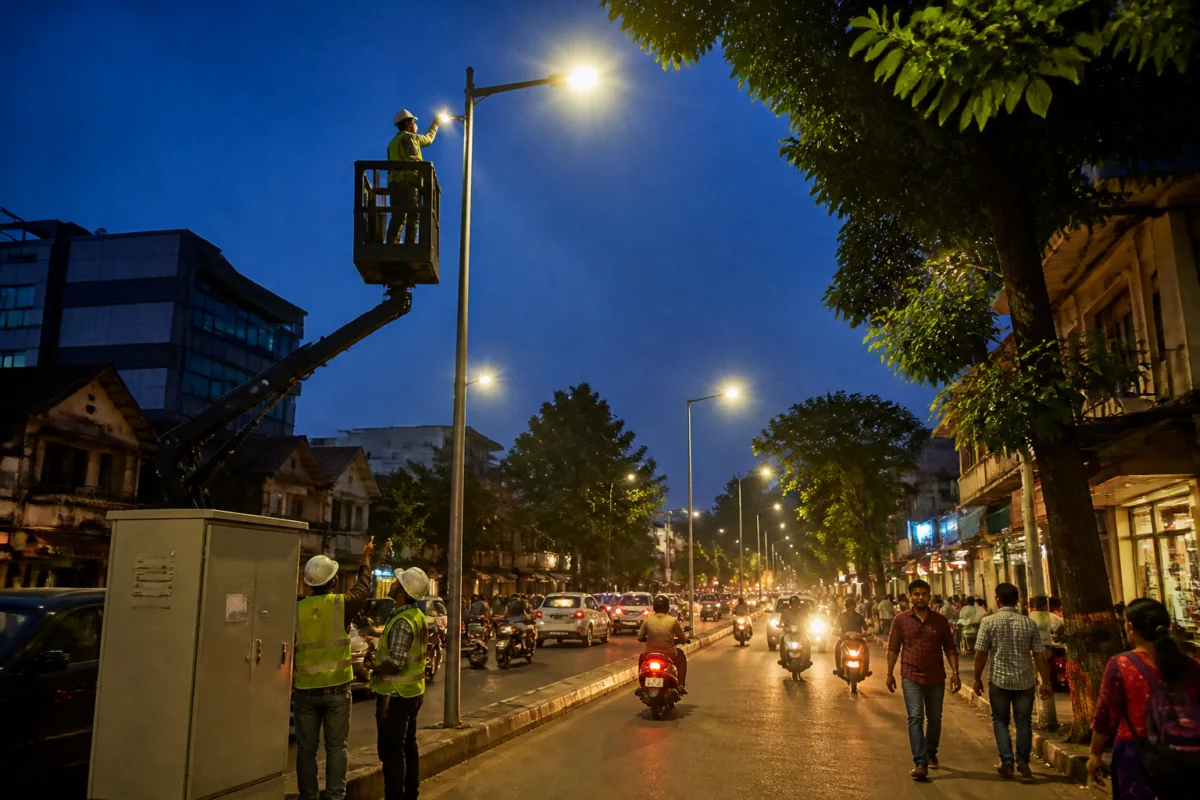
Bengaluru’s LED street-light upgrade is expected to save around ₹100 crore, or 54% of current expenditure, through energy-efficient lamps and a centralised monitoring system being rolled out across the city, Greater Bengaluru Development Minister Krishna Byre Gowda said on Friday.
The first Centralised Control and Monitoring System (CCMS) under the project was launched in Jayanagar by the Bengaluru South civic corporation. The system is intended to improve public lighting, reduce electricity consumption and identify faulty or non-functioning street lights before residents have to file complaints.
Under the new arrangement, technical teams will monitor the street-light network centrally and individually. The system can detect lights that are completely non-functional or only partially illuminated, allowing field teams to begin repairs without waiting for a complaint from the public, the minister said.
Street-light failures are among the issues that generate a high number of complaints from Bengaluru residents. Byre Gowda said better maintenance would improve the quality of a basic civic service and that improved lighting could also support residents’ safety and security.
The project includes replacing conventional street lights with energy-efficient LED lamps and connecting existing LED lights to an Internet of Things-based CCMS with GSM connectivity. Through the system, authorities will be able to monitor street lights from a central location as well as track individual units.
Separate field maintenance teams will be assigned to address faults identified by the monitoring system and complaints received from residents. The system provides for repairs within 24 to 48 hours of a fault being detected or a complaint being registered, according to the minister.
Maintenance contractors will also face automatic penalties if they fail to rectify faults within the prescribed period. The penalty mechanism is intended to link contractor performance to a defined service timeline, although the announcement did not specify the amount of the penalties or the number of street lights covered in the first phase.
The Jayanagar installation is being described as the first-phase milestone of the citywide project. It marks a shift from complaint-led street-light maintenance towards technology-assisted monitoring, in which faults are identified centrally and assigned to field teams for resolution.
The announcement did not provide a detailed rollout schedule for other areas, the total number of lights to be converted, or the precise basis used to calculate the projected ₹100 crore saving. The next stages will determine how quickly the system is extended beyond Jayanagar and whether the promised repair timelines are consistently met across Bengaluru.

