


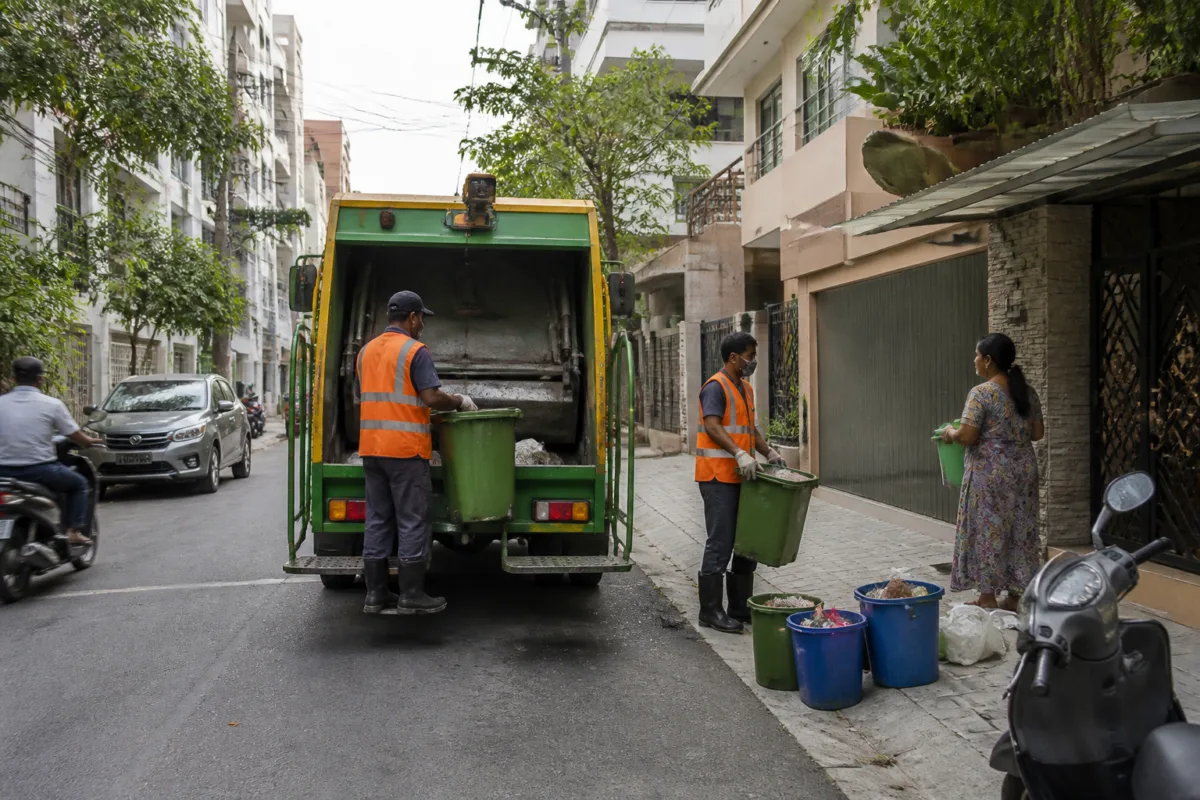
Bengaluru’s proposed overhaul of garbage collection has run into the familiar fault line between public-service design and contract execution. Only five of the 21 government-approved waste-collection packages have been accepted by contractors, forcing Bengaluru Solid Waste Management Ltd (BSWML) to recall 10 tenders and raising the possibility that the citywide rollout will be delayed by another three to six months.
The immediate problem is not the absence of a new operating model. BSWML has already designed one. The proposed system would replace the existing auto-tipper arrangement with GPS-based door-to-door collection, digitally monitored routes and payments linked to verified service delivery. The difficulty lies in getting enough agencies to accept the commercial and operational terms on which that system is being offered.
That distinction matters. Bengaluru’s waste challenge is often presented as a problem of collection capacity: whether vehicles, workers and contractors are available to move waste from homes to processing or disposal facilities. The current standoff shows that capacity is also shaped by procurement decisions, payment conditions, risk allocation and the credibility of the contract between the civic system and its service providers.
The proposed restructuring divides door-to-door collection into 33 packages covering all 28 assembly constituencies. The cabinet approved 21 of those packages, but work orders have so far been accepted only in Govindarajanagar, Mahalakshmi Layout, Chickpet, Chamarajpet and Vijayanagar. BSWML officials said Vijayanagar is expected to become the first constituency to receive the new system, with implementation expected to begin within a month.
For the remaining approved packages, the process has become a dispute over price and viability. According to BSWML officials cited in the report, contractors first sought a 25% premium over the estimated contract value. They later agreed to a 14% premium, on the basis of which government and cabinet approvals were secured. Several contractors subsequently declined to proceed, saying that 14% was insufficient.
“Only after they agreed for 14% premium did we proceed with securing all approvals. Now, they are saying 14% is not enough,” a senior BSWML official said. Bengaluru development minister Krishna Byre Gowda said the government would proceed with fresh tenders if contractors withdrew after the approval process.
The dispute therefore exposes a difficult sequence in public procurement. A department may secure administrative and political approval for a contract, but approval does not guarantee that the market will deliver the service at the approved price. If contractors reassess the cost of fuel, labour, statutory obligations, vehicle operations and compliance after the tender stage, the city can be left with an approved programme but no operational network.
The reported resistance also appears to be linked to the design of the new monitoring system. Under the proposed arrangement, collection vehicles would be GPS-tracked, routes would be digitally monitored and daily billing would be processed only after the assigned service had been verified online. These provisions are intended to make it possible to measure whether a route was covered and whether the contracted service was delivered.
That creates a stronger accountability mechanism than a system in which payments are less directly connected to digitally recorded route performance. It also changes the contractor’s exposure. A missed route, incomplete service or failure in the monitoring system could affect billing. The report does not establish whether the proposed contracts contain adequate provisions for disputed records, equipment failure or delays caused by conditions outside a contractor’s control. But the reluctance to accept the packages suggests that monitoring and payment conditions are central to the disagreement, not incidental features.
The tender process has another institutional dimension. Sources cited in the report said some firms and their co-working partners were disqualified during the process, which contributed to dissatisfaction among contractors. The supplied report does not specify the grounds for those disqualifications or whether they have been challenged. That missing detail is important because a procurement dispute can combine two separate questions: whether the contract is financially viable and whether eligible firms believe the selection process was fair and predictable.
The city’s administrative response has focused on continuity. Karnataka invoked the Essential Services Maintenance Act for waste-management services across Bengaluru for one year amid the standoff. Under the notification, workers involved in door-to-door collection, transportation and allied sanitation services are prohibited from going on strike. The government cited concerns over public health and sanitation, while contractors raised issues including revised wage implementation, diesel-cost reimbursement and delays in bill payments.
This is a sign of how dependent municipal sanitation is on outsourced delivery. The city needs contractors to provide vehicles, workers and daily collection, but the service is too essential to be allowed to stop without immediate public consequences. When negotiations fail, the administration’s first concern becomes preventing accumulation of waste rather than completing the longer-term reform of the service.
That short-term priority can make the underlying contract problem harder to resolve. Invoking emergency powers may reduce the risk of an immediate work stoppage, but it does not settle disagreements over premiums, statutory liabilities, fuel costs or outstanding payments. Nor does it by itself fill the 16 approved packages that have not received accepted work orders. Those packages still require a procurement decision and agencies willing to operate under the revised model.
The delay also has consequences for the logic of the citywide restructuring. A GPS-based collection system is designed to create a common operating framework across different parts of Bengaluru. If only five constituencies begin the transition while the rest remain under existing arrangements, the city will temporarily have multiple collection regimes. That can make service standards, monitoring and public expectations uneven across neighbouring areas.
The first rollout in Vijayanagar will therefore function as more than a pilot in practical terms, even if it is not formally described that way. Its implementation will show whether vehicles can be tracked consistently, whether routes can be verified, whether daily billing works as intended and whether residents experience more reliable door-to-door collection. The source report does not provide performance benchmarks or a formal evaluation framework, so it is not yet possible to assess how success will be measured.
The numbers reveal the scale of the current gap. Of 21 cabinet-approved packages, only five have been accepted, leaving 16 without accepted work orders. Ten tenders are being recalled, and officials estimate that fresh procurement could add three to six months to implementation. The broader plan covers 33 packages and all 28 assembly constituencies, meaning that the approved portion itself does not yet represent the complete citywide restructuring.
Bengaluru’s rapid population growth and inadequate waste-collection infrastructure provide the wider context for the reform. As the city expands, a collection system must handle not only larger volumes of waste but also more dispersed neighbourhoods, denser housing and greater expectations of regular service. The proposed digital model addresses one part of that challenge by seeking better visibility over vehicle movement and route completion. It does not, on the evidence supplied, resolve the wider questions of processing capacity, segregation, disposal or the financial sustainability of municipal sanitation.
That limitation is crucial. Collection is the most visible part of the waste chain because residents encounter it at their doorsteps. But better tracking of collection vehicles cannot by itself guarantee that waste is properly segregated, processed or disposed of after pickup. The present dispute is specifically about the collection contract, and the available information does not establish how the new package structure connects to the rest of Bengaluru’s waste-management system.
The immediate policy test is thus twofold. BSWML must secure agencies for the recalled packages while preserving continuity in the existing system. At the same time, it must demonstrate that the new contracts distribute costs and performance risks in a way that contractors can accept and the public can monitor. The government’s position is that fresh tenders are the only option if agencies withdraw. Contractors, as reported, argue that operational expenses and statutory obligations make the existing terms unviable.
What the episode confirms is that Bengaluru’s garbage-collection reform is not being held back by technology alone. The GPS platform, digital route monitoring and constituency-based package structure are administrative tools. Their success depends on procurement credibility, payment discipline, cost calculations and the capacity to enforce service standards without making participation commercially unattractive.
The next milestones are the commencement of the new system in Vijayanagar, the issuance of the remaining five accepted work orders and the fresh tendering of 10 packages. Whether those steps expand the reform or deepen the delay will depend on the terms offered, the response of contractors and the government’s ability to maintain sanitation services while the procurement dispute continues.

