


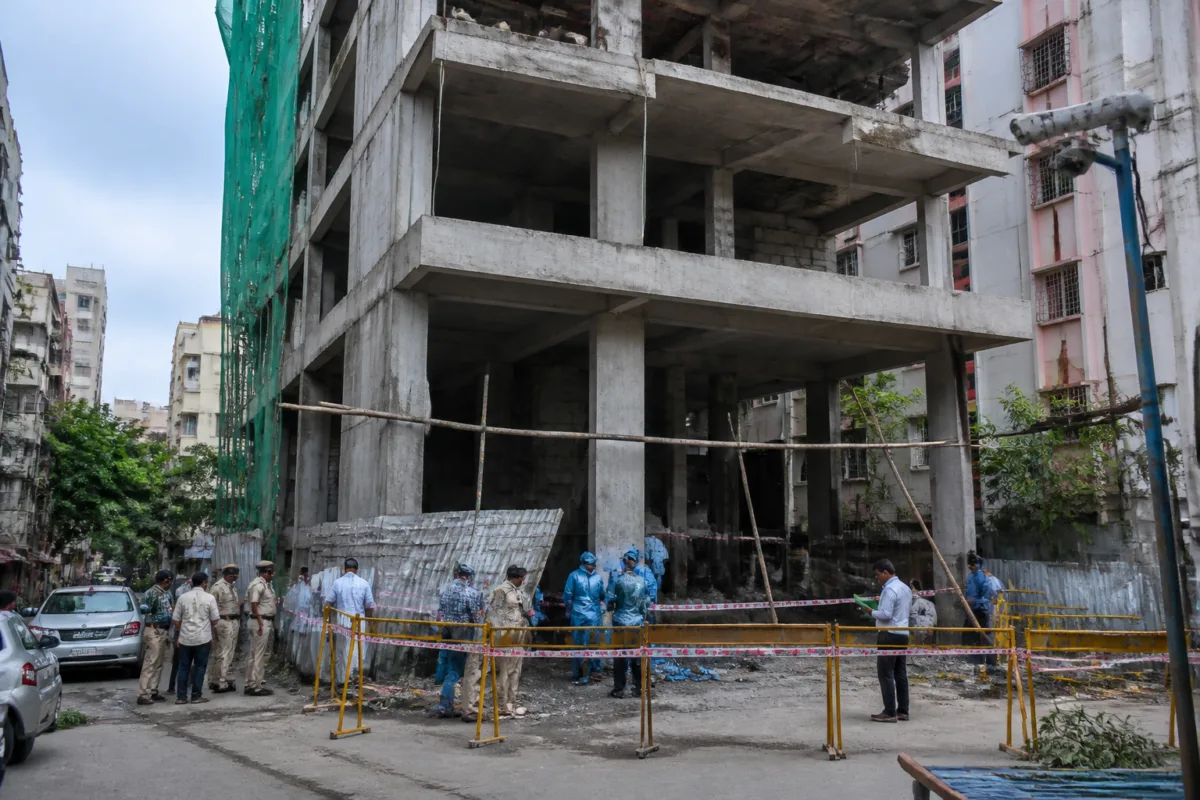
The investigation into the blast at a construction site on Jarmia Road in Bengaluru’s Pulakeshinagar police station limits has moved towards identifying the person who sent or left the parcel that exploded, while conflicting accounts from the two workers involved have left the central sequence of events unresolved. The incident, reported after the blast on October 20, has brought an often overlooked urban safety problem into focus: construction sites are active workplaces, storage areas and informal access points at the same time, with incomplete buildings creating conditions that can be difficult to monitor.
According to the report by Prajavani, an unidentified person called building watchman Allauddin on the morning of October 20 and told him that a parcel had been sent for workers. Allauddin received what was described as a battery-like parcel and informed Suraj, who was working on the fifth floor. The two later opened the parcel on a lower floor, when the explosion occurred. Both men suffered burn injuries. Allauddin has since been discharged from hospital, while Suraj was still receiving treatment when the report was published.
The police investigation is being led by officers from Bengaluru’s eastern division. Five separate teams have been formed under the leadership of an assistant commissioner of police and an inspector. Investigators have taken possession of Allauddin’s mobile phone and examined call records. Police sources quoted in the report said the location of the person who made the call was found to be within the city, but the report does not identify the caller or indicate that an arrest has been made.
The immediate investigative question is therefore not only who sent the parcel, but whether it was delivered through a phone call, physically placed at the building, or handled through some combination of the two. Allauddin has reportedly given inconsistent accounts. In one version, he said an unidentified person sent the parcel. In another, he said someone brought a bag and left it at the building. Since Suraj has not yet been able to provide a statement, investigators do not have a complete account from both people who handled the package.
That uncertainty matters because construction sites do not operate like completed commercial premises. They may have a watchman but lack a formal reception desk, visitor management system or designated delivery area. Workers, contractors, material suppliers and visitors can move through unfinished floors, temporary entrances and partially secured staircases. A parcel described as resembling a battery may therefore be treated as an ordinary delivery rather than an object requiring isolation and police inspection. The available report does not establish whether any safety protocol was in place at the building or whether the parcel had been recorded when it arrived.
The site’s physical condition is also relevant to the investigation. The blast occurred in an under-construction building, where several floors were accessible to workers and where the lower level was used to open the parcel. The report does not provide details about the building’s developer, contractor, occupancy status, security arrangements, construction approvals or the number of workers present. It also does not state whether the structure was sealed after the incident or whether work was halted. These missing details limit what can be concluded about the site’s compliance with workplace and emergency-safety requirements.
Police have collected samples from the scene and sent them to the Forensic Science Laboratory. The laboratory report is expected to help determine the composition of the material and establish whether the object was in fact a crude bomb, as described in the report. Until that examination is completed, the exact nature of the device remains a matter for forensic confirmation rather than an established technical finding. The report also does not specify the quantity of explosive material, the mechanism used, or whether the object was designed to target a particular person.
Investigators are examining a possible personal-enmity angle. The building owner, Rehman, and his friends have been questioned as part of that inquiry. However, the report does not say that police have established a motive or linked the blast to any individual dispute. The reference to personal enmity is therefore an investigative line being pursued, not a confirmed explanation for the incident.
The scale of the CCTV review indicates the difficulty of reconstructing movement around a dense urban site. Police teams have examined footage from cameras installed at more than 100 locations, according to the report. The number does not mean that all the cameras captured the relevant movement or that the suspect has been identified. It does show that the investigation extends beyond the construction site itself and is examining routes through the surrounding neighbourhood. In a built-up area, a parcel may pass through several public and private spaces before reaching an unfinished building, making footage, phone records and witness statements important parts of the same evidence chain.
The incident also reveals the fragmented responsibility surrounding construction-site security. A watchman may be the first person to receive a delivery, but the building owner, contractor, site supervisor and workers may each have different roles and levels of authority. The supplied report does not identify which entity controlled access to the premises or who was responsible for recording deliveries. Without that information, it is not possible to determine whether the incident resulted from a failure of supervision, an intentional act by an outsider, or a breakdown in communication among people working at the site.
For workers, the immediate concern is practical rather than investigative. Construction labourers often work in environments where floors, rooms and access routes change rapidly as a project progresses. Temporary lighting, incomplete barriers and the absence of permanent building-management systems can make it difficult to distinguish routine objects from hazards. The report confirms injuries to two workers but does not provide their employers’ details, their occupational roles beyond the available descriptions, or information about compensation and workplace reporting. Those facts would be necessary to assess the labour and safety consequences of the blast.
The incident also raises a narrower question about how police and civic agencies respond to suspicious objects in active construction zones. The available material confirms that police have formed teams, seized a mobile phone, reviewed call records, examined CCTV footage and sent scene samples for forensic analysis. It does not identify any broader advisory issued to construction sites, property owners or security personnel in the area. Nor does it state whether the municipal corporation, labour department, fire services or building authorities have inspected the premises after the explosion.
There is no wider incident data in the supplied report to establish whether parcel-related hazards are increasing at Bengaluru construction sites or whether this case is unusual. It provides no comparison with other construction-site incidents, no citywide figures on security complaints and no information on the number of unfinished buildings in the Pulakeshinagar area. The available evidence supports a focused account of one blast and its investigation, but not a citywide trend.
That limitation is important. A single incident can expose a vulnerability without proving that the vulnerability is widespread. In this case, the confirmed facts show that an unidentified caller or visitor was able to associate a parcel with workers at an unfinished building, that the parcel was opened by two workers, and that the resulting investigation depends on forensic evidence, phone records, CCTV footage and testimony that is not yet complete. The evidence does not yet establish how the object entered the site, who intended it, or whether existing safety procedures were breached.
The next stages of the case will depend on the Forensic Science Laboratory report, the recovery of a consistent account from Suraj, further questioning of Allauddin and the identification of the person connected to the call or parcel. Police are also expected to continue reviewing CCTV footage from the locations examined by the five investigation teams. Until those steps are completed, the blast remains a case with a confirmed site and injuries but an unresolved chain of responsibility and motive.

