


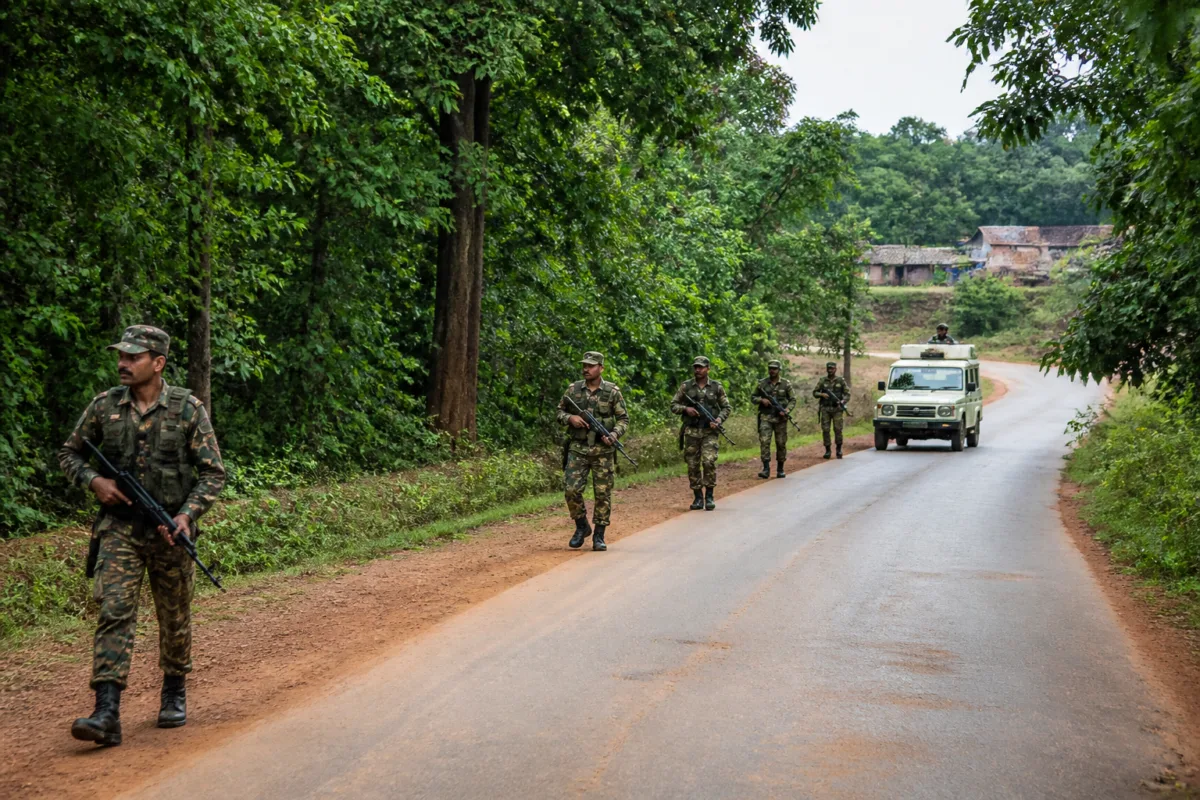
Chhattisgarh has decided to reduce security cover for 116 political leaders across party lines after a six-month threat assessment, freeing police personnel and vehicles for other security and law-enforcement duties in the Maoist-affected Bastar region.
The decision affects serving and former politicians, including cabinet minister Kedar Kashyap, state Congress president Deepak Baij, former ministers Mahesh Gagda and Kawasi Lakhma, and members of the family of slain Congress leader Mahendra Karma. Security for nine leaders, including these prominent figures, is being downgraded from Z+ to Z category. Other protectees will see their cover reduced from Z to Y+ or from Y+ to Y.
The move follows the Centre’s declaration of an end to armed Maoist insurgency and a review conducted after the March 31, 2026 deadline for eliminating armed Maoism. Deputy Chief Minister and Home Minister Vijay Sharma said the government had chosen a phased reduction rather than withdrawing protection immediately.
“Completely withdrawing security immediately would not have been justified,” Sharma said, adding that another assessment would be carried out after six months. The categories of protection could be reduced further after that review, he said.
Police figures cited in the report show that more than 1,550 security personnel and 500 vehicles are currently deployed to protect around 400 individuals across Chhattisgarh. In Bastar alone, more than 1,000 personnel provide security to over 250 political leaders and other protectees. Reducing the protection burden is expected to make personnel and vehicles available for other policing and security responsibilities.
The decision has drawn opposition from Congress, which cautioned that a decline in Maoist activity did not necessarily mean that threats to political representatives had disappeared. Baij said the threat remained in interior areas of Bastar, where politicians continue to travel, and called for a fresh assessment before the reductions were implemented.
The concerns reflect Bastar’s history of political violence. On May 25, 2013, Maoists ambushed a Congress convoy at Jhiram Ghati, killing several senior leaders, including Mahendra Karma, then Pradesh Congress Committee president Nand Kumar Patel and former Union minister Vidya Charan Shukla. The attack led to heightened protection for political leaders and their families, with many continuing under armed security for years.
The government’s latest decision follows sustained anti-Maoist operations. Figures cited by Union Home Minister Amit Shah in Parliament state that 4,839 Maoists surrendered, 706 were killed and 2,218 were arrested during three years of intensified operations. However, the state government has not released the complete list of the 116 leaders whose protection is being reduced.
A formal Home Department order detailing the revised security arrangements is awaited. The next assessment is scheduled after six months, when the government will review the threat categories and decide whether further changes are required.

