


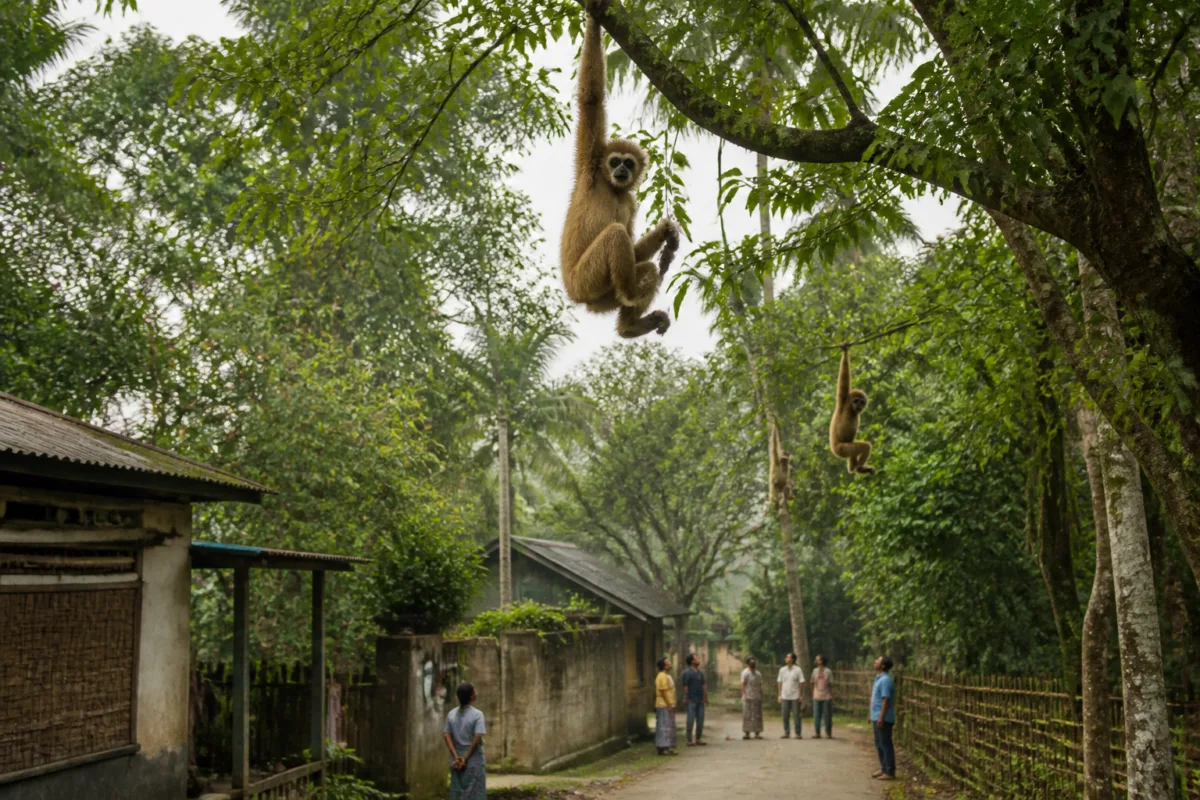
Barekuri’s hoolock gibbons have survived not behind a fence but within the everyday life of 21 villages in Assam’s Tinsukia district. That unusual relationship is now being presented as the foundation for a larger ecotourism economy, even as local communities ask the government to close basic infrastructure gaps that could determine whether tourism supports conservation or places new pressure on it.
The immediate occasion was a bicycle rally held on World Gibbon Day, when women who regularly feed the gibbons rode through the villages to spread awareness about their protection. The event also renewed a demand for better roads, homestays and visitor facilities. For Barekuri, the question is no longer simply whether tourists can be brought to see an endangered species. It is whether a fragmented rural settlement can receive visitors without weakening the cultural and physical conditions that have allowed the gibbons to live alongside people.
The reported population is small. Local estimates place five gibbon families, comprising around 20 individuals, across the 21 villages, along with three gibbons that live separately. The western hoolock gibbon is classified as endangered on the International Union for Conservation of Nature’s Red List. In Barekuri, however, the animals are regarded as part of village life rather than as a threat or nuisance. Women step out with food for them, and the animals move through lanes and household compounds.
That cultural relationship is the central asset of Barekuri’s conservation model. It is also more difficult to reproduce than a physical tourism facility. A road or homestay can be built through a government programme or local investment. Trust between residents and wildlife develops over time, through repeated contact and community practices. The report’s account suggests that Barekuri’s value lies in this combination: the gibbons are visible in a lived landscape, while residents have accepted their presence as part of the community’s identity.
The proposed tourism expansion therefore raises an infrastructure question before it becomes a tourism question. Satyajit Duarah, president of the Barekuri Eco Tourism Development Committee, said the immediate priority was a better road network connecting all 21 villages. The demand is significant because the attraction is spread across a settlement cluster rather than concentrated at one viewing point. Visitors moving between villages require access, but more roads and greater traffic can also alter the environment in which the animals move.
The supplied report does not establish how the road network is currently configured, what upgrades are proposed, or which agency would fund and execute them. Those details matter because infrastructure in a conservation landscape is not neutral. Its alignment, construction methods, lighting, traffic levels and maintenance can affect access for residents as well as movement patterns for wildlife. In Barekuri, the first planning task is therefore to connect the villages without treating the gibbons as an attraction detached from the settlement in which they live.
Accommodation is the second major pressure point. A homestay in Dighal Sako village, established around a decade ago, is reportedly no longer sufficient for researchers and tourists. Duarah said every one of the 21 villages needed at least two homestays. Dipti Bora, president of the Barekuri Hoolock Gibbon Conservation Society, said visitors needed to stay overnight because gibbons are best spotted early in the morning, before retreating to tall hollong trees and dense foliage by noon.
This timing makes homestays more than a commercial convenience. Overnight accommodation could distribute tourism income among households and reduce the need for visitors to make long, early-morning journeys from outside the area. At the same time, the report does not provide a carrying-capacity assessment, visitor numbers, operating standards or a waste-management plan. Without those institutional details, the scale of accommodation required remains a local demand rather than an established development framework.
The governance structure is already layered. Local conservation groups and the Barekuri Eco Tourism Development Committee are advocating for facilities. The Moran Autonomous Council is discussing homestays and resorts with the state government. The council’s chief executive member, Arunjyoti Moran, said the response from the state had been positive so far. Makum MLA Sanjay Kishan participated in the bicycle rally and described Barekuri as an example of human-wildlife coexistence.
That mix of local institutions, an autonomous council, an elected legislator and the state government could help mobilise support, but it also creates a need for clearly assigned responsibilities. The report identifies the demand for roads and accommodation, but does not specify which authority will approve tourism infrastructure, set standards for homestays, manage visitor access or monitor the effect on the gibbons. These administrative questions will shape whether ecotourism becomes a community-led conservation tool or simply another external development project.
Electricity infrastructure provides a more concrete example of how the built environment intersects with wildlife protection. Moran said the threat of electrocution had been reduced through measures accompanying nearly 99% cable electrification in the area, including protective coating on electricity transmission wires. He added that some work remained. The reported progress indicates that coexistence depends not only on cultural acceptance but also on technically specific interventions in everyday infrastructure.
The figure of nearly 99% electrification, however, does not mean that the safety problem has disappeared. The report does not identify the remaining unsafe locations, the length of protected wiring or the agency responsible for completing the work. Those details would be essential for assessing whether the intervention is comprehensive or whether gibbons remain exposed in particular stretches of the village network. The lesson is clear from the available evidence: electrification can support rural development and still create risks for wildlife unless safety is built into the system.
Barekuri’s example also sits within a wider conservation conversation in Assam. Chief minister Himanta Biswa Sarma highlighted the importance of the species to the state’s natural heritage and referred to a canopy bridge at Hollongapar in Jorhat district that helps gibbons cross a railway track safely. He said the sight of a gibbon using the bridge was encouraging and placed the intervention alongside the relationship between people and primates in Barekuri.
The contrast between the two locations is instructive. At Hollongapar, the reported response is a dedicated structure designed to address a conflict created by transport infrastructure. At Barekuri, the challenge is distributed across village roads, household compounds, electrical wires and future visitor facilities. Both show that wildlife conservation increasingly involves the design and management of infrastructure, not only the protection of formally defined forest areas.
Prime Minister Narendra Modi had praised the Barekuri villagers’ connection with hoolock gibbons during an episode of Mann Ki Baat in 2024. The renewed public attention on World Gibbon Day adds visibility to a local conservation practice that has already attracted national recognition. But recognition alone does not provide roads, accommodation standards or safety audits. The next stage requires the institutional commitments that turn public appreciation into durable local capacity.
The numbers also define the scale of the challenge. Around 20 gibbons in five families, plus three separate animals, are living across 21 villages with approximately 15,000 members of the Moran community. The ratio illustrates why a conventional wildlife-tourism model may not fit Barekuri. The attraction is not a large population concentrated in a reserve, but a small endangered population living within a human settlement landscape. Tourism planning must consequently account for household routines, animal movement and the uneven distribution of benefits across villages.
The evidence supplied so far confirms three facts. Barekuri has a rare community relationship with western hoolock gibbons; local representatives see ecotourism as an opportunity; and roads, homestays and electricity safety are now central to the conservation discussion. What remains unclear is how the government will translate support into a funded plan, how visitor growth will be managed and how the gibbons’ welfare will be measured as facilities expand.
Those unanswered questions will determine whether Barekuri becomes a credible model of community-based conservation. The next developments to watch are the state government’s response to the road demand, the Moran Autonomous Council’s discussions on homestays and resorts, and the completion of remaining electricity-safety measures. In Barekuri, the future of an endangered ape is being negotiated not only in forests, but along village roads, around homes and through the institutions responsible for building them.

