


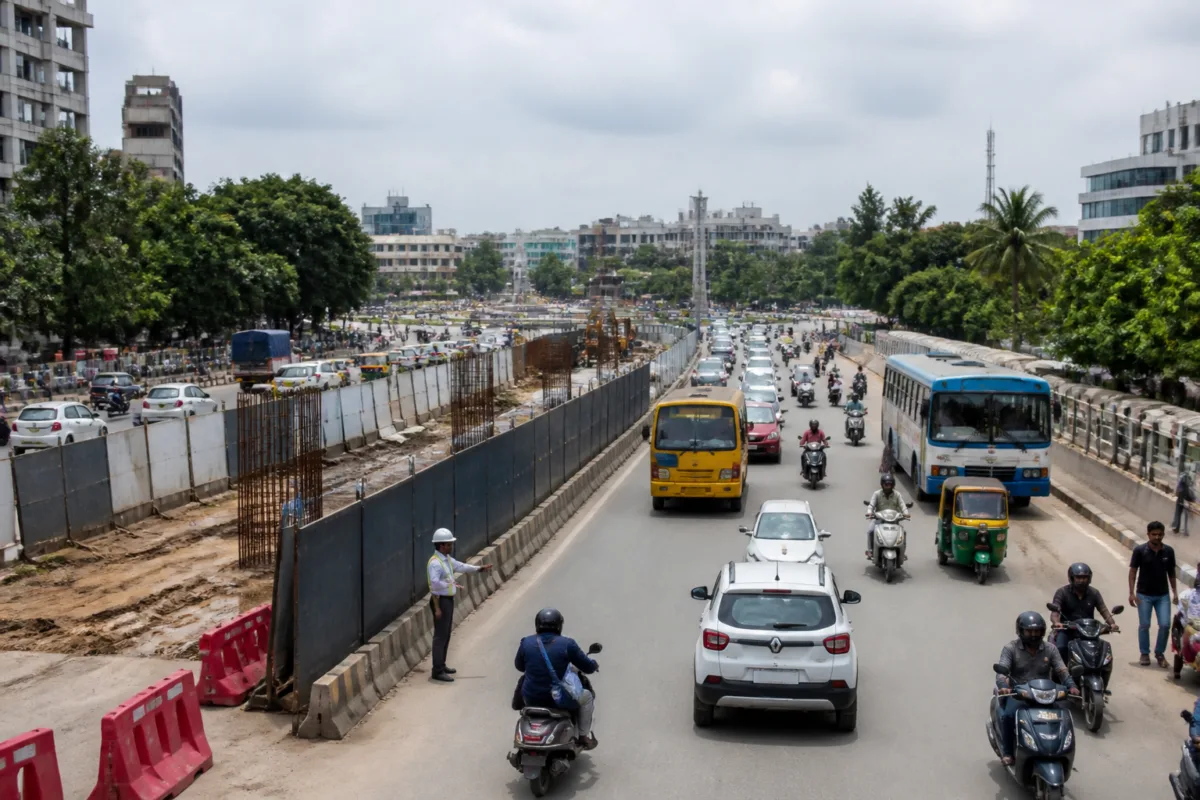
The Ballari Road elevated corridor in Bengaluru will be built without completely shutting the road for 18 months, the Bengaluru Development Authority (BDA) has clarified, easing concerns over prolonged disruption on one of the city’s key routes. Traffic will continue during construction through controlled restrictions and phased diversions wherever required.
The 18-month period refers to the scheduled construction timeline for the elevated corridor and does not mean that Ballari Road will remain closed throughout the work, the BDA said. The clarification followed an inspection of the project area by BDA chairman N.A. Harris and commissioner P. Manivannan on Saturday, along with project consultants, engineers and senior officials.
During the inspection, officials reviewed the proposed traffic-management arrangements and were directed to maintain continuous coordination between construction activity, traffic control and road repair work. The BDA said the objective was to prevent construction-related congestion from worsening traffic conditions along the corridor.
The existing road has three lanes on each side. According to Harris, construction barricades will be restricted to approximately 4.5 metres, affecting only one lane. The remaining two lanes and the service road are expected to remain open for traffic during the work.
Cars, two-wheelers, school buses and state road transport buses will be permitted to use the route. Entry for goods vehicles will be restricted, although the BDA did not provide further details in the supplied statement about the timing or operational boundaries of that restriction.
The project will cover 1.74 kilometres between the UAS staff quarters and Mekhri Circle. It will include a four-lane elevated corridor supported by 49 pillars and is estimated to cost ₹445.7 crore. An elevated rotary junction is planned at Mekhri Circle, with down ramps towards Yeshwanthpur through C.V. Raman Road and towards Jayamahal Road.
Harris said the project had been taken up in the city’s future interest and to meet the needs of a growing population. He also said the corridor had been planned with the city’s proposed metro infrastructure in mind, although the BDA’s clarification did not provide details on how the elevated road and future metro facilities would be integrated.
The BDA held discussions with joint commissioner of police (traffic) Karthik Reddy on traffic restrictions, route diversions and measures to maintain smooth vehicle movement. The authority’s stated approach is to keep traffic moving in stages rather than impose a complete closure during the construction period.
The project’s next operational challenge will be the execution of barricading, diversions and road repairs without reducing the corridor’s available capacity beyond the limits outlined by the BDA. The authority has not announced a separate schedule in the supplied statement for the start of construction or for individual traffic-management stages.

