


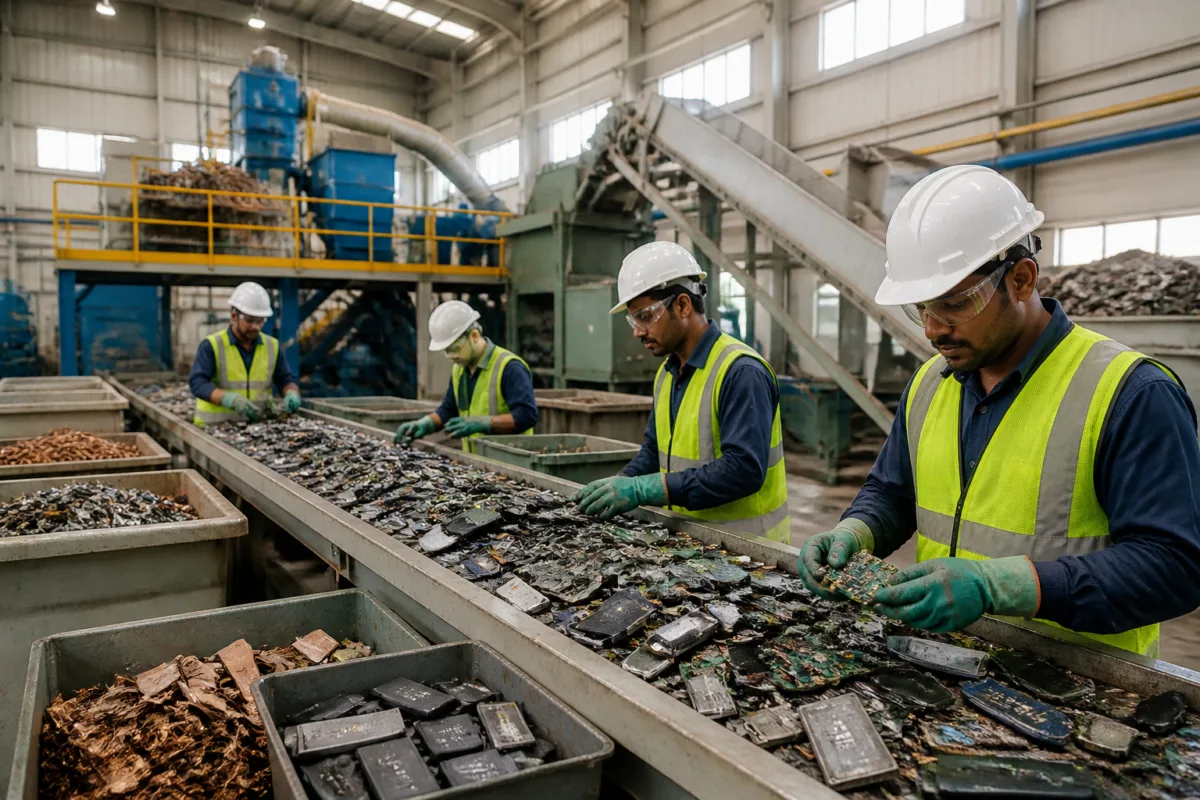
Attero’s e-waste recycling expansion could raise the scale of India’s critical-mineral recovery industry, with the company planning to invest around ₹3,000 crore over the next five years and add facilities in Bengaluru and Andhra Pradesh.
Attero Co-founder and Chief Executive Officer Nitin Gupta told PTI that the company intends to increase its total e-waste recycling capacity from about 225,000 tonnes per annum to 1 million tonnes over the next four years. The company also plans to expand its lithium and battery recycling capacity by roughly five times during the same period.
Gupta said around 40 per cent of the proposed investment would be directed towards facilities for lithium, nickel and cobalt. Attero currently claims to recover more than 22 critical minerals, including gold, silver, copper, aluminium, nickel, lithium, cobalt and rare earth elements such as neodymium and dysprosium.
The company’s existing e-waste recycling plants are located in Roorkee, Reengus near Jaipur and Pune. It is working on a new plant in Bengaluru with an expected capacity of about 60,000 tonnes of electronic waste. Gupta said the Bengaluru facility would become operational within six months of the start of construction, while another plant is planned in Andhra Pradesh. The company expects the broader capacity expansion to come online within five years.
The planned facilities would link urban waste management with the supply of materials used in batteries, electronics and other industrial applications. Attero’s stated expansion also indicates how recycling companies are seeking a larger role in reducing dependence on imported critical minerals by recovering materials from discarded electronics and batteries.
Gupta said recycled and domestically sourced materials could meet between 30 and 80 per cent of India’s critical-mineral demand, including 75 to 80 per cent of demand for rare earths. These are company estimates and were not independently assessed in the report.
He also said Attero had tested samples from a lithium mine in Jammu and Kashmir and recovered about 205 parts per million of lithium carbonate. Gupta argued that India would need both mining and secondary raw materials from recycling to become an exporter of critical minerals rather than remain an importer.
The expansion is expected to be funded through a combination of equity and debt, according to Gupta. The report does not provide details on the financing arrangements, land, environmental approvals, construction contracts or waste-processing permissions for the proposed facilities.
Those execution details will determine how quickly the announced capacity can translate into additional processing in cities. For now, the plan places industrial-scale e-waste recycling and critical-mineral recovery at the centre of Attero’s growth strategy, while highlighting the infrastructure and regulatory requirements involved in handling a much larger volume of discarded electronics.

