


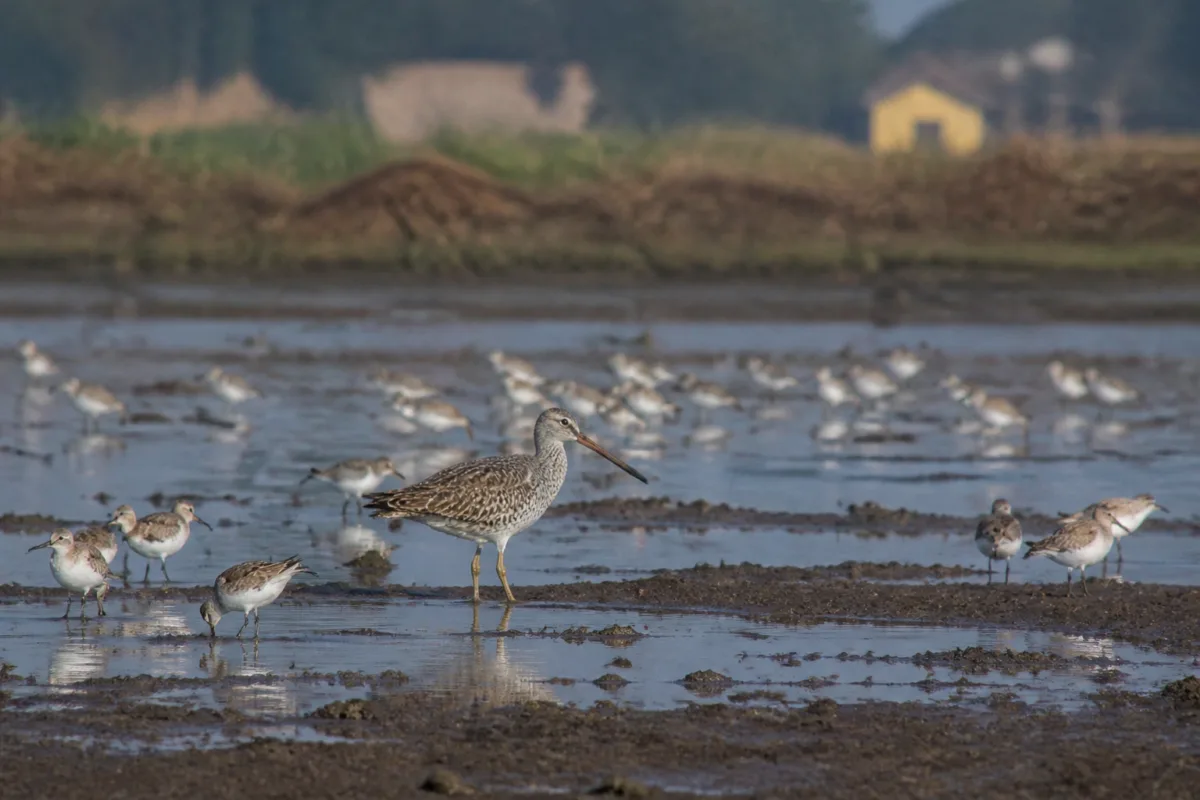
The Asian dowitcher, a rare migratory wader considered near-threatened on the IUCN Red List, has been photographed in Bengal for the first time at a bheri near Gopalpur in Haroa, North 24 Parganas. The sighting was made recently by birders at a wetland where water levels had fallen sharply, exposing habitat used by a mixed flock of migratory waders.
Birder Sujoy Mondal said the bird was first noticed on November 6 among marsh sandpipers. The flock remained in the water for only a few minutes before flying away, taking the dowitcher with it. Mondal was accompanied by fellow birders Arnab Ray, Saikat De and Tirthankar Saha. The photograph was taken in an area adjoining Gopalpur under Haroa police station limits.
The Asian dowitcher is a relatively large wader, measuring about 33 to 36 centimetres, with a long and distinctive bill. It breeds in freshwater wetlands across the Siberian steppe, Mongolia and northeastern China before migrating south during winter. Its winter range extends across parts of South Asia and Southeast Asia, including Indonesia, Java and Sumatra, and as far as Australia.
The sighting is significant because the species, although known as a winter visitor and passage migrant in parts of South and Southeast Asia, is not commonly recorded along India’s eastern coastline. Santanab Majumdar of the Birdwatchers’ Society said the bird’s global wild population is estimated at between 25,000 and 30,000.
Majumdar said the Haroa bheri provides habitat similar to the coastal mudflats used by migratory birds along the East Asian-Australasian Flyway. The flyway supports medium- and long-distance migration, making wetland conditions at stopover sites important to birds travelling between breeding and wintering grounds.
The Haroa sighting also draws attention to the ecological role of bheris, which are managed water bodies across the wetlands of North 24 Parganas. The bird was found alongside marsh sandpipers, common greenshanks, spotted redshanks, pied avocets, little stints and wood sandpipers, indicating the area’s use by several wader species.
Kanad Baidya of the Birdwatchers’ Society said flamingos had earlier been recorded in similar bheris at Andulpota in Basirhat in 2020 and 2021. He described the belt as an important birding zone requiring regular monitoring and greater public awareness.
Historical records show that the Asian dowitcher had occurred in Bengal before the latest sighting. British naturalist Edward Blyth collected a specimen from Calcutta Market on December 12, 1847. Naturalist Allan Octavian Hume reportedly procured three more specimens from the same market on December 13, 1878. Those records establish the species’ earlier presence in what is now West Bengal, while the Haroa observation marks its first documented photographic record in the state.
Birdwatchers’ Society members said wetlands such as the Haroa bheri need conservation and regular monitoring to protect migratory birds. The latest record adds to Bengal’s birding history and places renewed attention on the wetland habitats that support seasonal movement along the eastern migration route.

