


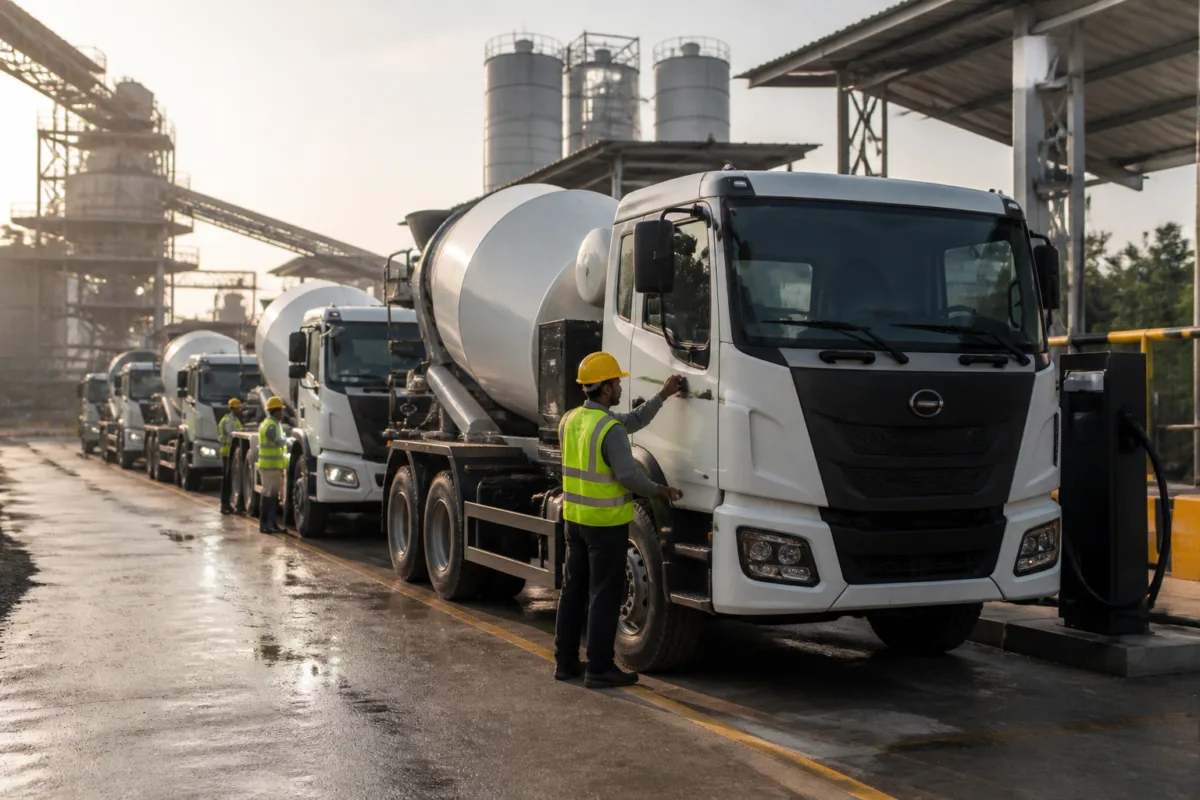
Ashok Leyland is expanding electric mobility beyond buses after its electric mobility-as-a-service subsidiary, OHM Mobility, secured an order to deploy more than 200 electric trucks for cement distribution on fixed routes, according to managing director and chief executive officer Shenu Agarwal.
The mandate, discussed during the company’s second-quarter FY27 earnings call, marks OHM Mobility’s entry into electric freight transportation. The company has not disclosed the customer, contract value or deployment timeline. The trucks are to operate under an electric mobility-as-a-service model, in which fleet deployment and operations are structured around transportation services rather than only vehicle sales.
The order is significant for urban and regional logistics because cement distribution connects manufacturing sites, construction projects, warehouses and building sites. Fixed routes can provide a more controlled operating environment for electric trucks, allowing fleet operators to plan charging and vehicle utilisation around known movement patterns. The source report, however, does not provide route lengths, truck specifications, charging arrangements or expected emissions savings.
Ashok Leyland is pursuing the freight order alongside a broader expansion of its electric commercial vehicle business. The company plans to establish a battery-pack manufacturing facility at Pillaipakkam near Chennai, with an initial capacity of 4 gigawatt-hours that could be scaled to 8-12 gigawatt-hours. Production is targeted to begin in the third quarter of calendar year 2027, primarily serving Ashok Leyland and its subsidiary Switch Mobility.
Management said battery localisation would become increasingly important as electric vehicle adoption grows, particularly in the light commercial vehicle segment. The company expects electrification in that segment to develop faster than in heavier trucks, although the report does not provide an adoption forecast or a national market estimate.
Switch Mobility India delivered 439 electric buses and 732 electric light commercial vehicles during the first half of FY27, while its electric bus order pipeline stood at around 2,800 vehicles, according to the company’s disclosures cited in the report. These figures indicate that the group’s current electric vehicle activity spans buses, light commercial vehicles and, through the new mandate, freight trucks.
The freight contract also comes as Ashok Leyland works to widen its conventional and electric light commercial vehicle coverage. The company is developing new LCV platforms and aims to increase the share of the addressable market covered by its portfolio to 80-85 per cent from 55-60 per cent. It is also expanding distribution across northern, eastern and central India.
Domestic LCV sales rose 21 per cent year-on-year to 21,371 units in the second quarter of FY27, while medium and heavy commercial vehicle volumes increased 44 per cent, the report said. Factory utilisation was nearing 90 per cent, and projected capital expenditure for FY27 was ₹1,000-1,200 crore.
The company also infused ₹150 crore into OHM Mobility during the quarter and spent ₹324 crore on repaying a loan at Switch Mobility UK. These commitments underline the capital required to develop electric vehicle platforms, batteries and fleet operations before new orders translate into sustained operating revenue.
For the construction and urban logistics sectors, the cement-truck deployment will be an important test of whether electric freight can move beyond pilots and buses into regular commercial supply chains. Its outcome will depend on factors not disclosed in the report, including charging access, daily vehicle utilisation, payload requirements, route distance and the commercial terms of the service mandate. The customer and deployment schedule will determine when the project’s operational and environmental impact can be assessed.

