


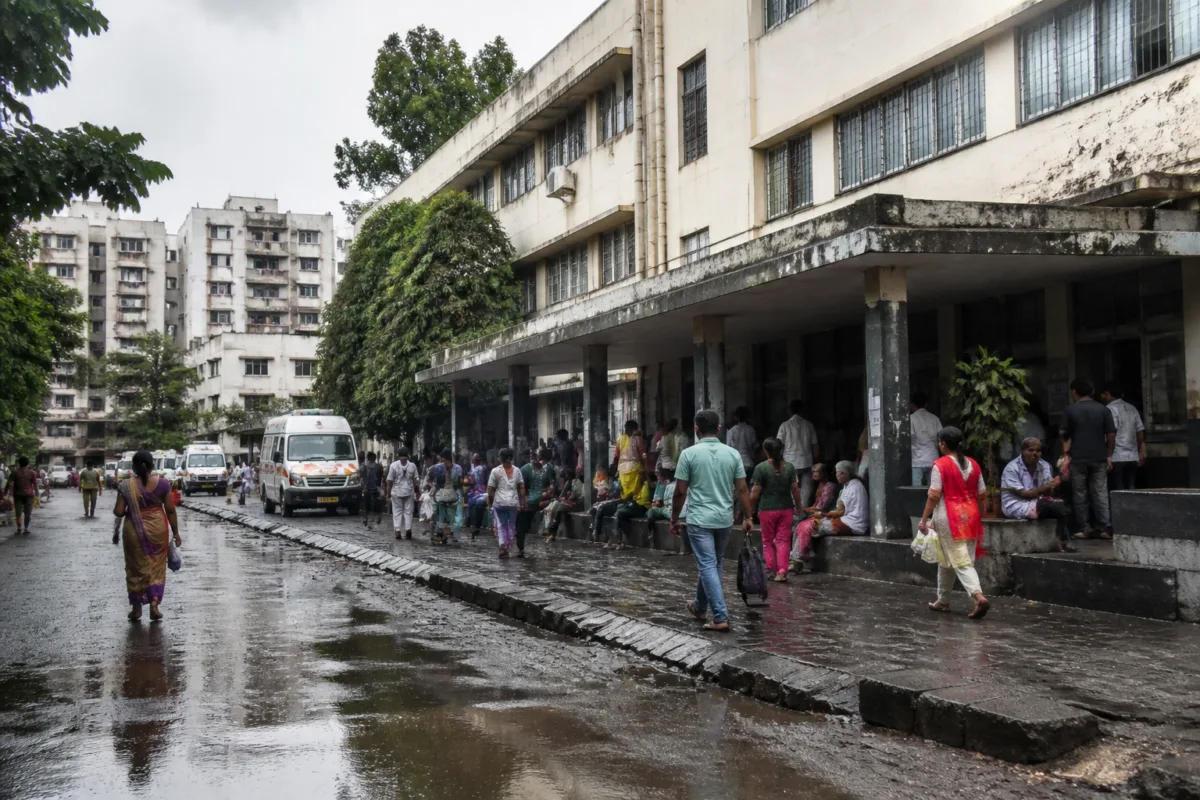
The condition of Annasaheb Magar Hospital in Hadapsar exposes a problem larger than one ageing municipal building: eastern Pune’s public healthcare network has expanded in population and demand faster than its secondary and emergency care capacity. A Lokmat report says the hospital continues to face shortages of medical equipment, specialist doctors, functioning devices and inpatient services, even as proposals to convert it into a modern multispeciality facility remain under discussion.
That gap matters because the hospital serves Hadapsar, Fursungi, Manjari, Mundhwa and nearby informal settlements. These areas include communities that depend on affordable municipal treatment and cannot easily absorb the cost of private healthcare. The report says residents are often directed to Sassoon Hospital or Kamala Nehru Hospital when services are unavailable at Annasaheb Magar Hospital. This shifts the burden from one under-equipped facility to patient travel, overcrowded referral hospitals and out-of-pocket treatment.
The immediate issue is not simply whether a new hospital building is announced. It is whether the existing public system can deliver the complete chain of care that residents need: diagnosis, specialist consultation, emergency treatment, admission, medicines and follow-up. Smaller primary-care facilities may handle routine consultations, but they cannot replace a functioning secondary hospital when patients require tests, inpatient care or specialist intervention.
The hospital’s role has become more important after villages were incorporated into the Pune Municipal Corporation limits, according to the report. The exact increase in patient numbers is not provided in the supplied material, but the report links the expanded municipal area and the growth of eastern Pune to a greater load on the hospital. This is a familiar urban governance challenge: administrative boundaries can enlarge faster than public institutions, budgets, staffing plans and service infrastructure are upgraded.
The report also describes a fragmented care pathway. Health and wellness centres and Balasaheb Thackeray Aapla Dawakhana facilities have been established for primary healthcare. However, the report says residents continue to rely on Annasaheb Magar Hospital for specialist advice, emergency treatment and inpatient services. When those functions are unavailable, patients must travel elsewhere. The result is not only inconvenience. For low-income households, a referral can mean transport costs, lost wages, delayed treatment and the possibility of moving into private care when public options are inaccessible.
The hospital’s physical condition adds another layer of risk. The existing building was constructed in 1956 and is described in the report as having reached the end of its usable life, with concerns about structural weakness. Because the hospital campus is lower than the adjoining road, rainwater reportedly enters the premises during the monsoon and can reach sensitive areas such as the operation theatre. The supplied report does not include a structural audit or an official safety assessment, so the condition should be treated as a reported concern requiring formal technical verification. But even as a reported concern, water entering a clinical facility points to the interaction between old buildings, drainage levels and healthcare safety.
Equipment failures make the building problem more consequential. The report says the X-ray machine is not functioning and that the oxygen plant has remained closed for several days. It also refers to beds and other material purchased during the Covid period lying unused. These claims are attributed to the report and local complaints; the material supplied does not provide equipment service records, downtime data, procurement documents or an official inventory. Those records would be necessary to establish the scale and duration of the failures.
Still, the distinction between physical capacity and operational capacity is central. A hospital may have beds, rooms or equipment on paper, but patients experience the system through functioning machines, available staff, medicines and timely decisions. A proposal for 200 to 250 beds would address only part of the problem unless it is accompanied by specialist doctors, trained medical staff, maintenance contracts, diagnostic services, oxygen systems and a reliable admission process. The citizens quoted in the report specifically call for these operational improvements alongside expansion.
This is where the proposed multispeciality upgrade needs to be examined as a governance project rather than only a construction project. Councillor Hemlata Magar said the hospital is planned to become a super-speciality facility and that Rs 4.5 crore has been allocated in the current year. The supplied report does not specify whether this amount is a capital allocation, a phased project provision, an equipment budget or the total project cost. It also does not establish a tender, design, construction or commissioning timeline. Without those details, the allocation signals administrative intent but does not yet demonstrate that expanded services will become operational.
The report identifies a vacant building next to the hospital, formerly used as a police station, as a possible resource for expansion. Reusing an existing municipal property could be faster than acquiring new land, but the source does not state whether the building has been structurally assessed, legally transferred, designed for clinical use or approved for conversion. These are not minor procedural questions. Hospitals require specialised electrical systems, infection-control arrangements, fire safety, medical gas networks, accessibility provisions, waste-handling systems and dependable water and power services. A vacant public building is not automatically a hospital extension.
The institutional responsibility is therefore distributed across several municipal functions. The health department must define services and staffing. Engineering authorities must assess the old structure, drainage and building safety. Procurement officials must repair or replace equipment and maintain supply chains. Finance authorities must release and monitor funds. Hospital administrators must track referrals, admissions, medicine availability and equipment downtime. If these responsibilities are not joined through a clear implementation plan, modernisation can remain a sequence of announcements rather than a functioning service upgrade.
The supplied report contains no patient-load figures, bed-occupancy rates, staff vacancies, referral counts, diagnostic volumes or waiting times. Those are the missing data points needed to measure the hospital’s capacity gap. The demand for 200 to 250 beds is a citizen demand, not an independently established requirement in the supplied material. A credible expansion plan would need to publish the basis for that number, including the population served, current and projected demand, emergency volumes, referral patterns and the role of other public hospitals in eastern Pune.
The same evidence gap applies to the reported equipment failures. A public dashboard or periodic disclosure could show which machines are functional, how long repairs take, how many patients are referred because of unavailable services and whether medicines are in stock. Such information would help distinguish a temporary maintenance failure from a sustained capacity problem. It would also allow the municipal corporation to judge whether the Rs 4.5 crore provision is improving access or merely creating additional assets.
The larger urban question is whether Pune’s public health infrastructure is being planned at the same scale as its expanding eastern settlements. Primary-care centres are important, but they cannot substitute for hospitals that provide diagnostics, emergency care and admission. At the same time, a new hospital is not a complete solution if the old building remains unsafe, equipment remains idle and specialist staffing is unresolved.
What the report establishes is a serious mismatch between the healthcare expectations placed on Annasaheb Magar Hospital and the facilities currently reported to be available. What remains unclear is the verified condition of the building, the exact status of the proposed expansion, the use of the Rs 4.5 crore allocation and the current service and staffing data. The next meaningful milestones are a formal safety and equipment assessment, publication of the expansion plan, clarity on the funding structure and evidence that essential services are functioning for residents before a larger facility is commissioned.

