


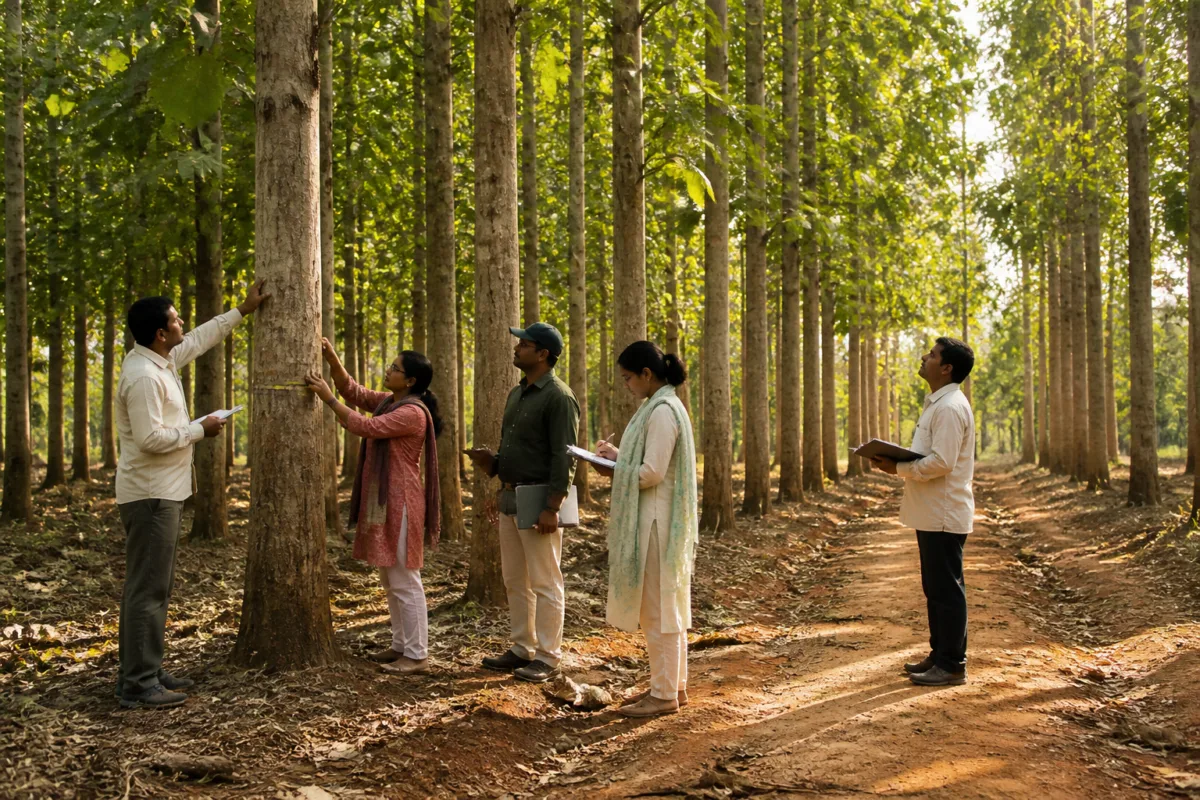
Andhra Pradesh’s improved teak clones have received national approval for commercial release, opening the way for further multiplication and possible use by farmers and growers. The three clones were developed by the state forest department in collaboration with the ICFRE-Institute of Wood Science and Technology (IWST), Bengaluru.
The clones — APFD-IWST-TG-1, APFD-IWST-TG-2 and APFD-IWST-TG-3 — were recommended by the ICFRE regional variety testing committee and approved by the variety releasing committee on November 9, 2026. The state forest department said the approval followed more than five decades of research dating back to 1972.
According to the reported evaluations, the clones recorded 10–20 per cent higher single-tree wood volume and 24–54 per cent higher heartwood content than standard check clones and seedling-origin trees. Their mean annual wood productivity was 9–11 cubic metres per hectare under the evaluated unmanaged plantation conditions.
The clones had wood density ranging from 0.55 to 0.64 grams per cubic centimetre, along with desirable timber colour, grain and strength properties. Their response to teak leaf skeletoniser ranged from moderate infestation to resistance. The first clone was developed at Gudimaripakala in the Narsipatnam forest division.
Deputy chief minister Pawan Kalyan said the improved clones could increase timber productivity, benefit farmers and growers, and support sustainable forest management. The reported performance figures, however, relate to the conditions under which the clones were evaluated and do not by themselves establish results across all plantations or growing environments.
The next phase will focus on multiplying and standardising the material. Principal chief conservator of forests and head of the forest force PV Chalapathi Rao and additional principal chief conservator of forests B Sundar visited IWST on November 23 to discuss large-scale multiplication with its director, Shakti Singh Chauhan, and scientists. IWST handed over the release certificates to Chalapathi Rao.
The meeting proposed restarting tissue-culture multiplication at BIOTRIM, Tirupati, conducting DNA fingerprinting, registering the clones with the Protection of Plant Varieties and Farmers’ Rights Authority, and licensing them to private laboratories through a royalty-sharing arrangement.
Officials also highlighted the need to standardise thinning, pruning and cultivation practices. These measures are intended to improve timber quality and returns as the approved clones move from research and evaluation towards wider production. The release therefore represents an institutional step in developing higher-productivity timber material, while its benefits will depend on multiplication capacity, registration, cultivation practices and performance beyond the evaluated plantations.

