


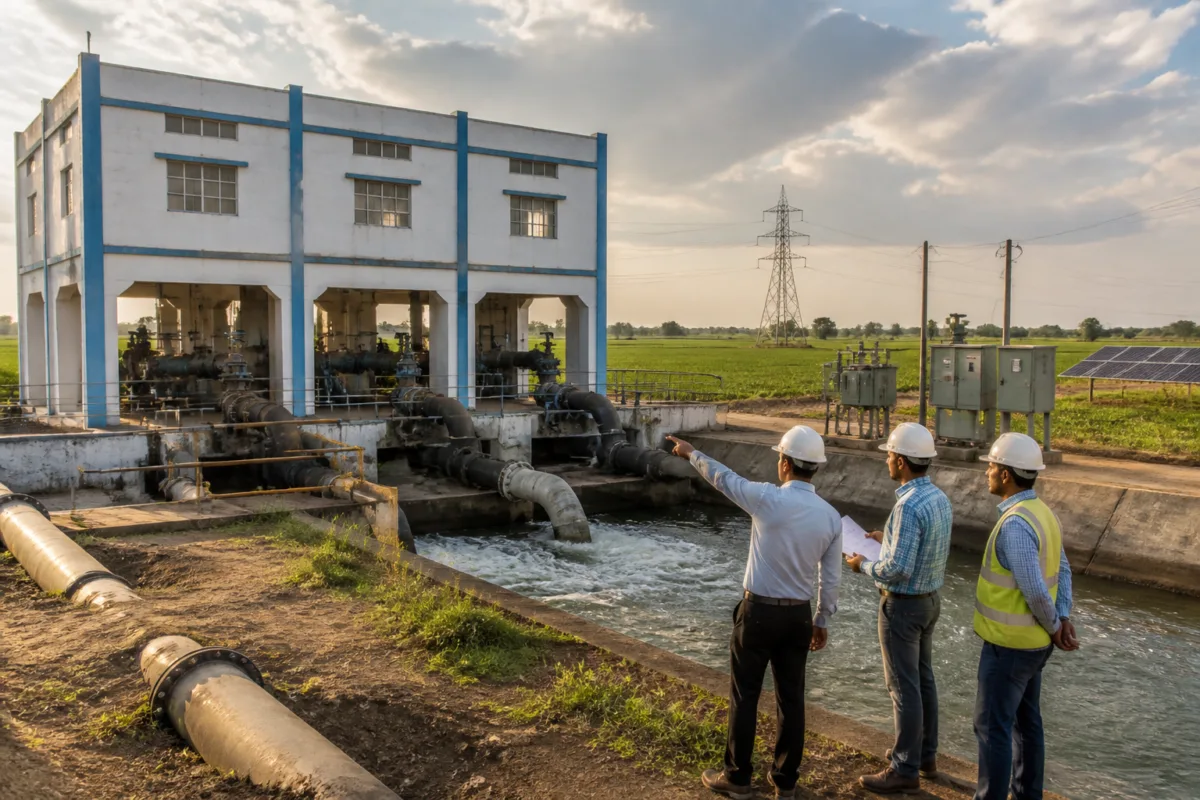
The Andhra Pradesh government will spend an estimated Rs 632.07 crore to restore 789 defunct lift irrigation schemes and make them operational before the next kharif season, Chief Minister N Chandrababu Naidu directed officials during a review of irrigation projects.
The restoration works are expected to improve irrigation facilities for 7.4 lakh acres of land, according to officials cited during the meeting. Naidu instructed the Water Resources Department to inspect the condition of the schemes at field level, invite tenders immediately and begin repairs without delay.
Officials were directed to complete the repairs by June next year. The government’s plan covers lift irrigation schemes that are currently defunct, although the report did not specify how many schemes require electrical, mechanical or civil repairs, or provide a district-wise breakdown of the restoration programme.
Naidu proposed assigning the continuous monitoring and maintenance of the schemes to the Jalaharathi Corporation. He also asked officials to establish a dedicated division for this work and consider appointing a Chief Engineer or Superintending Engineer in every district to supervise the restoration process. Departments were instructed to coordinate with one another during implementation.
The review also examined the use of government irrigation land for renewable energy generation. Officials said 4,171 acres could be used to establish solar power plants with a combined generation capacity of 903.1 MW. Of the 5,565 acres available under the Water Resources Department, 4,061 acres have been identified for solar installations with a potential capacity of 877.3 MW.
In addition, 110 acres spread across 84 locations under the Irrigation Development Corporation could support solar projects with a combined capacity of 25.8 MW. Naidu asked officials to explore solar and hydropower generation opportunities over canals, as well as the use of available land for energy projects.
The chief minister also directed officials to prepare a plan for uninterrupted electricity supply to lift irrigation schemes during the agricultural season and examine whether surplus power could be sold to the grid. Lift irrigation systems depend on electric pumping to move water across differences in elevation, making reliable power supply and maintenance central to their operation.
The meeting also considered a proposal to examine a Water Regulatory Commission on the lines of the Electricity Regulatory Commission. Naidu said such a mechanism could regulate water use across irrigation, industries, power generation and transport, including allocation questions connected to major initiatives such as the Ganga-Cauvery river-linking project.
Separately, Naidu assured officials that funds would be released without delay for 36 irrigation projects identified as government priorities. He directed them to complete these projects within the next two and a half years. The immediate milestone for the lift irrigation programme is the completion of the proposed repairs by June next year, ahead of the targeted kharif-season operations.

