


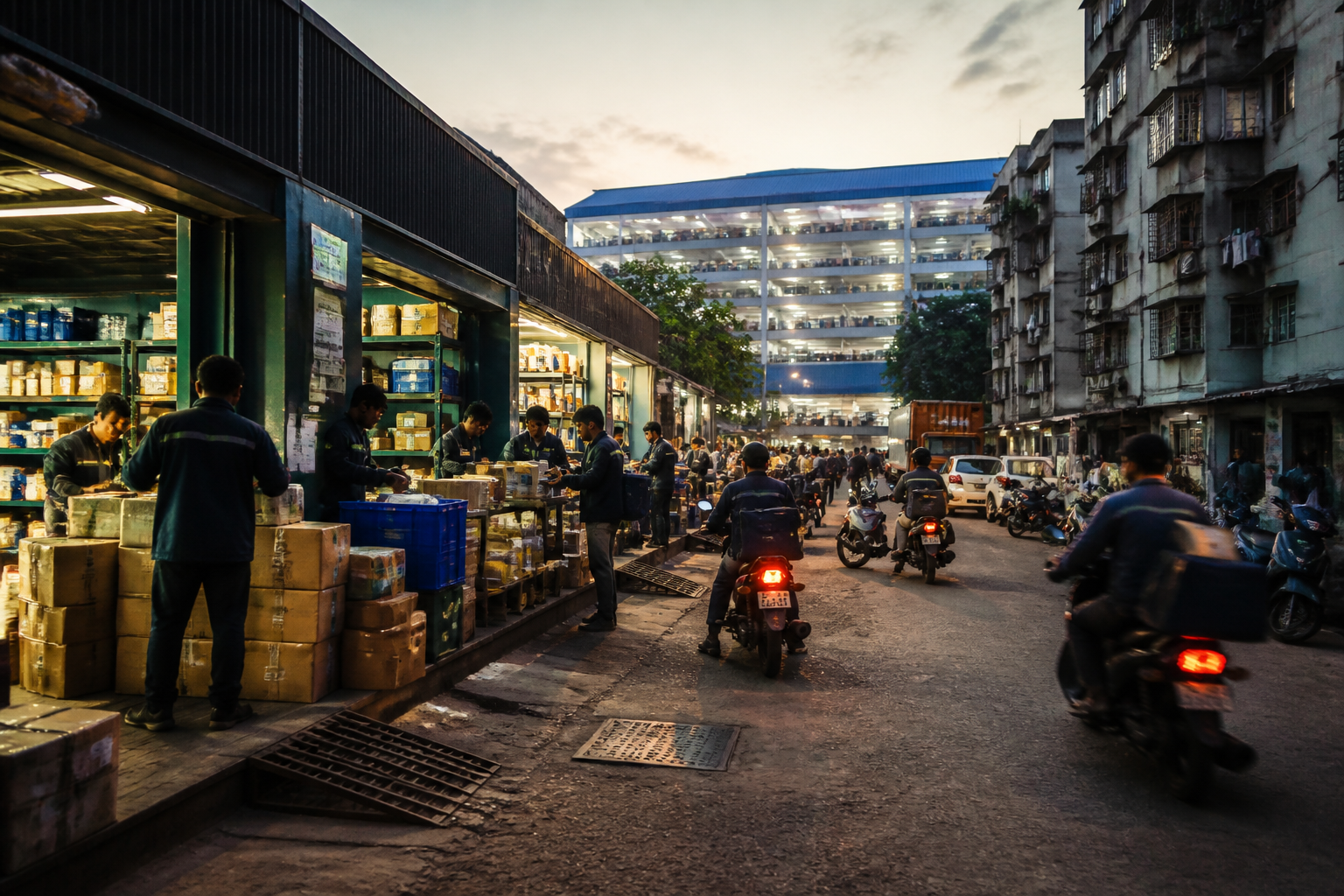
Amazon’s quick-commerce business has crossed a $1 billion annualised gross sales run rate in India, but the larger development is the physical network being built behind that milestone. Amazon Now has expanded to more than 60 cities, is targeting 100 cities by Diwali and is supported by more than 750 micro-fulfilment and urban fulfilment centres, according to Samir Kumar, Country Manager, Amazon India. The expansion places neighbourhood-scale logistics at the centre of Amazon’s India strategy.
The company’s announcement brings together three parts of the urban economy that are often discussed separately: consumer delivery, logistics real estate and digital commerce. Amazon is opening 20 fulfilment centres, six sort centres and 150 delivery stations across 118 cities for the festive season. It is also expanding its existing physical fulfilment network as part of a broader investment plan. These facilities are not simply back-end warehouses. Their location, operating hours and connection to delivery routes influence how goods move through cities and how quickly consumers can access them.
Amazon said its overall India commitment is $48 billion, with $21 billion committed to cloud and artificial intelligence data centres. The company has not disclosed in the supplied material how much of the wider commitment is specifically allocated to Amazon Now or to physical logistics infrastructure. That distinction matters because data centres, fulfilment centres, sort centres, delivery stations and micro-fulfilment facilities serve different functions and have different effects on urban land, energy use, transport demand and employment.
Amazon Now’s expansion also signals a change in the geography of online retail. The service covered more than 60 cities at the time of the company’s statement, four times the number it covered less than 10 weeks earlier. It is on track, the company said, to reach 100 cities by Diwali. Orders have doubled every quarter since launch, making Amazon Now the fastest-growing e-commerce business unit in Amazon India’s history, according to the company.
Those figures describe a rapid commercial rollout, but they also point to a more distributed model of urban storage. Traditional e-commerce depends heavily on larger fulfilment facilities, sorting infrastructure and delivery networks that connect cities and neighbourhoods. Quick-commerce requires inventory to be positioned closer to the customer, so that an order can be assembled and dispatched within minutes or a few hours. Amazon’s reference to more than 750 micro-fulfilment and urban fulfilment centres indicates the scale of that localised network, although the company has not provided a city-by-city breakdown in the supplied report.
This makes logistics real estate an increasingly important part of the urban built environment. A micro-fulfilment centre may occupy less space than a conventional warehouse, but a large network of such facilities creates a different pattern of land use. Storage is distributed across urban areas, while delivery activity is concentrated around dense customer clusters. The consequences can include more frequent short-distance trips, changing demand for commercial premises and greater pressure on loading, parking and access in neighbourhoods. The available information establishes the expansion of the network, but does not quantify its traffic, land or employment impact.
Amazon is positioning Now as an extension of its broader e-commerce proposition rather than as a standalone quick-commerce service. The company plans to offer tens of thousands of products within minutes or a few hours, more than one million products through same-day delivery and more than four million products the next day. The distinction is significant: Amazon is describing a tiered delivery system rather than a single-speed service. Different types of inventory would move through different layers of the network, from nearby urban facilities to larger fulfilment and sorting centres.
This approach also connects speed with product selection. Quick-commerce networks have often been associated with a limited range of frequently purchased goods, but Amazon says it wants to offer the largest assortment possible for minutes delivery. The company’s strategy therefore depends on balancing two competing logistics requirements: holding enough inventory close to consumers to make rapid delivery possible, while maintaining a broad enough selection to make the service useful beyond a narrow group of everyday products.
The company’s claim that Amazon Now has crossed $1 billion in annualised gross sales is a run-rate measure, not a disclosure of completed annual revenue. It reflects the pace of sales over the past three months when projected across a year. The figure is therefore best understood as an indicator of current momentum rather than a final measure of the business’s yearly performance. The source material does not provide profitability, order-value, delivery-cost or city-level sales data, so it cannot establish whether the expansion is economically sustainable in each market.
Amazon’s wider India strategy is also built around a much larger seller and technology base. The company said it added 3,00,000 sellers to its marketplace this year, taking the total seller base to two million. More than 2,00,000 sellers in India have adopted Amazon’s generative AI tools, while the company expects shopping to become increasingly personalised through AI-powered assistants and agents.
For cities, the seller figures matter because marketplace growth can generate additional demand for packaging, warehousing, transport and last-mile services. Yet the supplied report does not identify where the new sellers are located, how much of their merchandise is routed through Amazon’s physical network or whether the growth is concentrated in metropolitan areas or smaller cities. Amazon’s stated interest in value commerce and smaller-city consumers suggests a broadening market, but it does not by itself show how the company’s logistics footprint is distributed.
The expansion of Amazon Bazaar is part of that effort. Kumar said the company is seeking to deepen its presence in value commerce and argued that value-conscious customers are present in both metropolitan and non-metropolitan markets. That positioning places the quick-commerce and marketplace strategies within a wider attempt to bring more consumers and sellers into online retail. It also means that the infrastructure challenge is not limited to India’s largest urban centres. If the service reaches 100 cities, the company will need to operate across markets with different densities, road conditions, commercial rents, consumption patterns and delivery economics.
The institutional questions behind this growth remain largely outside the company’s announcement. The supplied material does not specify whether Amazon Now facilities are located in warehouses, retail premises or other commercial properties, nor does it identify the permissions, land-use rules or local operating conditions governing them. It also does not state how municipalities are responding to the growth of micro-fulfilment centres and delivery stations. These details will determine whether rapid delivery is absorbed into existing urban systems or creates new points of conflict over space, traffic and regulation.
The same gap applies to infrastructure impacts. Amazon has announced a substantial expansion of facilities across cities, but there are no figures in the supplied report on delivery fleet size, vehicle kilometres, electricity consumption, packaging volumes or worker numbers. Nor is there information on whether the company is using electric vehicles or other measures to reduce the environmental burden of last-mile delivery. Without such data, the urban consequences of the expansion can be identified as questions for monitoring, but not measured as established outcomes.
What the announcement does establish is a shift in the scale and speed of private urban logistics. Amazon is adding large facilities for seasonal demand while simultaneously building a dense network of smaller fulfilment points. The company is also linking that network to a broad product catalogue, a growing seller base and AI-enabled marketplace tools. Together, these moves suggest that online retail competition is increasingly being fought through physical proximity as much as through prices or digital interfaces.
The central urban question is whether cities have the planning and data systems to understand this new layer of commerce. A delivery promise of minutes or a few hours depends on where inventory is stored, how roads and buildings are accessed, how workers and vehicles move, and how demand is forecast. Those are built-environment and governance questions, not only technology or retail questions. Amazon’s figures show that the network is expanding rapidly; they do not yet show how cities are accommodating it.
For now, the confirmed milestones are the company’s $1 billion annualised gross sales run rate for Amazon Now, its presence in more than 60 cities, more than 750 micro-fulfilment and urban fulfilment centres, and its stated target of 100 cities by Diwali. The next evidence to watch will be the geographic distribution of those facilities, the company’s operational and financial disclosures, and the response of local authorities as quick-commerce becomes a more visible part of India’s urban infrastructure.
