


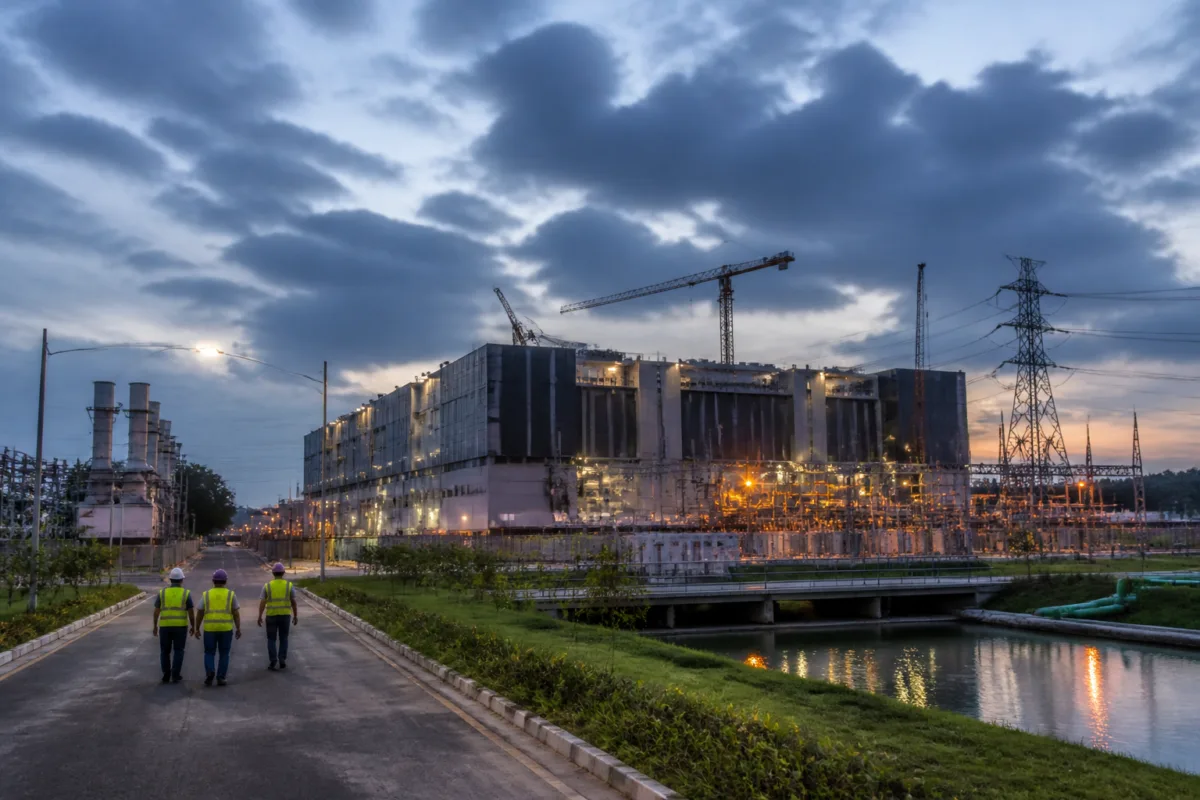
Amazon’s latest results show that the artificial intelligence boom is no longer only a technology or financial story. It is also becoming an infrastructure story, as the company prepares to spend at least $220 billion in 2026, largely on AI data centres and related technology infrastructure. The scale of that investment is exposing a tension at the centre of the current expansion: demand for computing capacity is accelerating, but the financial and physical systems needed to support it are under growing pressure.
Amazon shares fell as much as 7% in after-hours trading after the company reported third-quarter results that missed Wall Street expectations and offered a cautious outlook for the crucial holiday quarter. The fall came despite strong growth at Amazon Web Services, the company’s cloud computing division. AWS revenue rose 39% year on year to $46 billion in the quarter ended September 30, its fastest growth in nearly five years.
The market reaction underlines the changing economics of large-scale digital infrastructure. Cloud growth is no longer being assessed only through revenue expansion. Investors are also examining the cost of adding data-centre capacity, purchasing AI chips, expanding power-intensive facilities and converting that spending into cash generation. Amazon’s capital expenditure during the quarter reached $77.26 billion, about $20 billion above estimates compiled by LSEG.
That spending is taking place against a business that remains profitable and continues to grow. Amazon reported third-quarter net sales of $201.94 billion, up from $180.17 billion a year earlier. Net income, however, declined to $20.69 billion, or $1.89 per share, from $21.19 billion, or $1.95 per share, in the year-ago period. Analysts had expected earnings of $1.97 per share on revenue of $202.2 billion, according to FactSet.
The difference between operational growth and cash generation is central to understanding the infrastructure challenge. Amazon reported a trailing 12-month cash burn of $42.4 billion in the September quarter, driven by heavy capital expenditure. Dave Wagner, a portfolio manager at Aptus Capital Advisors, said the company’s operating cash generation was outweighed by capital spending. His assessment captured the concern that even strong demand may not immediately compensate for the cost of building the physical systems required to serve it.
Data centres are often discussed as invisible digital infrastructure, but they are large urban and regional projects. They require land, buildings, power connections, cooling systems, fibre links, roads, security arrangements and skilled maintenance workers. Their operation also depends on reliable electricity and, depending on the cooling design and local conditions, access to water. As Amazon expands its footprint, the financial question of capital expenditure is therefore connected to a wider question about how cities and utilities absorb concentrated infrastructure demand.
The company’s investment plans indicate that this demand is not expected to ease soon. Amazon has forecast capital expenditure of $220 billion for 2026, while chief executive Andy Jassy told analysts that spending would be “meaningfully more” next year without providing a specific figure. Jassy said AWS could become a business generating more than $1 trillion in annual revenue within five to 10 years and said customer demand for AI infrastructure remained strong.
That expectation is driving a construction cycle in which the timing of supply matters. AI services require computing capacity before their revenues are fully visible. Companies therefore have to build or secure infrastructure ahead of confirmed long-term returns. For data-centre markets, this can mean that investment decisions are shaped not only by present demand but also by expectations of future cloud and AI usage. The supplied results do not establish whether Amazon’s forecast spending will produce the returns investors expect, but they show the scale of the commitment being made before that outcome is known.
The physical concentration of this investment also creates a governance issue. Amazon said earlier this month that it would invest more than $1 billion over five years in communities where it operates data centres. The proposed areas of support include education, job training, water conservation and energy-related initiatives. These commitments acknowledge that data-centre expansion affects more than the company’s balance sheet and that local communities may need support as the infrastructure footprint grows.
However, the company’s announcement does not, in the supplied material, specify how the investment will be allocated, which communities will receive funding, or how outcomes will be measured. It also does not establish whether the spending will offset the full local requirements associated with data-centre development. Those details matter because the public costs and benefits of digital infrastructure are distributed locally, while the revenues generated by cloud services can be global.
The energy dimension is especially important. Amazon’s data-centre expansion is part of a wider technology-industry race to build facilities and deploy AI chips. The report notes that Alphabet shares fell 12% after investors reacted to rising expenditure on property and equipment, while Microsoft lowered its capital expenditure outlook to $170 billion from $175 billion. These developments suggest that the issue is not limited to one company. Major technology firms are making large infrastructure commitments at the same time, potentially increasing competition for power, land, construction capacity and equipment.
The available evidence does not quantify the energy or water demand of Amazon’s planned facilities, nor does it identify the locations of the additional data centres. It does, however, establish the direction of travel: more computing demand is producing more physical infrastructure spending, and that spending is large enough to alter company-wide cash-flow profiles. For urban authorities and utilities, the challenge is to evaluate such projects as infrastructure systems rather than as conventional commercial buildings.
Amazon’s other businesses provide a useful contrast. Its advertising division recorded revenue of $19.6 billion, up 12%, but missed analysts’ expectation for 18% growth. The company attributed some of the weakness to the timing of its Prime Day shopping event. Its fourth-quarter revenue forecast of $240 billion to $247 billion, with a midpoint of $243.5 billion, was slightly below analysts’ estimate of $244.51 billion.
These figures help explain why investors focused so heavily on capital intensity. Amazon’s retail and advertising operations continue to generate substantial revenue, while AWS is expanding rapidly. Yet the company’s infrastructure requirements are growing at a pace that makes the cost of expansion impossible to treat as a secondary issue. The result is a business in which cloud demand can be strong and still produce anxiety if the investment needed to meet that demand absorbs too much cash.
For the built environment, this changes the meaning of a data centre. It is not simply a technology asset placed inside an industrial or commercial zone. It is a long-term claim on infrastructure capacity, requiring coordination between the operator, power providers, local governments, construction contractors and surrounding communities. Decisions about approvals, utility connections, water conservation, transport access and workforce development can influence whether the facility functions as a regional economic asset or becomes a source of pressure on existing systems.
The report provides one example of how companies are beginning to respond to that social and infrastructure dimension. Amazon’s planned $1 billion community investment includes water conservation and energy-related initiatives alongside education and job training. The inclusion of these areas indicates that the company recognises local acceptance and infrastructure resilience as part of the expansion challenge. The material supplied does not provide enough detail to assess the programme’s effectiveness or compare it with the scale of Amazon’s capital expenditure.
The larger urban question is therefore not whether AI will require more data centres. Amazon’s spending plans and AWS growth show that the build-out is already underway. The more consequential question is how this expansion will be planned, financed and governed in places where power, water, land and construction capacity are limited. The financial market’s reaction makes the cost visible to investors; the infrastructure footprint will make it visible to communities.
Amazon’s results confirm three facts: AWS demand is accelerating, AI-related capital spending is rising sharply, and the spending is placing pressure on cash generation. They do not yet establish whether the projected infrastructure investment will produce the returns expected by the company or its investors. The next developments to watch are Amazon’s fuller 2026 capital-expenditure figure, the locations and specifications of new data centres, and the implementation of its community, water and energy initiatives.

