


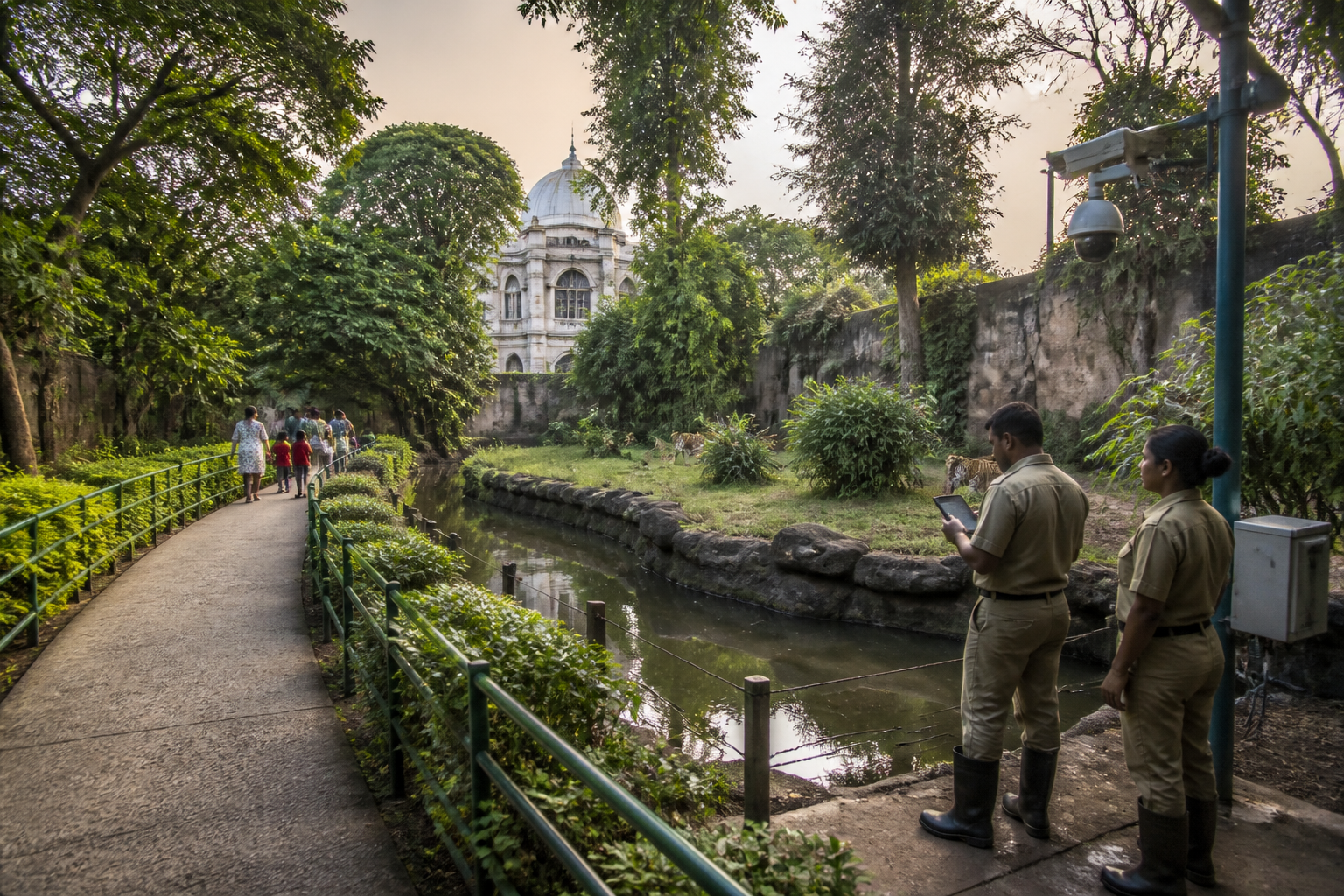
The proposed transformation of Kolkata’s Alipore Zoological Garden is more than a visitor-facility upgrade. It signals an attempt to recast a 151-year-old urban zoo as an institution built around animal welfare, conservation education and stronger administrative control, while retaining the public access that has long defined its role in the city.
The West Bengal government’s plan involves redesigning animal enclosures, improving visitor-facing facilities, upgrading monitoring systems and training zoo personnel. The stated objective is to allow visitors to understand how animals live and behave, rather than simply view them behind barriers. That shift places the zoo within a wider institutional question: how can a historic public attraction adapt its physical infrastructure and management systems to contemporary expectations of animal care?
West Bengal Forest Minister Manoj Kumar Oraon told The Statesman that the government wants the zoo to provide an “immersive experience” in which visitors can see and learn about animals. He said enclosures were being redesigned to replicate natural habitats as much as possible, with animal comfort and safety treated as priorities.
The approach is already visible in work under way for hyenas, Indian wolves, wild dogs and jackals, according to a senior forest department official posted at the zoo. Refurbishment is also being carried out around reptile facilities, including the wet moat and keeper passages. These projects connect the visitor experience to the less visible infrastructure that makes a zoo function: animal-care routes, enclosure maintenance, staff access and systems for observing individual animals.
That connection is important because a naturalistic enclosure is not simply a visual improvement. The zoo authorities say the redesigned spaces are intended to provide surroundings and enrichment more closely suited to the animals’ natural behaviour. For visitors, the physical setting can make animal behaviour easier to understand. For zoo staff, however, the model requires careful monitoring, specialised care and operating procedures that support both safety and welfare.
The Alipore project therefore combines two different kinds of modernisation. One is visible to the public: redesigned enclosures, improved facilities and the possibility of a more immersive route through the zoo. The other is administrative: animal identification, record-keeping, surveillance, caregiver training and veterinary cooperation. The second category may be less prominent in promotional descriptions, but it is central to whether the first can be trusted.
According to the report, the zoo is procuring transponders for animals to strengthen identification and tracking. Authorities are also strengthening surveillance across the premises and arranging specialised training for animal-care personnel. A more reliable system for identifying individual animals can improve records and make it easier to monitor changes in the collection over time. It can also help connect day-to-day care with formal inventory and reporting processes.
This administrative dimension carries particular significance because the zoo faced questions over an alleged discrepancy of 321 animals between its reported closing inventory for 2023-24 and opening inventory for 2024-25, based on figures cited from the Central Zoo Authority’s annual inventory. The Central Zoo Authority subsequently initiated an inquiry. Alipore Zoo authorities attributed the discrepancy to record-keeping or computing issues, while the matter remained under inquiry.
The report does not establish the outcome of that inquiry. It does, however, show why identification and record systems have become a stated component of the modernisation programme. In a zoological garden, the animal register is not merely an administrative document. It is part of the institution’s accountability structure, connecting individual animals to care, movement, mortality, births, transfers and official reporting. The proposed use of transponders and strengthened monitoring is consequently relevant to governance as much as to technology.
The programme also includes changes in how staff work with animals. Earlier this year, the zoo conducted a four-day behavioural enrichment and co-operative-care programme for northern giraffes. The programme focused on positive reinforcement, behavioural training and procedures intended to enable veterinary care with greater cooperation from the animals. This suggests an approach in which animal care is not limited to feeding and enclosure maintenance, but includes methods for reducing stress during routine management and treatment.
Such training also shows why the success of a zoo redesign cannot be assessed only by looking at new walls, moats or viewing areas. The physical enclosure, the keeper passage, the animal-monitoring system and the skills of the caregiving team operate together. If any one of these elements remains weak, the visitor-facing transformation may not deliver the welfare and educational goals described by the authorities.
The education component is being expanded alongside the infrastructure work. Recent programmes have included interactive activities on crocodile conservation and sessions intended to help visitors and students understand animal behaviour and wildlife conservation. The zoo is also developing a Zoo Ranger Programme to give students a closer understanding of wildlife and zoo management, according to the official cited in the report.
This changes the role of the zoo within Kolkata’s public-space network. A traditional zoo primarily offers proximity to animals. A conservation-oriented zoo also offers interpretation: explanations of habitats, behaviour, threats and management. The distinction matters because the educational value of a visit depends not only on what species are present, but on whether the institution helps visitors understand them beyond the moment of observation.
The proposed modern aquarium and marine museum in the Alipore area could extend that educational function. The planned facility is envisaged as an immersive aquatic experience with an underwater viewing tunnel, panoramic viewing areas and interactive displays on marine and aquatic biodiversity. If developed, it would add an aquatic component to the area’s wildlife and conservation offer.
The available information does not establish the aquarium’s construction timeline, funding arrangement, final design or operational model. Its significance at this stage is therefore best understood as part of the government’s stated ambition to build a broader wildlife-learning experience in Alipore, rather than as an operational facility. The distinction between a proposal and a completed public asset will be important as the project progresses.
The policy challenge for Alipore Zoo is to balance heritage with change. The minister described it as a heritage zoo and said the government was trying to modify its enclosures to the best of its ability. That acknowledgement points to a practical constraint: a historic institution cannot necessarily be rebuilt from scratch. Modernisation must be fitted into an existing site, with existing circulation patterns, structures and public expectations.
At the same time, heritage status cannot by itself resolve questions about animal welfare, surveillance or documentation. The authorities’ own programme recognises that the institution needs upgrades in all these areas. The most meaningful test will be whether the new systems become routine operating practices rather than remaining isolated projects associated with a makeover.
For Kolkata’s residents, the outcome will be experienced at several levels. Visitors may encounter more naturalistic enclosures and more information about wildlife. Children and students may gain access to structured conservation programmes. Zoo staff may work with improved training and monitoring tools. Animals, according to the stated objective, may receive greater enrichment and surroundings better suited to their behaviour.
The evidence supplied so far confirms an active modernisation effort, but it does not establish the completion status of every component or the outcome of the earlier inventory inquiry. Those are material points for future assessment. The next stage will require attention to how enclosure work, animal identification, surveillance, staff training and educational programming are implemented together.
Alipore Zoo’s proposed makeover is therefore best read as an institutional transition rather than a cosmetic renovation. Its success will depend on whether the heritage zoo can make its public spaces more engaging while making its internal systems more reliable, its animal-care practices more specialised and its conservation purpose more visible to the city it serves.
