


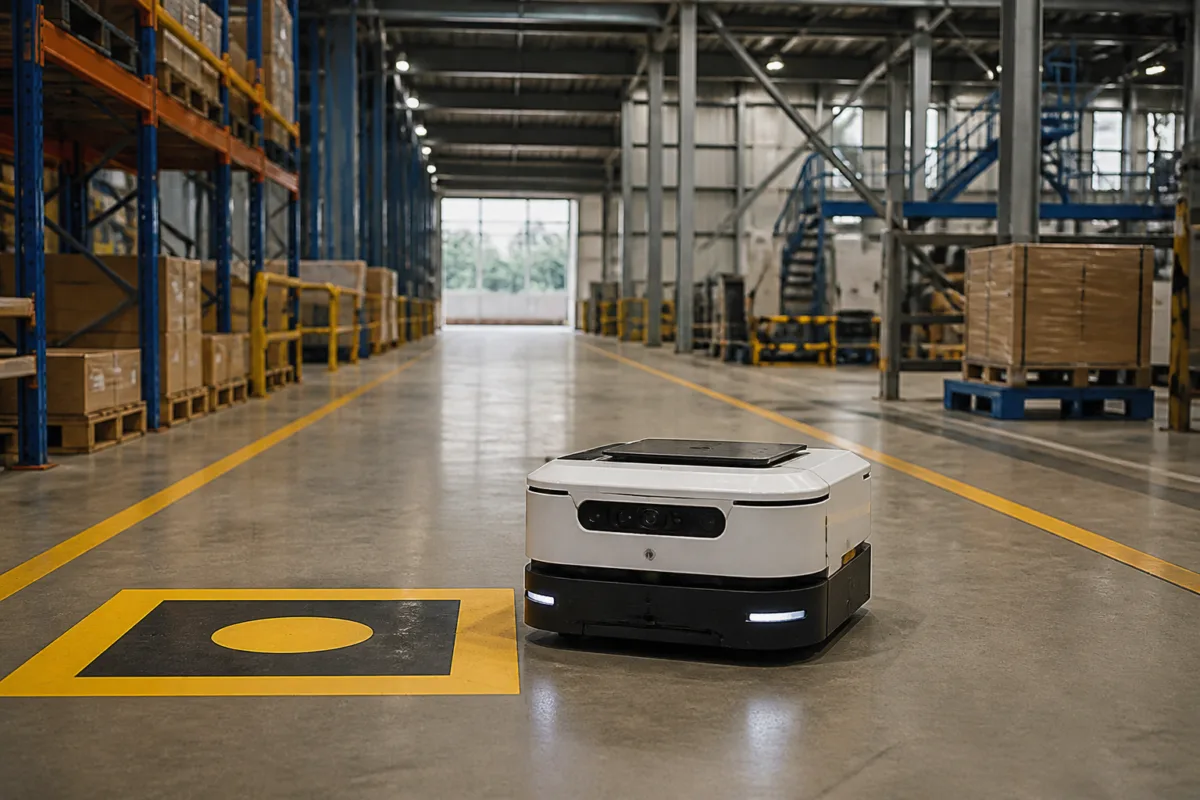
An autonomous mobile robot has reached a target on a factory floor using camera images and AI-based 3D reconstruction, in a demonstration by the International Institute of Information Technology Hyderabad (IIIT-H) and Ati Robotics that tested navigation without conventional LiDAR maps.
The practical test built on research developed by IIIT-H’s Robotics Research Center and a partnership with Ati Robotics that began in 2023. The researchers examined whether robots could use visual cues, recognisable landmarks and artificial intelligence to locate themselves and plan routes without creating dense, detailed maps of their surroundings.
Prof. Madhava Krishna of IIIT-H’s Robotics Research Center said conventional LiDAR systems map surroundings and help robots estimate their position through simultaneous localisation and mapping, or SLAM. The approach tested by the IIIT-H team instead represents an environment through a smaller set of landmarks. In a warehouse, these could include areas near a door or opposite an elevator, rather than measurements covering every part of the floor.
The research also tested image-based navigation. Under this method, an operator can identify a destination by pointing to a pixel in an image instead of entering precise coordinates. The system then compares images to identify corresponding points in the physical environment, estimates their spatial relationships and assesses possible routes.
The work has been presented at international robotics and artificial intelligence forums, including the IEEE International Conference on Robotics and Automation, NeurIPS and the Conference on Robot Learning, according to Prof. Sourav Garg of the research centre.
IIIT-H has transferred code to Ati Robotics for testing and deployment in warehouse robots. The company has also adapted parts of the research into OccupancyReact, a LiDAR-based variant that is closer to its existing systems, indicating that the current deployment path combines new visual-navigation research with technologies already used by the company.
Ati Robotics said its immediate focus was on improving the final stages of robot movement, including docking, approaching pallets and manoeuvring through narrow spaces. These operations require precise movement inside working warehouses, where small time savings can accumulate across a shift. The demonstration therefore connects laboratory research with the operational demands of warehouse automation, although the supplied report does not specify a commercial rollout timeline or the number of robots involved in testing.

