


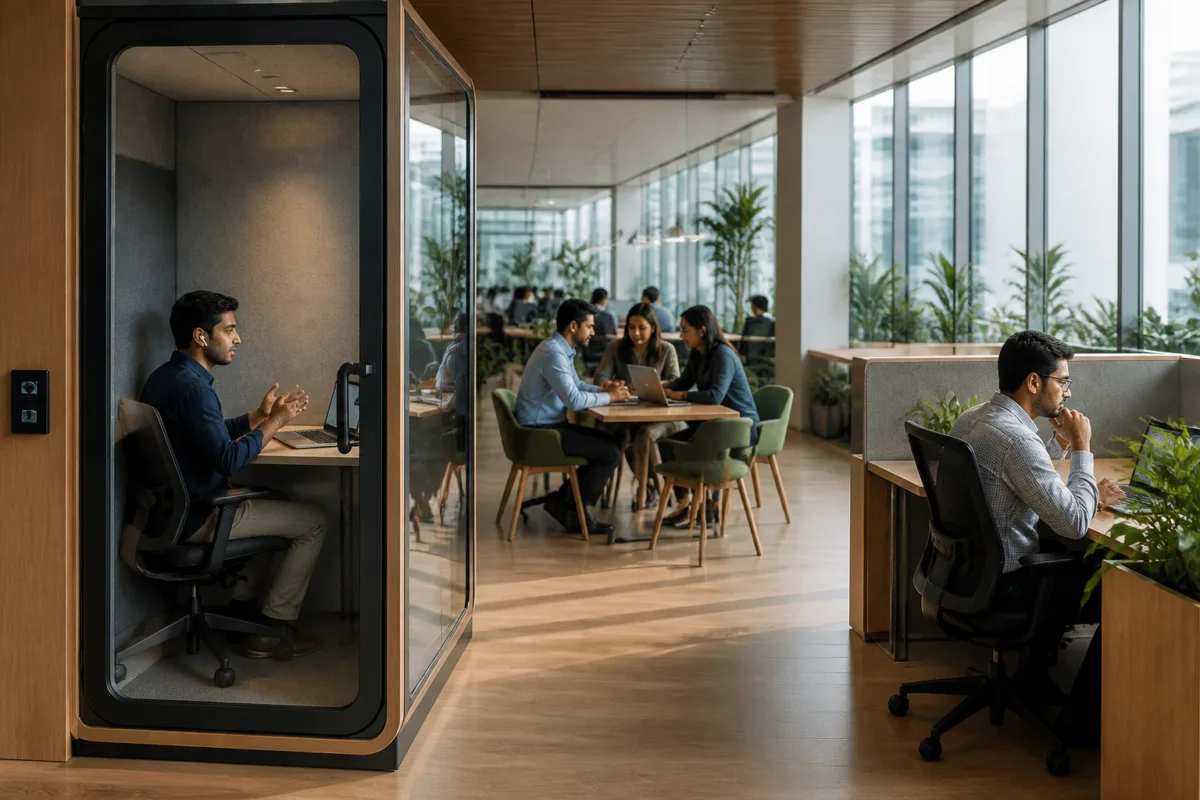
Artificial intelligence is changing how employees use offices in Asia Pacific faster than in the rest of the world, but the physical workplace is struggling to keep pace. A 2026 Steelcase survey of 5,438 office workers found that 47% of AI users in the region said AI had already changed how they use their office, compared with 35% globally. In India, the figure was higher at 58%.
The finding is significant not because it establishes a single model for the future office, but because it shows that workplace change is arriving unevenly. China reported the fastest shift, with 61% of AI users saying AI had changed how they use their office. India followed at 58%, while Japan recorded only 12%. These differences suggest that the office is not responding to AI through technology alone. The design, availability and distribution of physical spaces are also shaping how workers experience the transition.
Steelcase’s research points to a basic mismatch. Employees are being asked to work across more digital interactions, video calls and collaborative tasks, but many offices continue to organise space around individual desks. Across Asia Pacific, 43% of employees said they most commonly take video calls at their desks, even though 87% would prefer to take them somewhere else. At the same time, 61% said they cannot find privacy when they need it.
That combination creates a workplace problem that is easy to underestimate. A desk may be the most immediately available location for a call, but it is rarely designed to provide acoustic separation, confidentiality or freedom from interruption. The result, according to the survey, is background noise, overheard conversations and broken concentration for people taking part in the call as well as those working nearby.
Amber Matthews, Global Director, WorkSpace Futures Research at Steelcase, described the desk-based video call as a sign of a wider planning gap. “Taking a video call at your desk can seem like a small thing, but it reveals a bigger gap between how people work today and the spaces available to them,” she said. Matthews added that the issue was not simply technological, but reflected workplaces that had not kept pace with what employees needed to do their work.
The evidence matters for office owners, occupiers and designers because it shifts the question from how many desks a workplace can accommodate to what kinds of work those spaces can support. The survey’s central design finding is that employees who can choose from three or more types of office space report better outcomes than those with fewer options.
According to the Asia Pacific findings, access to three or more types of space is associated with a 20% improvement in reported wellbeing, compared with 13% globally. The reported improvement in engagement is 17%, against 14% globally. Productivity rises by 14%, compared with 8% globally, while sense of community rises by 21%, against 15% globally.
The survey does not establish that adding different rooms directly causes these outcomes. It reports a relationship between greater choice and higher reported wellbeing, engagement, productivity and community. That distinction is important for organisations making capital decisions, because the findings support a more varied workplace but do not provide a universal formula for the amount or type of space every office requires.
The relevant design implication is nevertheless clear. A workplace built mainly around desks may not provide adequate support for focused work, private calls, meetings, informal interaction and recovery. A more varied workplace can include quiet rooms, meeting areas, spaces for calls and places to recharge. Steelcase’s research identifies these choices as particularly important in Asia Pacific, where the gains associated with having more types of space are above the global averages for all four outcomes measured.
India presents a distinctive part of this picture. The survey found that 58% of AI users in India said AI had already changed how they use their office. At the same time, 83% of AI users in India said AI had increased their interactions with colleagues. That finding challenges the assumption that the adoption of AI necessarily makes office work more isolated. In the evidence supplied by the survey, AI use in India is associated with more interaction among colleagues, increasing the importance of spaces that can support collaboration without undermining privacy and concentration.
This is a different requirement from simply expanding shared work areas. If more interaction takes place through calls, digital tools and collaborative tasks, workers may need both visible communal spaces and places where conversations can happen without disruption. The survey’s India results therefore connect workplace technology with a physical planning challenge: offices must accommodate greater interaction while also allowing employees to withdraw from noise and interruption when the task requires it.
China illustrates another pressure. In that market, 59% of employees said they feel expected to complete tasks faster, compared with 39% globally. The survey describes China as the fastest-changing market in the region. A workplace in which employees face stronger expectations of speed may place greater pressure on circulation, meeting arrangements, digital infrastructure and access to spaces that support uninterrupted work. The supplied findings do not measure those individual design features separately, but they show why the relationship between productivity expectations and office configuration is becoming more important.
Japan presents a contrasting challenge. Only 12% of AI users there said AI had already changed how they use their office, yet 79% of employees said they cannot get the privacy they need when they need it. The result suggests that a slower pace of AI-related workplace change does not remove the need for office redesign. Privacy is a problem in its own right, and the survey indicates that the shortage can exist even where the reported workplace impact of AI is relatively limited.
The Asia Pacific results also expose a broader limitation in the way office performance is often discussed. Occupancy, desk counts and attendance requirements can be measured relatively easily. The quality of the spaces available for different tasks is harder to capture, but it affects how employees use the workplace once they arrive. A desk that is occupied is not necessarily a desk that is supporting productive work, particularly when it is being used for a call that requires privacy or when nearby workers are affected by noise.
This has practical relevance for organisations planning an office move, refurbishment or expansion. Steelcase says the findings matter for employers asking employees to spend more time in the office, but the survey does not prescribe a fixed ratio of desks to meeting rooms, phone booths or quiet spaces. Instead, it places emphasis on listening to employees in each market and providing a choice of spaces aligned with the work being performed.
That market-specific approach is important because the three countries covered in the Asia Pacific sample show different patterns. China combines the highest reported rate of AI-related change with stronger expectations of faster task completion. India records a high rate of AI-related change and a strong increase in colleague interactions. Japan reports a lower rate of AI-related change but a pronounced privacy gap. Treating the region as a single workplace market would obscure these differences.
The research also raises an institutional question about who carries the cost of adaptation. AI adoption can be introduced through software, devices and company policies, but the physical changes required to support new work patterns involve property decisions, fit-outs, space standards and ongoing facilities management. Employers may ask workers to return to offices or collaborate more frequently, while the usefulness of that time depends partly on whether the building offers spaces that home or desk-based work cannot provide.
For the built environment sector, this creates a shift in the value proposition of office space. The issue is not only whether a building can house employees, but whether its internal planning supports the different activities that bring employees into the workplace. The supplied survey does not assess specific buildings or office markets, so it cannot show how widespread these design gaps are across India. It does, however, provide a structured indication of the kinds of mismatch employees report.
The survey was conducted between 2 December 2025 and 13 January 2026 among active office workers in nine countries. The Asia Pacific sample included 1,778 respondents: 592 in China, 593 in India and 593 in Japan. These figures provide the basis for the market comparisons, while the wider sample provides the global benchmarks. The findings are published in Steelcase Research: Work Has Changed. Has Your Office? Asia Pacific 2026.
The evidence confirms that AI is changing office use at different speeds across Asia Pacific, and that the physical office is not automatically adapting at the same pace. In India, the strongest signal is the combination of high AI-related change and increased colleague interaction, alongside a regional shortage of privacy and alternative spaces for video calls. What remains uncertain is how these reported experiences vary by industry, city, building type and office size, since those breakdowns are not provided in the supplied material.
The immediate question for organisations planning workplaces is therefore not whether AI has arrived, but whether the office offers enough choice for the work that follows. The next stage of the discussion will depend on how employers translate these survey findings into space planning, refurbishment and occupancy decisions without assuming that one Asia Pacific model can serve every market.

