


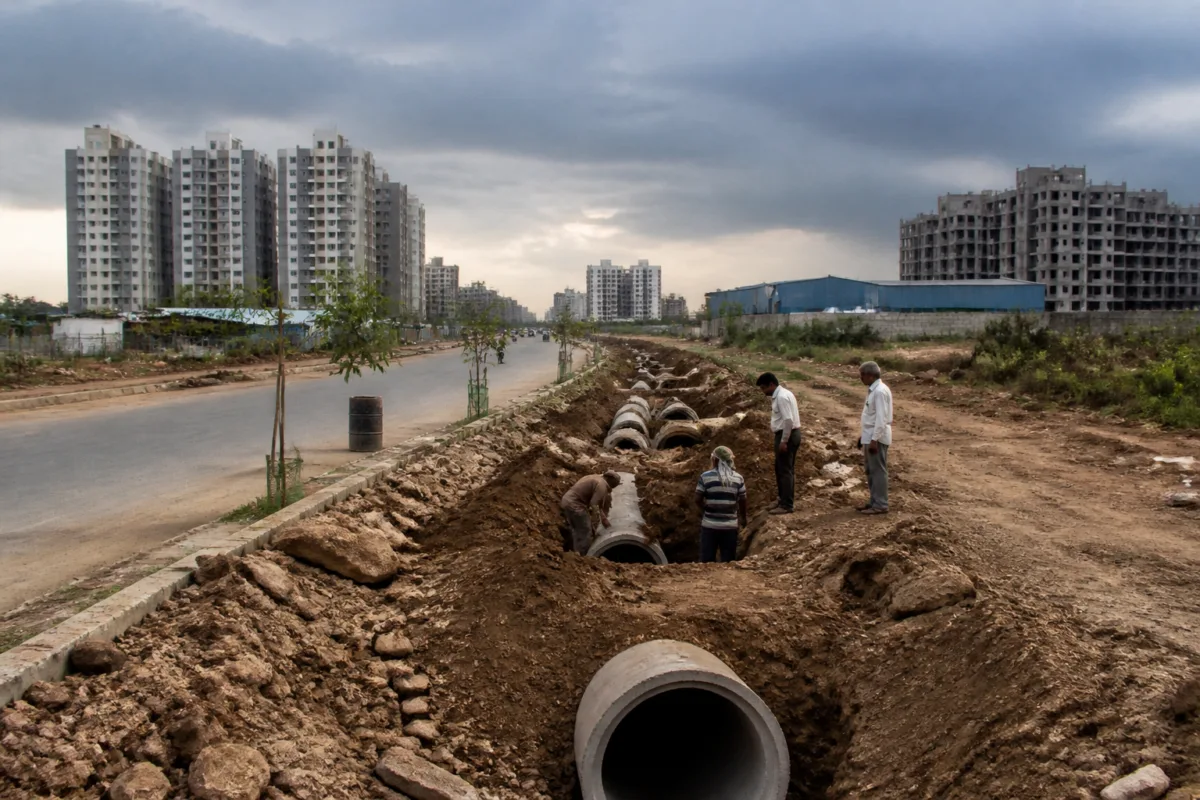
Ahmedabad’s proposed ₹42.47 crore drainage line project from Kathwada to the Odhav Traders Association area has exposed a larger infrastructure problem on the city’s eastern edge: new residential and industrial development is advancing faster than the sewage network and treatment capacity needed to support it. The project is intended to provide legal drainage connections to areas where residents and businesses still depend on old soak pits, but questions have emerged over where the additional sewage will ultimately go.
The proposal was prepared by the Ahmedabad Municipal Corporation’s East Zone engineering department and placed before the Water Committee and Standing Committee, according to a report by Nav Gujarat Samay. It covers Kathwada and adjoining areas included in Town Planning Schemes 111, 505, 414 and 415. The civic engineering department has argued that the main roads in the new town-planning schemes have been opened by the Estate Department, creating the conditions for a formal drainage network.
The immediate trigger is the pace of construction. The report says residential projects and industrial-shed-type structures are developing in TP Schemes 414 and 415. Bungalows and apartment schemes are also expanding in Kathwada village and the nearby Tableepara area. These locations, however, do not have a drainage-line network, leaving older soak pits in use. Representations from corporators, the local legislator and developers led the East Zone engineering department to commission a project estimated at about ₹43 crore. The proposal now puts the question of network expansion before the municipal approval process.
The controversy is not about whether the area needs drainage infrastructure. The report indicates that the need for formal connections is widely acknowledged. The unresolved question is whether the proposed line has a viable receiving system. During earlier discussions after Kathwada was brought within the municipal limits, civic engineers and ruling party office-bearers reportedly examined the possibility of carrying sewage towards an old Naroda-Narol line. That option was considered impractical, according to the report.
A second constraint concerns the 1,800-millimetre sewage line passing near the Odhav Traders Association area. The report says this line is already running full, raising doubts about whether sewage from Kathwada can be discharged into it without worsening existing pressure. It also states that the sewage treatment plants at Vinzol and Pirana are operating beyond capacity. These claims are central to the debate because a new collection line can only solve the first part of the sewage chain. If trunk infrastructure and treatment plants cannot receive additional flows, extending the local network could transfer the problem rather than resolve it.
This is the institutional distinction at the heart of the proposal. Local drainage lines collect sewage from individual properties and neighbourhoods. Trunk lines carry that flow across larger parts of the city, while sewage treatment plants are expected to process it before final disposal or reuse. A project that addresses only the first layer may provide visible connections but still leave the municipality without sufficient downstream capacity. The supplied report does not provide flow projections, design capacity, current utilisation figures or a technical assessment showing how much additional sewage the proposed line would generate.
The report also records a different option discussed by civic officials and municipal representatives. Former East Zone Water Committee chairman Dilip Bagariya said the discussions concluded that sewage from Kathwada and surrounding areas should preferably be taken towards Singarwa. Under that approach, land would be obtained around Kanbha for a new sewage treatment plant, and treated water would then be discharged into the Khari River. Bagariya said a process for land acquisition had also been initiated after the discussions.
That alternative indicates that the drainage question is linked to land, treatment and environmental management, not only to underground pipes. A new treatment plant would require a confirmed site, land acquisition, financing, technical design, construction and operating arrangements. The supplied report does not establish whether the proposed plant has received final approval, whether land has been secured, or how its cost and timeline relate to the ₹42.47 crore drainage-line proposal. It also does not state the proposed plant’s treatment capacity or the quality standards that would govern discharge into the Khari River.
The project’s geography explains why this debate has surfaced now. Kathwada and its surrounding areas are being absorbed into the city’s formal planning and service-delivery structure while development is already taking place on the ground. The inclusion of the area within municipal limits creates an expectation of legal and reliable civic connections. At the same time, town-planning schemes and newly opened roads do not automatically create the full utility network required to support construction. Roads may be available for laying pipes while downstream treatment systems remain constrained.
The conflict therefore reflects a familiar sequencing problem in expanding urban areas: development permissions, road formation and building activity can move ahead of water and sanitation capacity. In Kathwada, the municipal engineering department’s proposal is an attempt to close that gap. But the reported constraints on the Naroda-Narol line, the Odhav-area trunk line, and the Vinzol and Pirana treatment plants suggest that the project cannot be evaluated only by its construction cost or the length of the proposed network.
The available evidence does not show whether the ₹42.47 crore estimate includes only the local and main drainage lines or also any downstream treatment infrastructure. It also does not clarify the number of properties expected to receive connections, the projected sewage volume, the implementation period or the operating responsibility after completion. These details are important because the cost and feasibility of a network depend on the population and built-up area it is designed to serve, as well as the treatment destination available when the system becomes operational.
The proposal’s movement through the Water Committee and Standing Committee is the next administrative stage identified in the report. Approval at the committee level would not, by itself, resolve the larger capacity question. The municipality would still need to align the project with the receiving network, treatment infrastructure and any land requirements associated with the Singarwa-Kanbha option. Without that alignment, a new line could connect properties to a system whose downstream components remain overloaded.
The environmental dimension is equally significant. Bagariya’s account refers to treating the sewage before discharging treated water into the Khari River. That distinction matters: the proposal described in the report is not for releasing untreated sewage into the river, but the material supplied does not provide details on the proposed plant’s technology, standards, monitoring system or discharge conditions. Those would determine whether the river receives adequately treated water and whether the new arrangement creates a durable disposal route.
For residents, builders and businesses in Kathwada and Tableepara, the immediate issue is the absence of a formal drainage network despite expanding housing and commercial activity. For the Ahmedabad Municipal Corporation, the larger challenge is integrating newly urbanising areas without overloading infrastructure already serving established neighbourhoods. The project has consequently become a test of whether the city plans sewage collection, trunk transport, treatment and disposal as one connected system.
The evidence currently confirms that a drainage network is proposed, that existing downstream options have been questioned, and that a separate treatment-and-disposal strategy has been discussed. It does not yet establish which option has been finally approved or whether the technical and financial conditions for implementation are in place. The municipal committees’ consideration of the proposal, the status of land acquisition around Kanbha and the capacity plan for receiving and treating Kathwada’s sewage will determine whether the project becomes a functioning urban service or only a new link to an overstretched system.

