


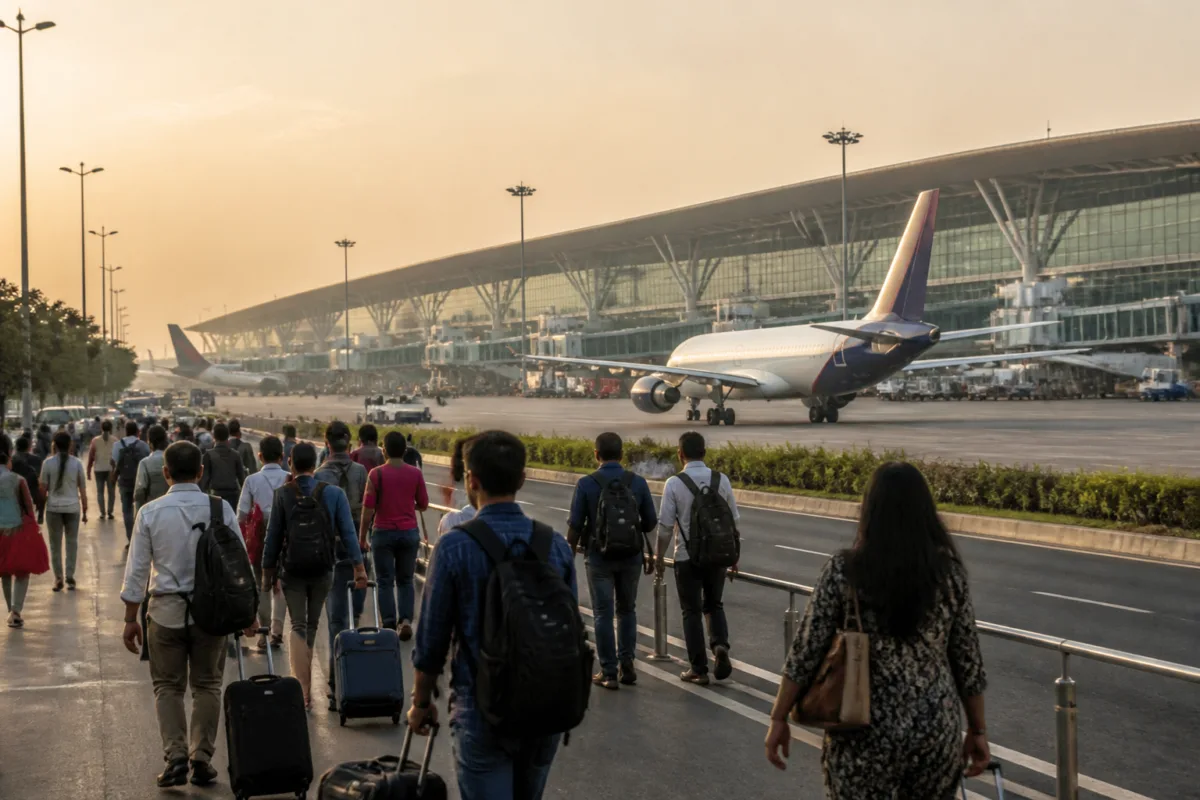
Ahmedabad’s airport is handling fewer flights than it did a year ago, even as domestic passenger demand has proved more resilient than the reduction in aircraft movements. The resulting capacity squeeze at Sardar Vallabhbhai Patel International Airport (SVPIA) is tightening travel choices before the festive season and may place further pressure on fares during high-demand dates.
The airport recorded 5,468 domestic aircraft movements in September, down 18% from 6,668 in the same month last year, according to figures reported by the Times of India. International movements fell 15.1%, from 1,249 to 1,060. The decline was not limited to a single month: during April-September, domestic aircraft movements fell 8.7% to 38,290 from 41,955 a year earlier, while international movements dropped 23.6% to 6,290 from 8,229.
These figures describe capacity, not simply passenger preference. An aircraft movement generally represents one arrival or departure, so a fall in movements indicates that fewer flight operations were available at the airport. Passenger traffic has also declined, but the scale of the domestic fall over six months was considerably smaller than the reduction in domestic movements. That difference is the most important signal in the data supplied with the report.
Domestic passenger numbers fell 9.2% in September to 7.5 lakh from 8.3 lakh. Yet across April-September, domestic passenger traffic declined only 2.3%, to 52.8 lakh from 54 lakh in the corresponding period. In other words, the airport saw a sharper contraction in aircraft movements than in the number of domestic passengers using it over the six-month period.
The pattern suggests that the available seats and flight options have contracted faster than underlying domestic travel demand. It does not establish the exact reasons for the reduction in operations, because the supplied report does not identify specific airlines, routes or airport decisions responsible for the change. It does, however, show that passengers are confronting a smaller flight schedule while demand has not fallen by an equivalent amount.
International connectivity has weakened more sharply on both measures. International passenger traffic fell 15.8% in September to 1.5 lakh from 1.8 lakh. For April-September, the international passenger tally declined 19.3% to 9.58 lakh from 11.8 lakh. This reduction is broadly consistent with the 23.6% fall in international aircraft movements during the same period, although the supplied data does not explain whether the change reflects route withdrawals, frequency reductions, aircraft deployment decisions or softer demand on particular corridors.
The timing makes the capacity issue more significant for passengers. The report says the winter schedule had been implemented, but the overall number of flights remained below last year’s level. This means the seasonal schedule has not, at least in the figures cited, restored the airport’s operations to the previous year’s position. For travellers, the practical consequence is fewer departure times and potentially fewer alternatives when a preferred flight is unavailable.
Travel industry commentary points to the pricing effect of that reduced flexibility. Travel expert Jigar Dudakiya said fewer flight options could increase demand for seats on high-demand routes and lead to higher fares, particularly for last-minute bookings and peak travel dates. He also said overall demand during Diwali week had softened, with some travellers choosing to fly before or after the festival to avoid peak airfare prices.
That observation highlights two different forms of passenger response. Some travellers may postpone or advance their journeys when fares become difficult to afford, reducing demand during the most expensive period. Others, including passengers tied to work, family events or fixed festival dates, may have limited ability to shift their travel. For the second group, a reduction in flight frequency can have a direct effect on both affordability and convenience.
The available data also shows why passenger totals alone can conceal a capacity problem. If passenger numbers decline only modestly while aircraft movements fall more substantially, flights may be operating with stronger occupancy, or passengers may be concentrating on the remaining services. The supplied report does not provide seat capacity, load factors, route-level schedules or fare comparisons, so it cannot establish which of these mechanisms is dominant. It does establish that passenger traffic has been more resilient than the airport’s operating volume, especially in the domestic market.
For Ahmedabad, this is an infrastructure and connectivity issue rather than only a seasonal airfare story. Airports function as networks linking residents, businesses and visitors to other cities and countries. A reduction in flights can affect the usefulness of that network even when the airport continues to handle millions of passengers. Fewer services may reduce schedule flexibility, make direct travel less convenient and increase dependence on a smaller number of high-demand departures.
The distinction between domestic and international traffic is also important for understanding the airport’s position. Domestic movements declined 8.7% in the first six months of the financial year, while international movements fell nearly three times as much in percentage terms, at 23.6%. International passenger traffic also recorded a larger six-month fall than domestic traffic: 19.3% compared with 2.3%. The numbers point to a more pronounced weakening of international connectivity, although they do not identify its operational causes.
Responsibility for the outcome is distributed across the aviation system. Airlines determine route networks, flight frequencies and aircraft deployment; passenger demand influences commercial decisions; and airport authorities manage the infrastructure through which those operations are handled. The supplied report does not attribute the fall to any one institution or provide an official explanation from SVPIA, an airline or a civil aviation authority. That limitation matters because aircraft movement data shows what changed, but not why it changed.
The figures nevertheless offer a clear basis for monitoring the airport through the festive and winter travel period. The key indicators are whether domestic and international movements recover, whether passenger traffic continues to exceed the rate of capacity decline, and whether travellers alter their booking patterns around peak dates. Route-level frequency, available seats and actual fare movements would be needed to measure the full effect on passengers.
What the evidence confirms is a mismatch between falling flight operations and comparatively resilient domestic passenger demand at Ahmedabad airport. The mismatch is smaller in international travel, where both movements and passengers have declined sharply. What remains unresolved is the institutional and commercial explanation for the reduced schedule. Until that is clearer, the immediate urban connectivity story is straightforward: Ahmedabad’s air network is offering fewer options at a time when many passengers still need to travel, leaving festival-period affordability and flexibility exposed to capacity constraints.

