


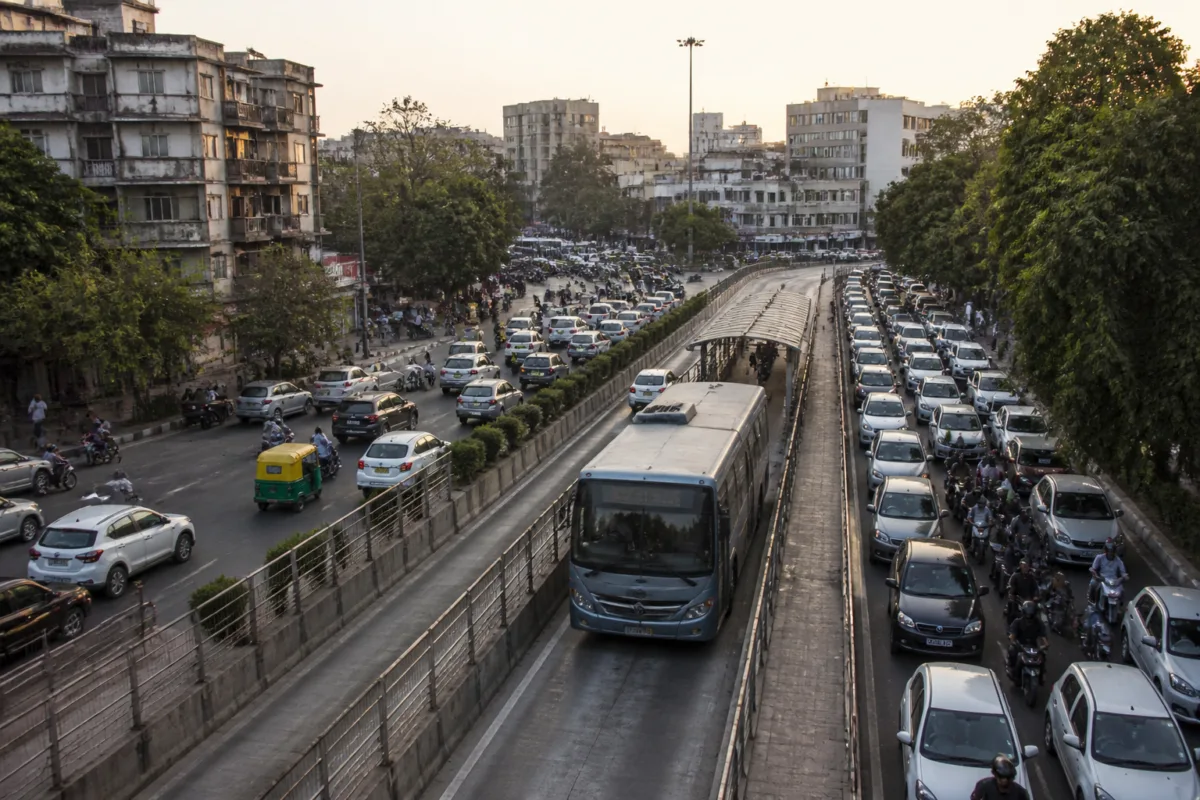
Ahmedabad’s debate over worsening traffic has turned towards the city’s bus rapid transit system (BRTS), with elected representatives from both the Bharatiya Janata Party and Congress seeking changes to, or removal of, some dedicated corridors. The demands have raised a wider question for the city: whether traffic congestion is being caused by BRTS road space, inadequate planning and traffic management, or the sharp growth in private vehicles.
According to a report by Nav Gujarat Samay, the issue was raised at a meeting of the BJP coordination committee and in a coordination meeting involving the municipal administration. Some representatives have sought the closure of BRTS corridors or the removal of their railings so that the space can be opened to general traffic.
The demand is particularly focused on stretches where roads are already narrow or where the available carriageway for other vehicles is perceived to have been reduced. The report identifies the route from Ellisbridge through Kalupur towards Shahpur, a single corridor in Maninagar, and the stretch from AEC Crossroads in Naranpura towards Sattadhar and the Sola Bridge as areas where complaints have persisted.
In Naranpura, BJP legislator Jitendrabhai Patel has reportedly sought the removal of BRTS railings on the road between AEC Crossroads and Bhuyangdev. The concern is linked to redevelopment in Naranpura Housing and nearby areas, where older buildings are being replaced by taller structures. The report says that once these projects are completed, more households and vehicles could add to pressure on the surrounding road network.
Congress legislator Imran Khedawala, representing Jamalpur-Khadia, has also argued that BRTS railings further restrict already narrow roads in the walled-city area. He has previously sought their removal from parts of the old city, according to the report. The emergence of similar demands from a BJP legislator has given additional political weight to the issue.
However, removing a dedicated lane does not by itself establish that congestion will be resolved. The municipal administration is reported to be concerned that accepting a corridor-removal demand in one area could lead to similar requests elsewhere, potentially weakening a citywide public-transport system built through substantial public expenditure. Officials are also reported to have questioned whether opening the space to mixed traffic would make a lasting difference while the number of vehicles continues to rise.
That distinction is important for Ahmedabad’s transport planning. A BRTS corridor uses road space, but it also reserves that space for buses intended to carry more people than individual cars or two-wheelers. Converting a dedicated lane into general traffic space may increase short-term flexibility for motorists on a particular stretch, while reducing the priority given to public transport. The outcome would depend on local road geometry, bus demand, junction design, enforcement and the availability of alternative routes—factors that cannot be settled through political claims alone.
The report also refers to an annual loss of about ₹93 crore associated with BRTS. This figure is presented as part of the ongoing discussion, not as a documented finding in the material available. A proper assessment would need to distinguish operating expenditure, fare revenue, municipal support, capital costs and wider public benefits. Public transport is not required to generate a commercial profit, but persistent financial pressure would still warrant scrutiny of ridership, route allocation, service frequency, maintenance and operating costs.
A corridor-by-corridor review would provide a more useful basis for decisions than treating BRTS as either wholly responsible for congestion or beyond criticism. Such a review would need to identify routes with strong passenger demand, sections where buses receive insufficient priority, locations where railings create demonstrable bottlenecks, and junctions where design or traffic management is the principal constraint.
Possible responses could include redesigning the median or railings, adjusting junction operations, changing traffic arrangements at particular times, improving bus operations, or modifying only those sections where evidence shows that the existing design is unsuitable. These options would preserve the possibility of targeted reform without automatically discarding the entire network.
For residents, the immediate issue is not simply whether a railing remains on a road. It is whether Ahmedabad can allocate limited street space in a way that reduces unreliable travel, protects access to public transport and accommodates redevelopment without allowing congestion to determine transport policy by default. The current debate points to the need for published, route-level evidence before the city makes irreversible changes to its BRTS infrastructure.

