


Ahmedabad’s latest municipal review has brought three everyday urban risks into the same administrative frame: rising dengue cases, worsening air quality and incomplete waste-management systems. The review by the Ahmedabad Municipal Corporation (AMC) commissioner did not produce a single new citywide statistic on any of these issues, but it revealed gaps in registration, monitoring, data access and public infrastructure that can limit the corporation’s ability to respond effectively.
The review covered bulk-waste generators, air-quality sensor data, construction dust, dengue cases, waste segregation along the Sabarmati Riverfront and wider civic complaints. It also included water-leakage complaints, repeatedly reopened grievances, street vending on roads and encroachments around lakes. Taken together, the issues show how urban administration depends not only on rules and equipment, but also on whether departments can identify sources, receive reliable data and close the loop with enforcement.
The most concrete gap emerged in the system for monitoring bulk waste generators. Ahmedabad has identified 5,848 establishments that generate more than 100 kilograms of waste a day. Officials told the commissioner that 5,399 of them had been registered. That leaves a difference of 449 establishments between the identified total and the registered count, although the review did not establish whether every unregistered unit was operating in violation of municipal requirements.
The commissioner sought more detail on the coverage of wedding party plots and hospitals, both of which can generate substantial volumes of waste. The review specifically noted that only two hospitals appeared in the count despite a large number of hospitals being located in the north-west and south-west zones. The available report does not say whether the two facilities represented a verified complete list, a partial survey or a classification issue. That uncertainty is important because registration is the basis for tracking waste generation, collection and disposal responsibilities.
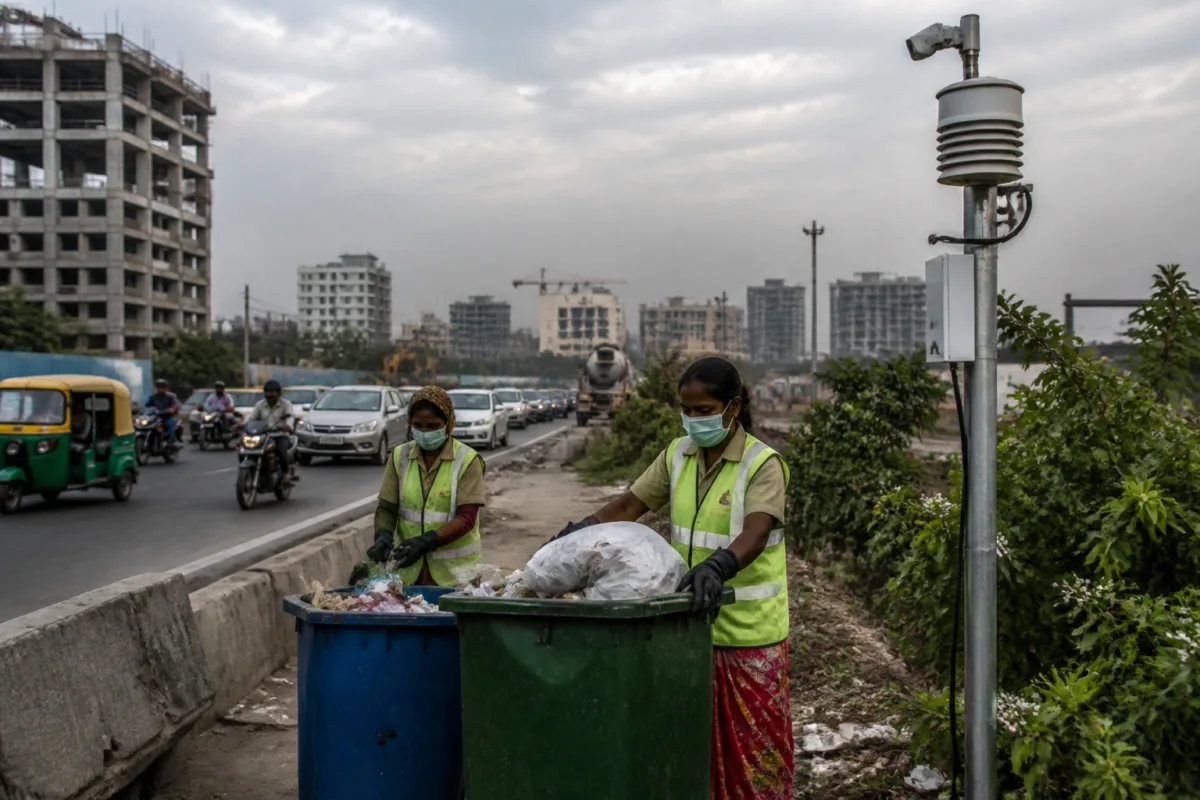
The AMC also reported that food waste from canteens in its own hospitals was being collected. At the same time, the review stressed the need for greater awareness among residents and sanitation workers about keeping wet and dry waste separate. This places waste segregation at two levels: households and public institutions must separate waste correctly, while the municipal system must provide the infrastructure and supervision needed to preserve that separation through collection and processing.
The Riverfront discussion illustrated the difference between citywide provision and location-level availability. Officials said around 2,000 four-bin units had been installed across the city, but no four-bin unit was available at the Sabarmati Riverfront location discussed during the review. The issue is not simply the number of bins installed across Ahmedabad. It is whether public places with high visitor movement have the right type of facility where waste is generated and whether those facilities are maintained and used as intended.
The air-pollution review raised a similar question about coverage and data reliability. An Air Quality Index of 185 was reported in the Pirana area, while higher pollution levels around the airport were also discussed. Construction activity and dust were identified as concerns, prompting instructions for water sprinkling at construction sites and action against sites that violate applicable rules.
However, the monitoring system itself appeared incomplete. Officials were asked how many of the 100 air-quality sensor machines expected from the Indian Space Research Organisation had been received. The report says there was no clear answer during the review. Three machines installed by IIT Kanpur were discussed, but officials said data from only two were reaching the corporation. The commissioner’s response was direct: if the machines were being paid for, the corporation should receive data from all three.
This distinction between installing a sensor and obtaining usable data is central to urban environmental governance. A sensor that is installed but does not transmit data cannot support timely enforcement, public communication or comparison between locations. The available report does not establish why data from the third IIT Kanpur machine was unavailable, how frequently the machines were expected to report or how the corporation intended to use the readings. It does establish that equipment deployment and operational data access were treated as separate problems in the review.
The dengue discussion showed another information gap. The commissioner sought a clear account of the increase in dengue cases, but the report supplied no precise number for the rise. Officials referred to changing disease patterns and mutating viruses being taken into consideration. Without a figure, time period or ward-level breakdown in the available material, the scale and geographical concentration of the increase cannot be assessed from this review alone.
That limitation matters because municipal health action depends on more than recognising that cases are rising. Authorities need to know where cases are being reported, how quickly information is moving between health facilities and civic teams, and whether preventive action is reaching the affected areas. The source report does not provide those operational details. It records that the commissioner asked for clarification and that the health department responded in general terms about changing disease patterns.
The review therefore points to a common institutional challenge: city systems can have multiple programmes and assets while still lacking a consolidated picture of performance. Bulk-waste registration figures were available, but questions remained about hospitals and party plots. Air-quality machines had been installed, but data from one of the three IIT Kanpur machines was not reaching the corporation. A citywide figure for four-bin units was cited, but a prominent public space reportedly had none. Dengue cases were described as increasing, but the precise increase was not provided.
These are not identical failures. Waste registration is an administrative coverage problem; sensor data is an operational and technology-management problem; four-bin availability is a public-space service-delivery problem; and dengue reporting is a public-health information problem. Their common feature is the gap between a system being formally established and that system producing complete, usable information at the point where decisions must be made.
The review also brought resident welfare associations into the administrative discussion. The commissioner sought details about the rules governing the appointment and presence of RWA members, and instructed officials to act according to the rules against members who remained absent for long periods. The report does not specify the total number of RWAs involved or the nature of the action proposed. It does show that the AMC is treating community-level participation as part of its civic-management structure rather than as a separate public-relations function.
The broader administrative framework appears to depend on coordination between departments. The commissioner instructed officials to improve work from sanitation to health, respond more quickly to citizen complaints and coordinate across departments. The corporation has also set a target of completing 100 projects in the next 100 days. The report does not identify the projects, their budgets or their completion status, so the target cannot yet be assessed against measurable outcomes.
For Ahmedabad, the significance of the review lies in the number of basic urban systems that require verification at the same time. Waste generators must be counted and registered. Construction sites must control dust. Sensors must deliver the data for which they were installed. Public spaces must have suitable segregation infrastructure. Health officials must provide a clear account of disease trends. Each task has a responsible department, but the review suggests that performance is being tested at the points where departmental records meet street-level conditions.
The evidence currently confirms administrative concern, not a complete diagnosis of the city’s environmental or health performance. AQI 185 was reported at Pirana, but the available material does not provide a time series or citywide comparison. Dengue cases were said to have increased, but no number was supplied. Waste registration stood at 5,399 out of 5,848 identified units, while the completeness of hospital coverage remained a question. The next meaningful indicators will be whether the AMC receives all available sensor data, clarifies bulk-waste registration, installs or verifies segregation facilities at the Riverfront and publishes a precise account of dengue trends and corrective action.

