


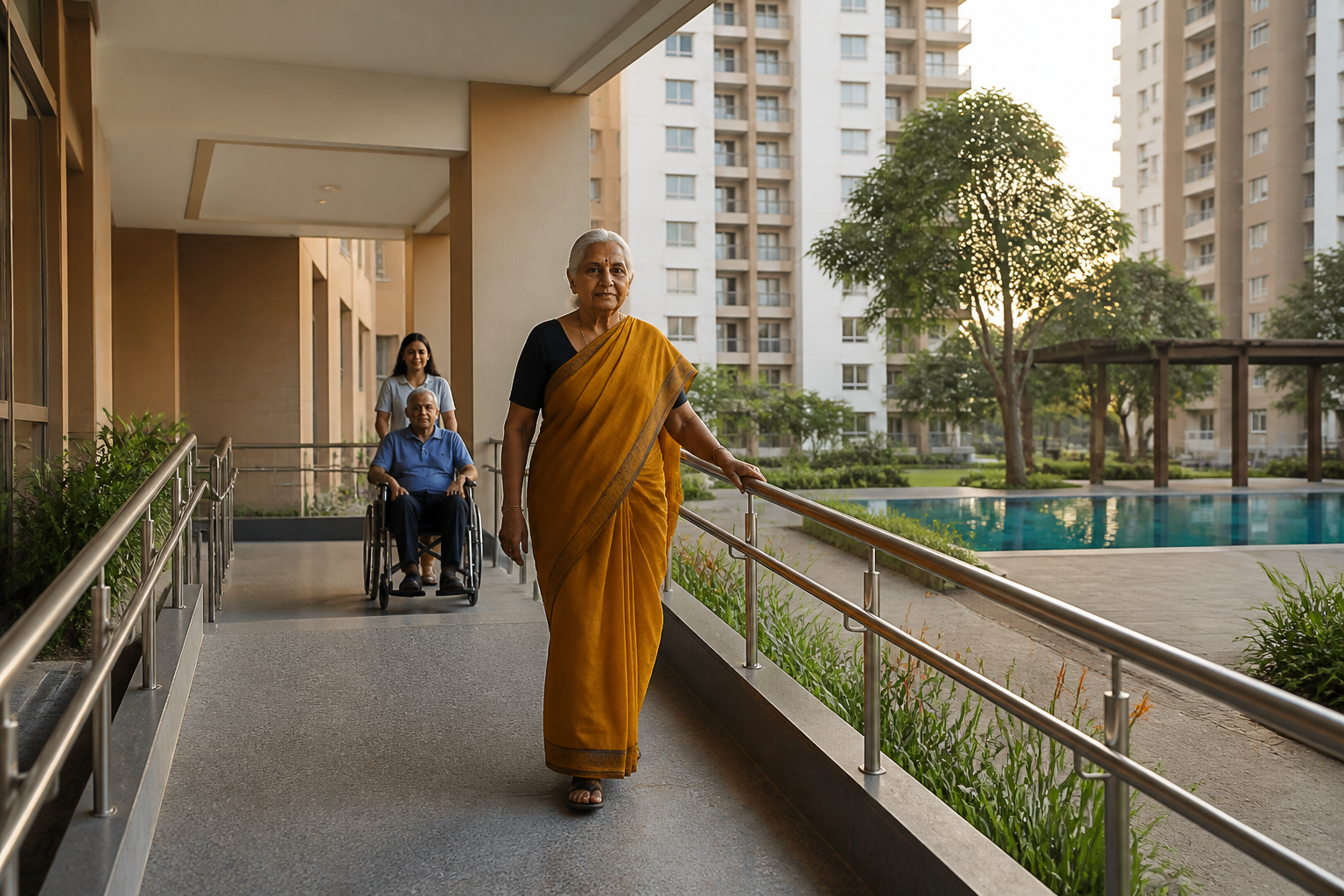
The question of whether an apartment community is accessible is often answered by its entrances, staircases, lifts and common amenities. In Chennai, examples from a 25-year-old residential complex in MRC Nagar, a gated community in Arumbakkam and an inclusively designed campus near Poondi reservoir show that accessibility is shaped not only by building codes, but also by the willingness of residents, associations and builders to act.
That question forms the central idea of Block A For Accessibility, a 20-minute CBFC-certified short film released at a private screening at PVR Satyam Cinemas on September 25. Directed by Madhavi Latha and made by YWTC (Yes, We Too Can!!!) Charitable Trust in collaboration with Fiserv, with United Way Mumbai as the CSR partner, the film follows Natarajan, an ageing father who begins using a wheelchair and withdraws from the social life of his apartment complex because he does not want to trouble his son.
A fall on the building’s stairs becomes the turning point for the community. The film then follows the realisation of the association secretary and the action taken by the builder. Its production itself reflects the inclusion it advocates: Natarajan is played by a deaf person, Ravi Kumar; the voice is provided by wheelchair user Umapathy; and most of the cast and crew, including the director, are persons with disabilities. The film includes sign-language interpretation and subtitles.
The film’s premise is straightforward, but the examples around it reveal a more complex urban problem. Accessibility is frequently treated as a specialised requirement affecting a small group of residents. In practice, handrails, ramps, accessible toilets, pool lifts and sensory spaces influence whether older people, people with disabilities and residents recovering from illness can use the same buildings and amenities as everyone else.
At Raheja Regency in MRC Nagar, two residents used personal experience and long-term involvement in the community to address a basic design gap. Arjun Krishna and Vasantha Arjun, among the earliest residents of the 25-year-old gated community, had previously helped install handrails at most blocks when they were part of the resident association. The rails have since been used particularly by senior citizens.
The couple recently paid for handrails at additional locations as a gift to the community, where they completed 25 years of residence in June. Vasantha said one resident had fallen while trying to manage a location without a railing. The account illustrates an important feature of accessibility in existing housing: the need does not always emerge when a building is first occupied. It can become visible as residents age, mobility changes or common routes become more difficult to navigate.
This also raises a question about responsibility. In a new development, accessibility can theoretically be incorporated through design and construction. In an older apartment complex, improvements may depend on association decisions, maintenance budgets, resident advocacy or individual contributions. A handrail is a relatively small intervention, but the absence of one can determine whether a person can safely enter or leave a building without assistance.
The experience at Triumph Apartments in Arumbakkam shows how a community amenity can be adapted through consultation. Madhavi Latha, a national Paralympic swimming champion and president of YWTC Charitable Trust, owns a flat in the 108-flat community. Before a pool lift was installed in 2022, her late father had to help her enter the swimming pool.
Latha persuaded the apartment association to make the facility accessible. The manufacturer demonstrated the equipment to committee members before they approved it. The lift can now be operated remotely, allowing her to enter the pool independently. The community also constructed a ramp to provide access to her block and made similar improvements at other towers.
The significance of this intervention extends beyond swimming. A common facility that is technically present but physically unusable is not genuinely common. The pool lift changed the relationship between a resident and an amenity that had been available to others but not to her on equal terms. It also demonstrated that accessibility decisions can be considered through an association’s normal approval process rather than treated as an impossible alteration.
Latha has pointed to the accessibility standards in the National Building Code, which insist on a barrier-free built environment and access to common facilities. She has also urged buyers to ask builders about accessible features before investing in a flat. That point places accessibility within the housing transaction itself. It is not only a question of whether a project has a lift or ramp in its brochure, but whether residents can use the entire community independently and safely.
The gap between formal standards and everyday experience is often found in these details. A building may have a ramp, but it may not connect all the way to a home. A lift may exist, but the route to it may include an obstruction or a step. A swimming pool may be advertised as a common amenity, but without a pool lift or suitable entry system, it may remain inaccessible to some residents. The available examples do not establish how widely such gaps occur across Chennai, but they show how accessibility is experienced at ground level.
A different model has emerged at the Community Living Association for Parents of Special Citizens, or CLAPS, near the Poondi reservoir in Tiruvallur. The 8.5-acre residential campus was conceptualised by 50 parents of young adults with special needs. In August, the community marked four years since moving into the campus, which was designed around the needs of its residents.
The campus includes an activity centre, swimming pool and sensory park. Latha Krishnan and Vaijayanthi Srinivasan, both parents of children with special needs, identified these as among the most popular facilities for young adults aged 20 and above. Many residents are on the autism spectrum, while others have Down’s Syndrome or intellectual disabilities.
The sensory park uses equipment with different textures, while the activity centre allows residents to choose programmes according to their moods and interests. The campus also has external professionals, including a warden, supervisor and activity head, to help oversee residents. This approach differs from adapting a conventional apartment after a resident encounters a barrier. Here, the physical environment and support systems were considered together from the start.
The contrast is useful for understanding two dimensions of inclusive housing. Universal design concerns the physical features that allow people with different abilities to move through and use a space. Community support concerns the people and systems needed to make that space function every day. A ramp or sensory installation cannot by itself provide independence if residents lack safe routes, information, assistance or the authority to influence decisions about common spaces.
The three examples also show that accessibility operates at different scales. At Raheja Regency, the intervention involved handrails at specific entry and exit points. At Triumph Apartments, it involved ramps and a pool lift across a 108-flat community. At CLAPS, the entire 8.5-acre campus was conceived around inclusive living. These are not interchangeable models, but together they show that accessibility can be retrofitted, negotiated or embedded into the original design.
For apartment associations, the institutional challenge is to treat accessibility as a continuing responsibility rather than a one-time construction checklist. Resident profiles change. Older residents may develop mobility difficulties, while families may include people with disabilities whose needs were not visible when the building was approved. The people most affected may also be least able to participate in association meetings or argue for improvements without support.
For builders, the issue begins before handover. Buyers need clear information about accessible routes, common facilities and design features, rather than assurances that a project is generally modern or compliant. For residents, the examples show the value of raising specific demands: a handrail at a particular entrance, a ramp connecting a tower to the main route, or equipment that makes a pool independently usable.
The available accounts do not provide a citywide assessment of compliance with accessibility standards, nor do they establish how many apartment communities in Chennai have made similar improvements. They do, however, demonstrate the consequences of treating accessibility as optional. A person can become isolated inside a socially active complex, require family assistance to use a pool or remain unable to participate in activities that other residents take for granted.
Accessible housing therefore has a wider urban meaning. It determines whether people can remain in their homes as they age, whether families can live together without treating disability as a reason for separation, and whether common amenities are genuinely shared. The examples from Chennai and Tiruvallur suggest that the built environment can either deepen dependence or support autonomy.
The evidence here confirms that modest physical changes and purpose-built design can materially improve everyday life. It also leaves open larger questions about how consistently accessibility standards are applied, who pays for retrofits in older communities and how residents can enforce their right to use common facilities. The next step for apartment communities is not simply to ask whether a building has accessible features, but whether every resident can move, participate and live with dignity within it.
