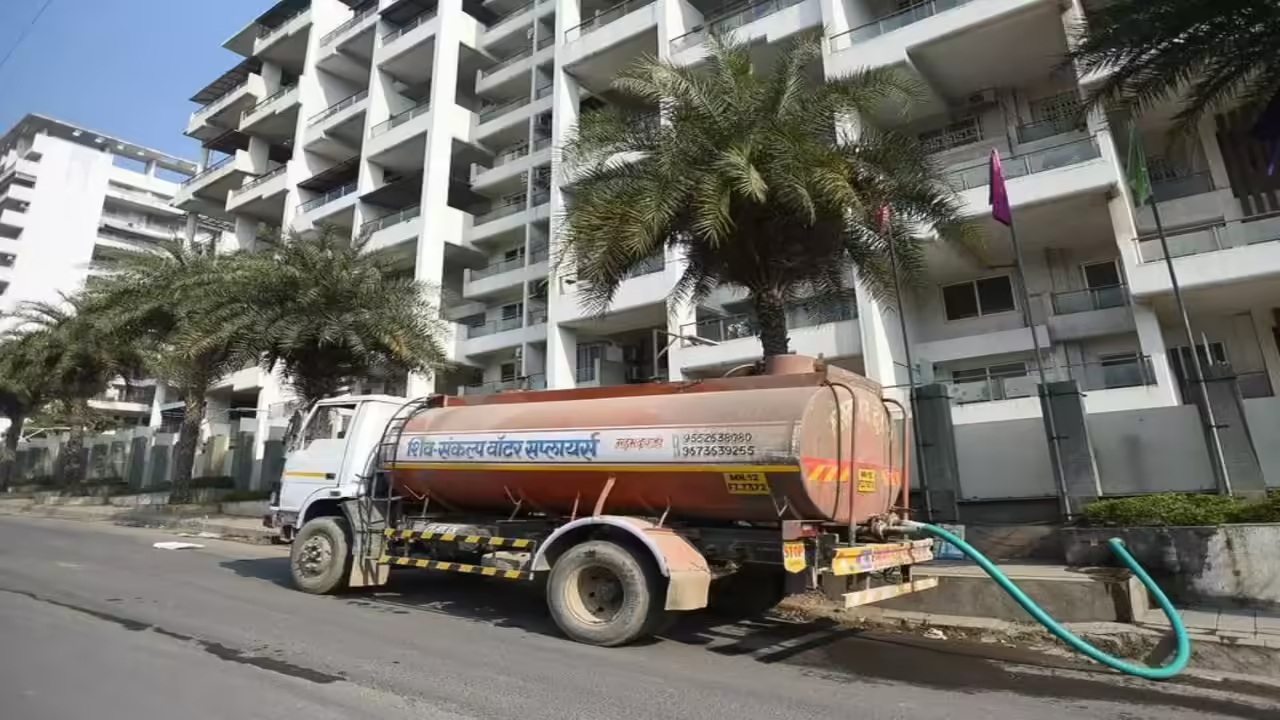
Pune-Water scarcity has resurfaced in Vimannagar weeks ahead of the summer peak, pushing residential societies back into daily dependence on private water tankers and raising concerns over the city’s distribution resilience despite a healthy monsoon last year.Multiple housing societies across the eastern Pune neighbourhood report a sharp decline in municipal water pressure over recent weeks. While supply timings on paper remain unchanged, reduced flow has made it impossible for many buildings to fill overhead tanks, disrupting daily domestic use and increasing operating costs for large residential complexes.
Residents say the issue follows a brief period of relative stability earlier this year. The renewed stress has forced several societies to arrange multiple tanker deliveries each day to meet basic needs. For high-density developments with hundreds of apartments, daily demand can run into tens of thousands of litres, making tanker dependence both unavoidable and expensive. Urban planners note that such disruptions highlight structural weaknesses in last-mile water distribution rather than absolute water availability. “When supply pressure drops in elevated or peripheral neighbourhoods, it usually signals systemic distribution inefficiencies, not a shortage at source,” said a water infrastructure expert familiar with Pune’s supply network. Societies report that tanker water is increasingly being used even for potable purposes, while limited municipal supply is rationed for kitchens or essential use. At prevailing market rates, daily tanker expenses can exceed ₹4,000–₹6,000 per society, costs that are eventually passed on to residents through maintenance charges.
Officials from the civic water supply department have acknowledged receiving complaints and indicated that internal checks are underway to assess affected pockets. However, residents argue that recurring explanations such as maintenance work, incomplete distribution tanks, or upstream pipeline issues have failed to deliver lasting relief.The situation has wider implications for Pune’s urban growth corridors, particularly areas like Vimannagar that have seen rapid residential and commercial development over the past decade. Real estate analysts point out that recurring water stress directly impacts housing livability, rental demand, and long-term asset values in otherwise premium micro-markets.Climate specialists also warn that early-onset water stress, even after good rainfall, underscores the need for decentralised storage, aquifer recharge, and demand-side management at the neighbourhood level. Without such measures, tanker dependence risks becoming a permanent feature rather than a temporary fallback.
As summer approaches, residents and urban policy experts alike say coordinated action is needed — from pressure audits and pipeline upgrades to stricter tanker regulation and local rainwater harvesting enforcement. The coming weeks will test whether Pune’s water governance can shift from reactive fixes to resilient, equitable distribution for a growing city.