


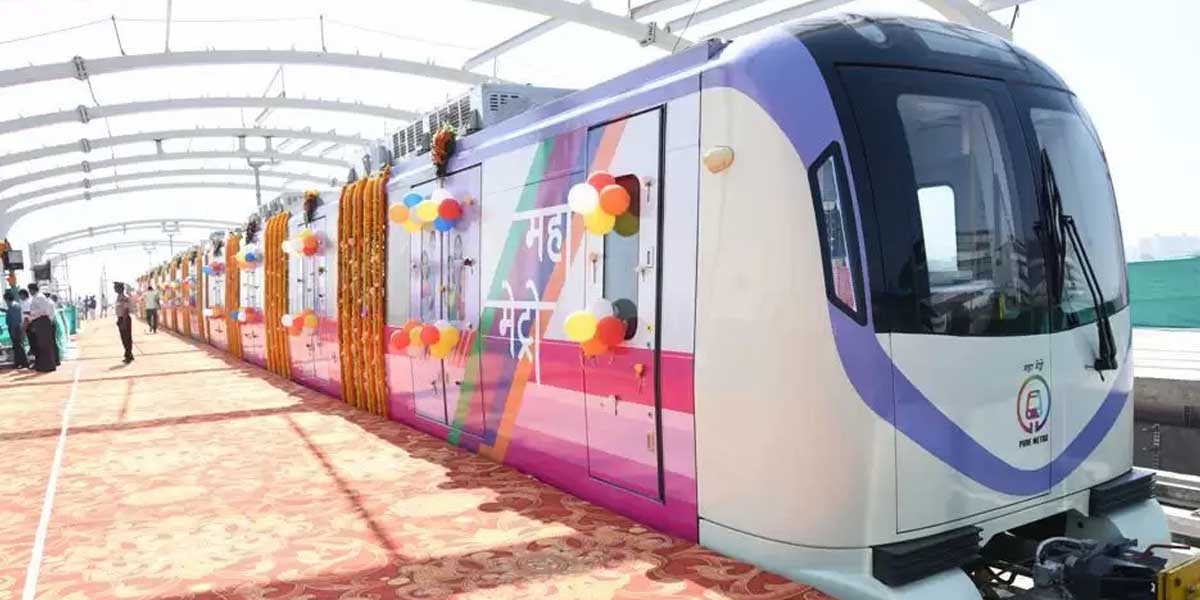
Pune’s long-awaited east–west mass transit link connecting the city’s technology district with its academic and commercial core has moved into its final construction phase, signalling a potential shift in how one of India’s fastest-growing urban regions manages daily mobility. Trial operations on a major section of Metro Line 3 have now been completed, placing the corridor on track for commissioning by early 2026.
The fully elevated Metro Line 3 stretches over 23 kilometres, linking the IT-heavy Hinjawadi area with Shivajinagar and the university precinct. Authorities overseeing the project confirm that more than nine-tenths of civil and systems work has been completed, with the remaining stations and track sections expected to be finished within the next year. For Pune, where private vehicle dependence has grown alongside employment hubs, the corridor represents a structural intervention rather than a cosmetic upgrade.Urban planners note that the Baner–Hinjawadi corridor has long operated beyond its intended capacity, with peak-hour delays eroding productivity and adding to vehicular emissions. By offering predictable travel times between residential clusters, office parks and institutional zones, the new Metro route is expected to absorb a significant share of daily commuter traffic that currently relies on personal cars and two-wheelers.
The project also reflects a broader recalibration in Pune’s infrastructure planning. Instead of expanding road capacity alone, the city has adopted layered transport solutions, including an integrated double-decker structure near the university junction. This design allows Metro services to operate above surface traffic, while road users benefit from reconfigured ramps and intersections below. Transport experts say such compact engineering is increasingly necessary in land-constrained Indian cities where mobility upgrades must coexist with existing urban fabric.From an economic perspective, improved connectivity between Hinjawadi’s technology parks and the city’s central districts could influence real estate dynamics and workforce behaviour. Shorter and more reliable commutes tend to expand residential choice, support decentralised housing markets, and reduce the pressure on inner-city rentals. For employers, the line promises greater punctuality and a wider talent catchment.
Environmental outcomes are also central to the corridor’s long-term relevance. Transport analysts estimate that even a modest shift from private vehicles to electric mass transit could deliver measurable reductions in fuel use and tailpipe emissions along one of Pune’s most congested routes. While the Metro alone cannot solve the city’s mobility challenges, it provides a backbone around which feeder buses, walking infrastructure and last-mile services can be reorganised.As final approvals, safety certifications and operational readiness assessments progress over the coming months, attention will turn to how seamlessly the line integrates with Pune’s existing transport network. For commuters, the real test will not be the launch date, but whether the system delivers the reliability and accessibility that a growing, climate-sensitive city increasingly demands.
Also Read : Mumbai Borivali Plans New Ferry Jetty Expansion
