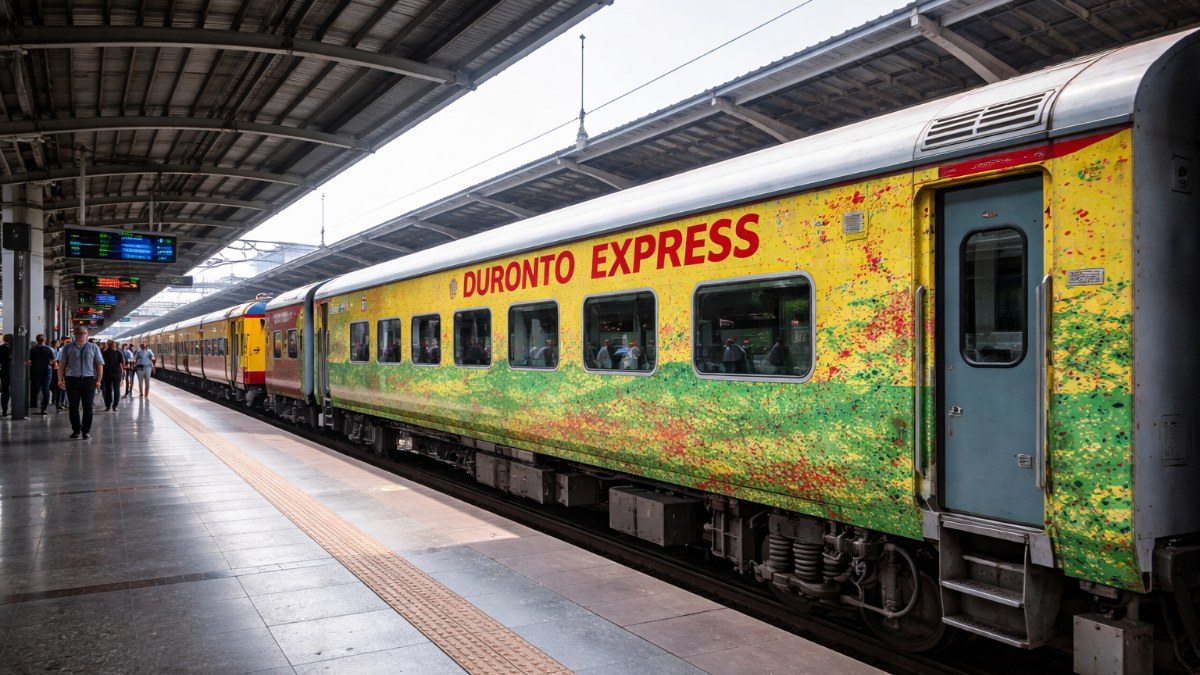
Intercity rail connectivity between southern and western India may be poised for a significant upgrade, as Indian Railways evaluates options to substantially shorten travel time between Bengaluru and Mumbai. According to officials familiar with planning discussions, a premium long-distance service is under consideration that could reduce the end-to-end journey to approximately 18 hours, offering a faster alternative on one of the country’s busiest inter-metro corridors.
The Bengaluru–Mumbai rail corridor plays a critical role in linking two major economic engines, supporting business travel, logistics movement, and labour mobility across Karnataka and Maharashtra. At present, most long-distance services on the route take well over 22 hours, limiting rail’s competitiveness against air travel despite its lower carbon footprint and higher passenger capacity. Railway planners are understood to be examining the feasibility of introducing a Duronto Express on the corridor. Designed for long-distance travel with limited halts, Duronto services typically prioritise speed, operational efficiency, and end-to-end connectivity between major urban centres. Industry observers note that such trains are structured to bypass smaller stations, reducing dwell time and improving punctuality.
The potential move follows the recent launch of a new bi-weekly superfast service connecting Bengaluru with Mumbai’s central suburban rail hub. While that train has added capacity to the corridor, its extended journey time and multiple stoppages have drawn criticism from regular passengers and business travellers who were expecting a faster option. The gap between passenger expectations and service performance has intensified calls for a more time-efficient rail solution. If approved, the proposed Duronto Express would connect Bengaluru’s primary rail terminal with Mumbai’s main long-distance station, passing through key rail junctions in Karnataka and Maharashtra. Transport analysts say the route selection reflects a balance between speed and regional accessibility, while still maintaining the Duronto model of minimal intermediate stops.
From an urban and environmental perspective, a faster Bengaluru–Mumbai rail service could have broader implications. Rail-based intercity travel emits significantly less carbon per passenger kilometre compared to aviation, making it a critical component of low-emission mobility strategies for India’s expanding metro regions. Improved rail speeds also strengthen the case for businesses to shift short-haul corporate travel away from flights. Urban planners further point out that better long-distance rail connectivity supports more balanced regional development. Cities along the corridor benefit from improved access to talent, markets, and investment, while reducing pressure on congested airports in Bengaluru and Mumbai.
Railway officials caution that the proposal remains under evaluation, with no final approvals announced so far. Operational feasibility, rolling stock availability, and timetable integration will determine whether the service moves forward. However, if implemented, the Duronto Express could mark a meaningful step toward faster, more sustainable intercity mobility between two of India’s most influential urban regions.
Indian Railways Studies Faster Bengaluru Mumbai Rail Link