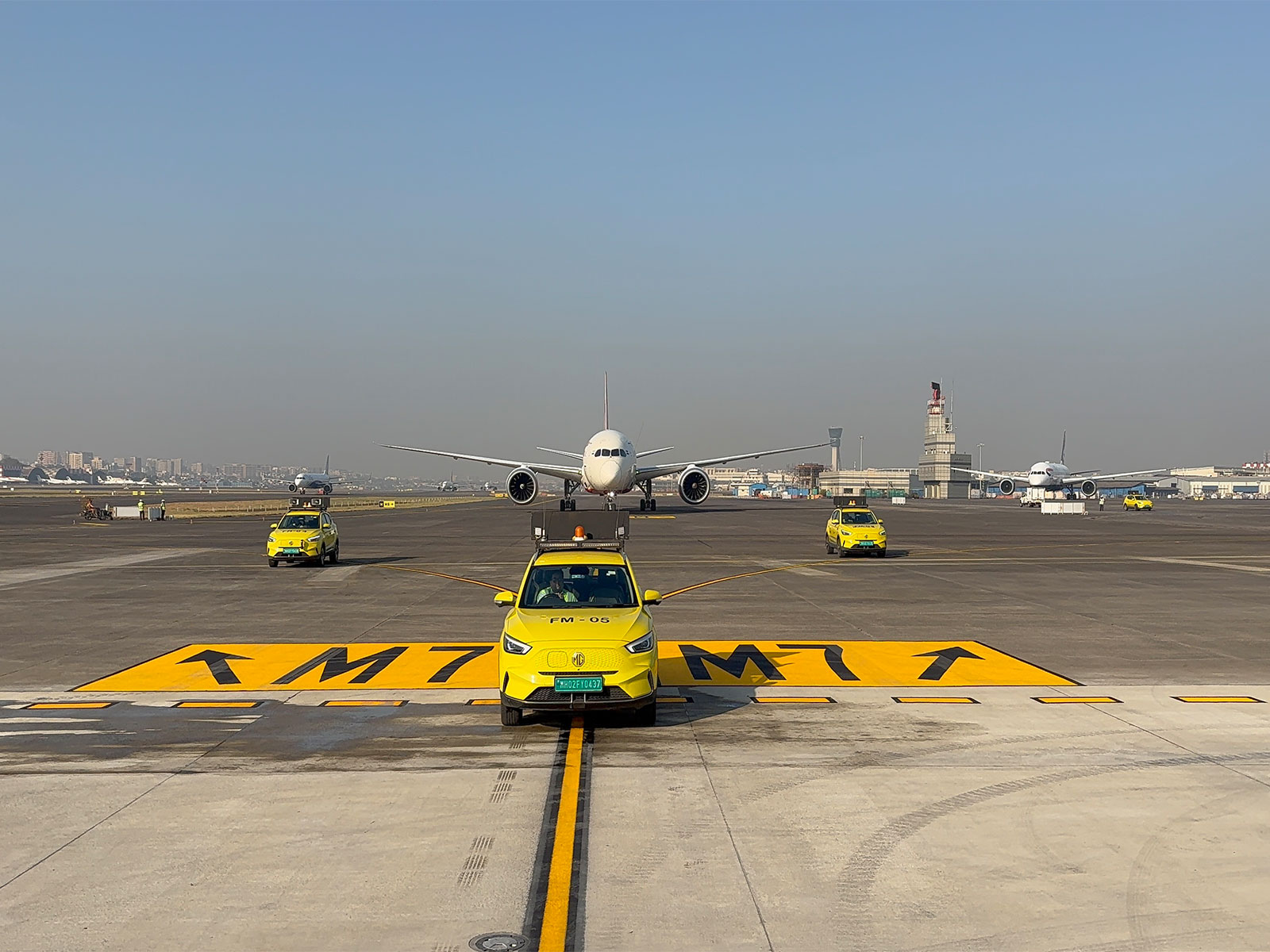
Take-offs from Mumbai’s primary aviation hub are set to become faster and more predictable following the commissioning of a new full-length parallel taxiway at Chhatrapati Shivaji Maharaj International Airport. The airside upgrade, known as Taxiway M, is expected to significantly improve aircraft movement efficiency at one of the world’s busiest single-runway airports, with implications for airline punctuality, fuel use and overall network resilience.
The newly operational taxiway runs parallel to the airport’s main Runway 09/27, enabling aircraft to taxi continuously without repeatedly crossing the active runway. Airport officials said this configuration reduces ground movement delays, particularly during peak hours, when congestion often builds up due to limited manoeuvring space. By allowing aircraft to line up more efficiently before take-off clearance, the airport can sequence departures with greater precision. Industry experts note that the absence of a continuous parallel taxiway had long constrained operations at the airport, which handles close to 1,000 aircraft movements daily. Until now, airside traffic depended heavily on a single parallel taxi track that remained in near-constant use, leaving limited flexibility during maintenance windows or unexpected disruptions. The addition of Taxiway M introduces redundancy into the system, a key requirement for high-density airports operating at capacity.
The project also addressed long-standing safety and operational challenges. Construction required the relocation of an existing emergency response facility positioned along the taxiway alignment. To maintain international safety standards, airport authorities commissioned a temporary fire station while work progressed on a permanent replacement, ensuring uninterrupted emergency response capability throughout the construction phase. Delivered over multiple phases, the project was executed within an active airfield environment, bordered by operational runways and taxiways. Aviation planners familiar with the project said such upgrades are particularly complex at land-constrained airports like Mumbai, where expansion options are limited and infrastructure improvements must be carried out without disrupting daily operations.
From a sustainability standpoint, the benefits extend beyond time savings. Shorter taxi distances and reduced waiting times on the ground translate into lower fuel burn and fewer emissions. Urban transport analysts argue that incremental efficiency gains at airports can play a meaningful role in reducing the aviation sector’s environmental footprint, especially in cities where air traffic growth is difficult to accommodate through new runways. With Taxiway M now in service, airport authorities believe the facility is better equipped to handle existing demand while creating operational headroom for future growth. As Mumbai continues to function as India’s busiest aviation gateway, such targeted infrastructure investments are increasingly seen as essential to balancing economic competitiveness with safety, efficiency and long-term sustainability goals.
Mumbai Flights To Depart Faster With CSMIA Parallel Taxiway M Launch