


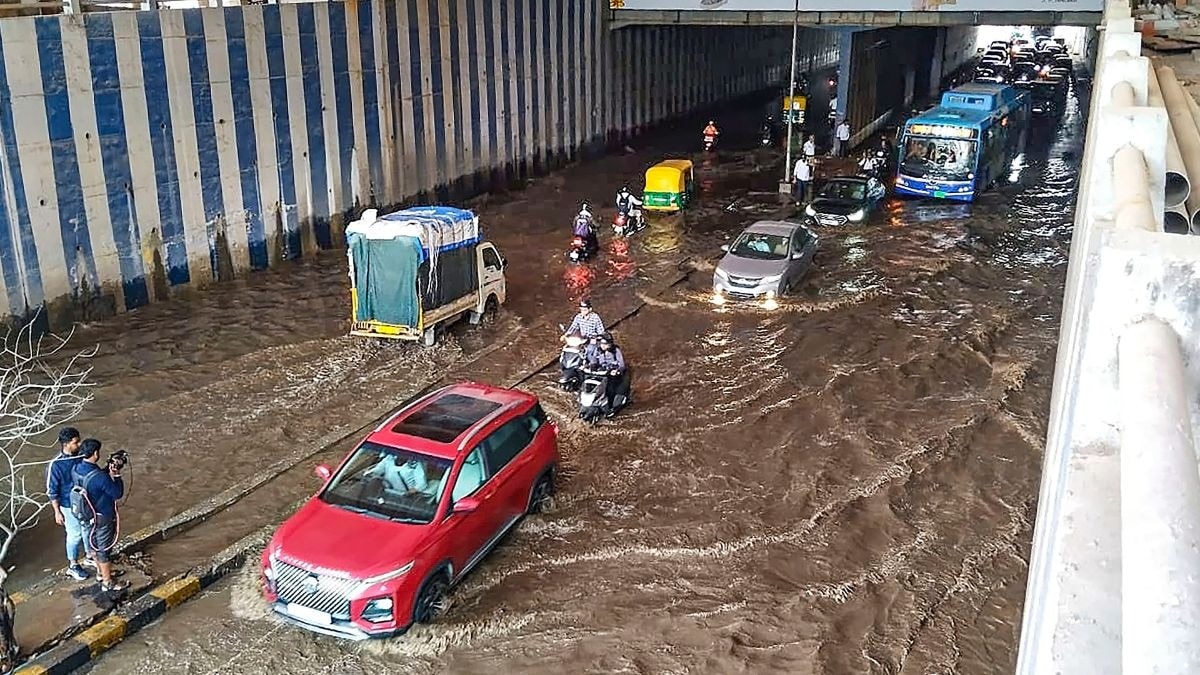
As pre-monsoon showers continued to drench the Karnataka capital this week, residents in several parts of Bengaluru found themselves once again grappling with waterlogged streets, tree falls, extended power cuts, and gridlocked traffic.
The recurring urban challenge, now routine with every spell of seasonal rain, raises serious questions about the city’s stormwater infrastructure readiness and crisis response preparedness. By Wednesday evening, at least eight trees had been uprooted across key neighbourhoods — including Sanjaynagar, Hebbal service road, Mico Layout, Chikkabanaswadi, and Banashankari — in yet another reminder of the capital’s fragile civic systems. Officials confirmed that multiple arterial and residential routes were either partially blocked or severely congested following the downpour.
Data from the Karnataka State Natural Disaster Monitoring Centre indicated that areas such as Peenya Industrial Area and Kengeri received up to 10 mm of rainfall, with northeastern localities bearing the brunt of the storm. The India Meteorological Department has forecast continued light to moderate showers until May 20, warning of intense spells in isolated parts of the city on Thursday. Tuesday’s sudden and powerful rains, accompanied by gusty winds, had already caused significant disruptions — with a trail of uprooted trees, snapped branches, flooded roads, and electricity outages leaving the city disoriented. What began as an afternoon storm returned late at night, triggering overnight waterlogging that crippled traffic movement well into Wednesday morning.
Despite the Bruhat Bengaluru Mahanagara Palike (BBMP) deploying response teams, the numbers reveal the extent of the chaos: over 121 incidents of branch falls and 27 full tree collapses were reported in just 24 hours. The East Zone emerged as the worst affected, with civic workers clearing 35 fallen branches and six uprooted trees. While officials claimed the debris was swiftly removed, residents and commuters told a different story — one of long delays, absent emergency services, and confusion. The situation at Hebbal Junction — a critical traffic node and construction site for both Namma Metro and a parallel flyover by the Bangalore Development Authority — remained dire more than 12 hours after rainfall ceased. Commuters described it as a “mini reservoir,” with blocked drainage channels turning the junction into a virtual deadlock zone.
Civic inaction, particularly the failure to desilt stormwater drains at known bottlenecks, came under scrutiny again. The same location had experienced identical flooding during the last monsoon, yet little seems to have been done since to mitigate future risks. Officials blamed the heavy construction activity and ongoing metro works, but local residents and commuters have called for urgent, long-term solutions. According to urban risk assessments conducted jointly by civic agencies, at least 133 locations in Bengaluru have been designated as flood-prone zones. While not all of them are equally vulnerable during every rain event, a number of critical transit corridors regularly witness deluges. These include the Outer Ring Road (ORR) stretches between Nagawara and Hebbal, junctions on the International Airport Road, Rupena Agrahara on Hosur Road, Kasturi Nagar Bridge, Agara 14th Main, Queens Circle, and the Panathur underpass, among others.
In response to the rising number of obstructions on roads due to fallen trees and waterlogging, the city’s traffic police department has equipped its teams with chainsaws and clearing tools to reduce dependence on delayed civic intervention. A senior traffic official confirmed that coordination meetings with BBMP are being held to streamline emergency response before the onset of the full monsoon season. The chaos wasn’t confined to roads alone. The electricity supply was also severely affected. Bangalore Electricity Supply Company (Bescom) reported an unprecedented 1.39 lakh complaint calls on Tuesday, compared to the average daily volume of 50,000 to 60,000. Areas like Nagawara reportedly faced outages lasting up to five hours, while several other neighbourhoods experienced shorter but frequent power cuts.
Bescom officials attributed the spike to fallen trees damaging power lines and transformers. “This is a seasonal pattern. Weak trees give way during the first major showers, and the electrical network bears the brunt,” an official explained. The abrupt transition from hot afternoons to evening downpours adds to the stress on aging power infrastructure. According to technical experts, this thermal shock can cause transformer oil to cool too rapidly, leading to internal damage and increased failure rates. The situation has once again brought to the forefront the inadequacies of Bengaluru’s urban planning — especially concerning climate resilience and disaster mitigation. With pre-monsoon patterns becoming increasingly unpredictable due to climate change, experts argue that the city must adopt a more sustainable and scientific approach to urban stormwater management. This includes restoring natural drains, strengthening local catchment areas, and strictly regulating construction near lake beds and floodplains.
Environmental planners have long advocated for integrated rainwater harvesting, increased urban green cover, and the revival of Bengaluru’s interconnected lake systems — many of which have been encroached upon or choked by construction debris. A climate-neutral approach, experts say, not only reduces flooding risks but also helps recharge groundwater and lower urban heat stress. Residents, meanwhile, are left to deal with the same set of disruptions year after year — from flooded basements and impassable roads to stalled vehicles and powerless evenings. With Bengaluru rapidly urbanising and expanding beyond its traditional boundaries, the urgency to implement decentralised and sustainable infrastructure cannot be overstated.
Also Read : Mangaluru Water Metro Set for 2026 Launch
