


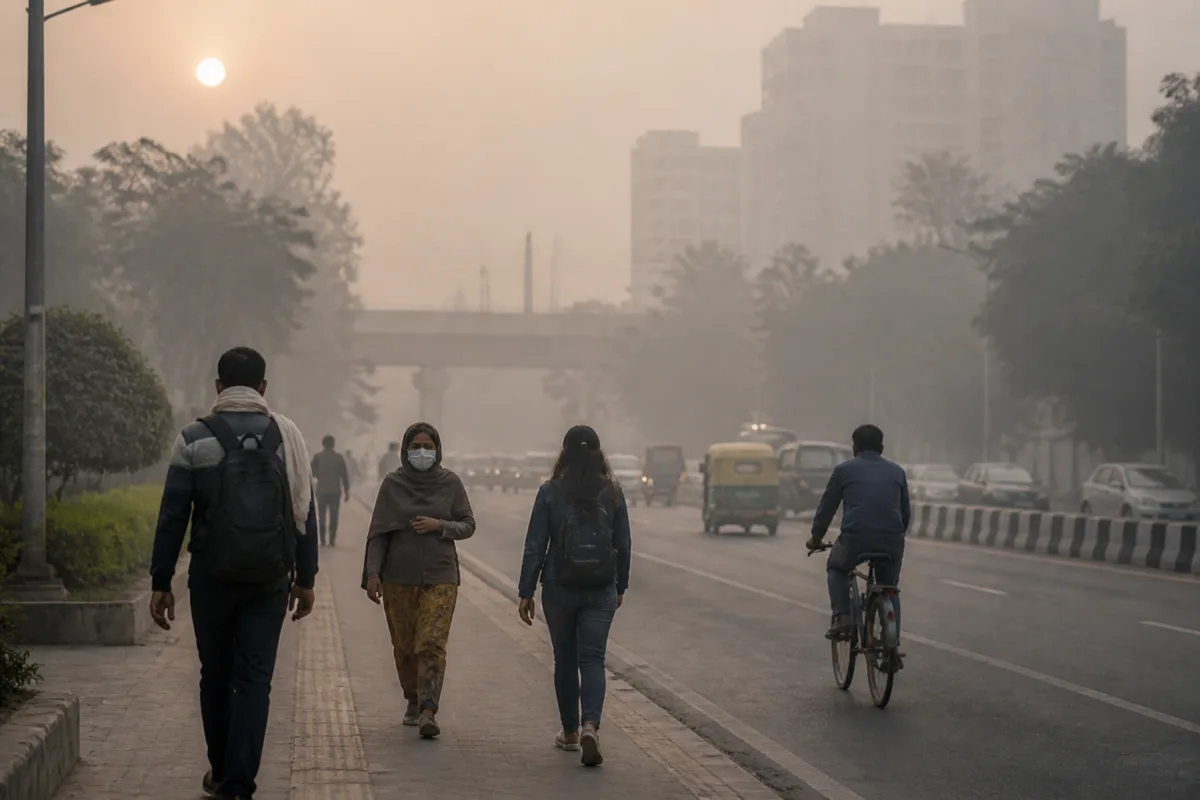
Delhi air pollution has become more than a seasonal public-health crisis in political and cultural debate. In an essay for Scroll, Joya John argues that smog, particulate matter and the language of environmental degradation are increasingly being used to describe the condition of public life itself.
The argument comes against the backdrop of what the essay describes as another annual period of severe air pollution in Delhi, marked by school closures, rising air-purifier sales and spikes in the air-quality index after Diwali. It also places the city’s experience alongside the stalled global climate negotiations at COP31 in Antalya, where, according to the essay, governments failed to reach consensus on fossil fuels, mitigation and finance.
For John, the significance of polluted air lies not only in its physical effects. Air is shared by everyone in a city, making it an unusually direct measure of governance. As pollution becomes part of daily life, AQI readings, smog and the inability to secure clean air have entered political criticism as shorthand for administrative failure and broken promises.
The essay traces this political vocabulary through several examples. In 2016, then Defence Minister Manohar Parrikar described Delhi’s real pollution as “political pollution” during a period of intense smog. In 2021, Samajwadi Party leader Akhilesh Yadav accused the Bharatiya Janata Party of polluting politics as well as rivers. More recently, Uttar Pradesh Chief Minister Adityanath is described as having responded to questions on air pollution by shifting from the condition of the air to the pollution of the political system.
John’s central criticism is that such language can become a way to redistribute blame without changing the decisions that shape urban air. Pollution becomes a partisan metaphor, used to dramatise a seasonal crisis or accuse political opponents of poisoning public discourse. The rhetorical force of the phrase may be considerable, but the essay suggests that it has not altered the material conditions in which residents continue to breathe polluted air.
Poetry, the essay argues, can offer a different way of making that material reality visible. Drawing on the work of Hindi poet Rajesh Joshi, John discusses a poem written after the Bhopal gas tragedy. In “Hawa”, or “Air”, a chemical leak is compared with the bite of a krait or snake. Poison moves through the air, whose body trembles and suffers. The image gives physical form to something normally invisible and taken for granted.
The poem does not turn pollution into an abstract metaphor. Instead, the metaphor makes the danger of poisoned air more palpable. For urban residents, this distinction matters: fine particulate matter and toxic gases cannot always be seen, yet they determine how public spaces, schools and everyday movement are experienced during severe pollution episodes.
John also reads Mangalesh Dabral’s 2012 poem “Ghatati hui aaksijan”, or “Decreasing Oxygen”, as a work that joins environmental and political deterioration. The poem refers to increasing nitrogen, sulphur and carbon oxides, along with dangerous particulate matter suspended in the air. It places these physical changes beside rising hatred, repression and retribution.
The poem later extends the idea of diminishing oxygen to language itself. If the breath of words is also weakening, the essay suggests, the condition of public speech cannot be separated from the condition of the environment. The connection is not that air pollution is merely a convenient symbol for political failure. Rather, polluted air is a shared physical experience that exposes the limits of political language when rhetoric substitutes for action.
A further poem by Sudhir Ranjan Singh, also titled “Hawa”, closes with the wind declaring that its work is to breathe life into words. John uses this image to return the discussion to the physical necessity of air. Public life depends on speech, but speech also depends on bodies that can breathe safely.
The essay’s broader implication is that urban air should not be treated only as a technical indicator or a seasonal emergency. AQI figures and pollution episodes are also part of how residents understand the performance of institutions and the quality of civic life. Political rhetoric may draw attention to that relationship, but it can also obscure responsibility when it turns a measurable environmental condition into a purely partisan accusation.
By reading pollution through poetry, John keeps both dimensions in view: air as a material condition and air as a language through which a society describes its failures. For cities such as Delhi, the challenge is not to choose between the literal and the figurative. It is to ensure that compelling rhetoric does not displace the public decisions needed to make the air breathable.

