


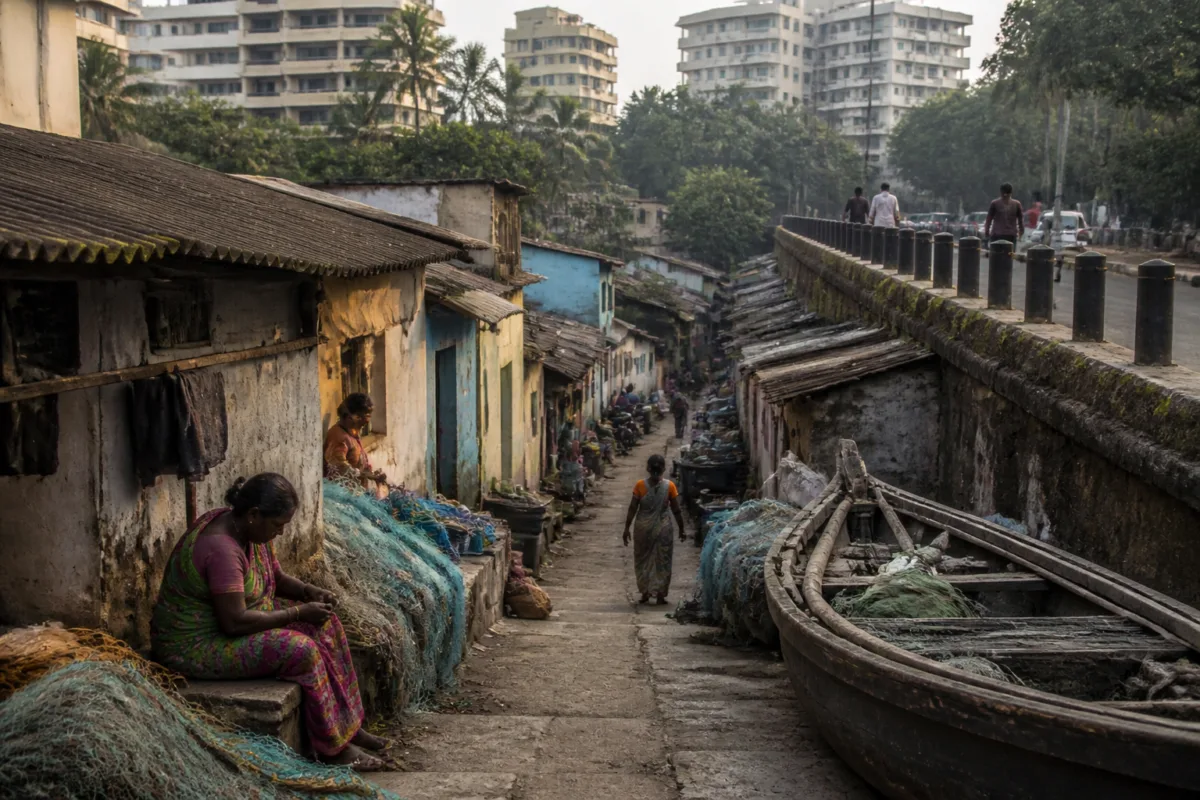
Residents of Mangelawadi Koliwada in Juhu say the settlement’s identity, fishing livelihood and remaining open spaces are under pressure as redevelopment and infrastructure have reshaped the neighbourhood. They oppose efforts to classify the settlement as a slum, arguing that the community has lived in the area for generations and should be recognised as a koliwada or gaothan.
A report by Loksatta-Mumbai describes Mangelawadi as a fishing settlement located off Juhu Tara Road, alongside the route running parallel to SNDT Women’s University. The community is locally known as ‘Khadda’, residents say, because the road was built at a higher level, making the settlement appear sunken. According to the report, the road also disrupted the settlement’s earlier access to the sea.
The residents’ account places the dispute within a longer history of coastal urbanisation. Juhu and surrounding areas were once connected through land reclamation and road construction, which divided several koliwadas. In Mangelawadi, residents say the community has existed for between 300 and 400 years and that the fifth generation now lives there. These historical claims are based on information provided by senior members of the community and are not accompanied in the report by official land or settlement records.
The immediate concern is the loss of space needed for fishing. Residents say that areas formerly used to keep boats and dry fish have been reduced as bungalows and buildings expanded along the coast. Only space for one or two boats is said to remain, while construction has begun at the location where those boats are kept. Vandana Mangela, president of the Mangelawadi Fishing Koliwada Gaothan Vividh Karyakari Sanstha, alleged that the community was being pushed towards extinction.
Residents also say they have been advised by the suburban district administration to keep boats at Versova-Madh or Khar Danda. According to their account, local fishers at those locations object to boats from Mangelawadi, and attempts to use the spaces can result in damage. The report says the number of boats in Mangelawadi has already fallen from the earlier presence of several small and large boats to only a few.
The community links the decline in fishing activity to both the shortage of boat space and wider changes in the coastal environment. Residents also attribute a fall in fish availability to the Bandra-Versova Sea Link. These are residents’ claims in the report; no independent assessment or official response on the project’s effect on fish availability is cited.
Access within the settlement has narrowed as well. Residents say Mangelawadi earlier had four or five entry routes, but only a limited number remain. The former route towards the sea has reportedly been renamed Jitendra Lane. The combination of reduced access, high land values and development around the settlement has intensified fears of displacement.
Chetan Mangela, vice-president of the residents’ organisation, alleged that homes belonging to members of the koli community near Maniksha Cooper School on Juhu Tara Road had been demolished or directly purchased in the name of redevelopment. He further alleged that attempts were being made to absorb the adjoining settlement because of the value of the land. The report does not provide the names of the developer, project approvals, ownership documents or an official account of the redevelopment.
Residents also object to being described as slum dwellers because a slum has developed around the koliwada. They say the presence of surrounding informal housing is being used to characterise the historic fishing settlement in the same way, despite their claim that the community has a distinct history and livelihood.
The Mangelawadi dispute therefore goes beyond a disagreement over terminology. Recognition as a koliwada or gaothan can affect how a settlement’s history, homes, access routes, community spaces and livelihood infrastructure are considered in planning and redevelopment decisions. For fishing communities, a house is not the only critical asset: boat-storage areas, drying spaces and routes to the water are part of the working settlement.
The report does not establish whether Mangelawadi has been formally surveyed, how its land is classified, or whether any competent authority has issued a decision to declare it a slum. It also does not record responses from the district administration, municipal authorities, planning agencies or developers. Those records will be essential to determine the settlement’s legal status and assess the residents’ allegations.
For now, the account highlights a recurring urban question in Mumbai’s coastal neighbourhoods: whether infrastructure and redevelopment can proceed without erasing the spatial arrangements and livelihood systems of communities that predate the modern city around them.

