


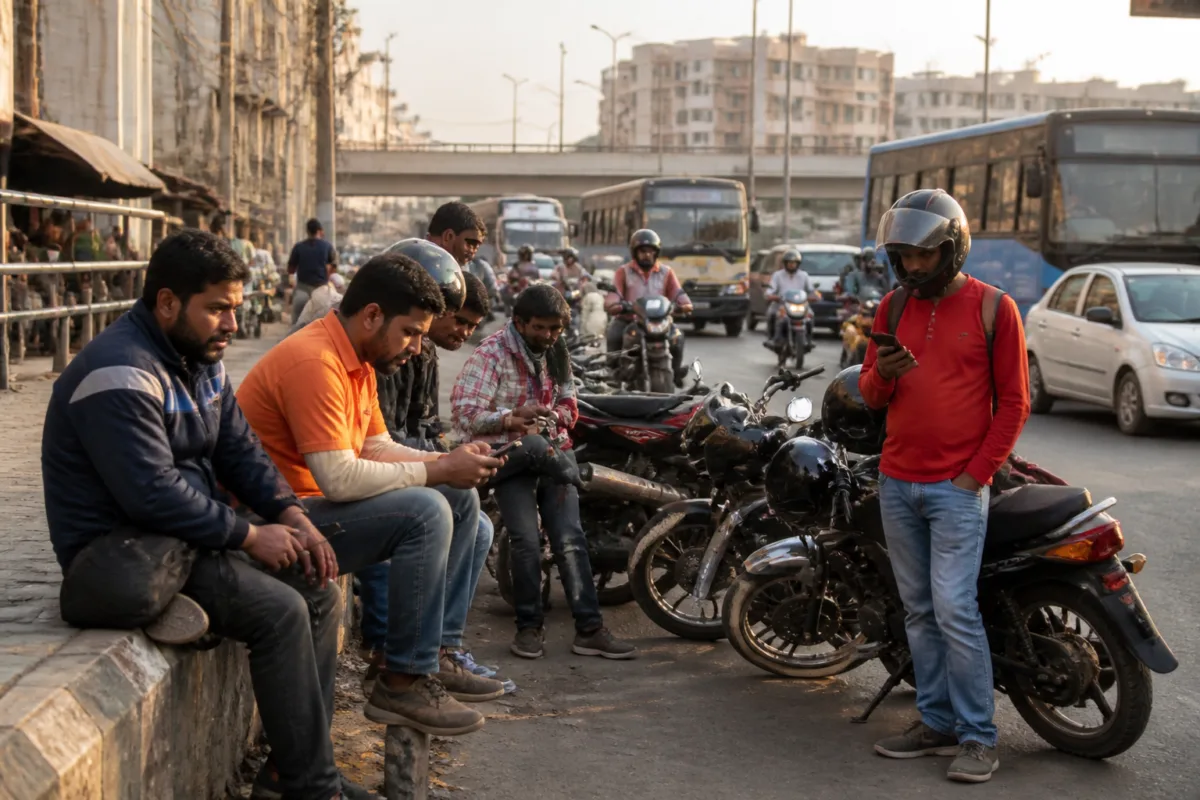
Gig workers and trade union representatives have renewed calls for safeguards against algorithmic management, accident risks and uncertain earnings at the 43rd All India Trade Union Congress (AITUC) national conference in Bengaluru.
The conference focused on the growing use of artificial intelligence and automated systems to allocate tasks, set prices, assess performance and suspend workers on digital platforms. Delegates called for national protections, accident insurance and minimum wages, building on the Karnataka Platform Based Gig Workers Act, 2025, according to a report presented at the meeting.
The discussion centres on a structural imbalance in platform work. Workers are generally described by aggregators as independent contractors, while platform applications and algorithms determine much of how their work is performed. A draft commission report titled ‘Gig and Platform Workers – Organising the Digital Working Class’, tabled by Vahidha Nizam, Vidya Sagar Giri, V K Singh and R Prasad, described the app as the entry point to work, the algorithm as the supervisor and the platform as the controller.
The report said automated systems influence task allocation, dynamic pricing, performance ratings, working conditions and account deactivations. It cited the example of a worker whose account could be suspended after missed deliveries, without a human manager hearing the circumstances or an appeal process being available. The report presented this as a consequence of opaque algorithmic decision-making rather than a conventional employer-led disciplinary process.
For workers in urban delivery and transport networks, the financial risks extend beyond platform access. The commission report said workers bear the cost of vehicles, fuel, equipment, maintenance and downtime, while also facing risks linked to illness, accidents and fluctuating demand. It associated flexible work without assured earnings with long hours, stress, social isolation and pressure to meet targets.
NITI Aayog estimates cited at the conference put India’s gig-worker population at 77 lakh in 2020-21, equivalent to 2.6% of the non-agricultural workforce. The estimate rises to 1.2 crore in 2024-25 and is projected to reach 2.35 crore by 2029-30, or 6.7% of the non-agricultural workforce and 4.1% of total livelihoods.
These figures point to the growing importance of platform workers in urban economies, particularly in last-mile delivery, passenger transport and other app-mediated services. They also raise questions about who is responsible when a worker loses access to an income-generating platform, or when automated ratings and pricing systems affect earnings without a transparent review mechanism.
India’s Code on Social Security, 2020 provides for welfare schemes for gig and platform workers but does not grant them full employee status, wages or the complete set of enforceable labour protections associated with employment. The AITUC meeting therefore called for a broader national framework covering social security, minimum earnings, accident insurance and accountability for algorithmic decisions.
The draft report also referred to international worker resistance through strikes, organising and unionisation. It called for stronger labour laws, worker-owned cooperatives and India’s ratification of ILO Convention Number 193, which the report said would require a mechanism to determine the employment status of platform workers.
The central policy challenge is to reconcile the flexibility associated with platform work with protections against arbitrary deactivation, income volatility and work-related risks. As platform systems become more important to urban service delivery, the rules governing their algorithms and the responsibilities of the companies operating them will increasingly affect both workers and the functioning of city economies.

