


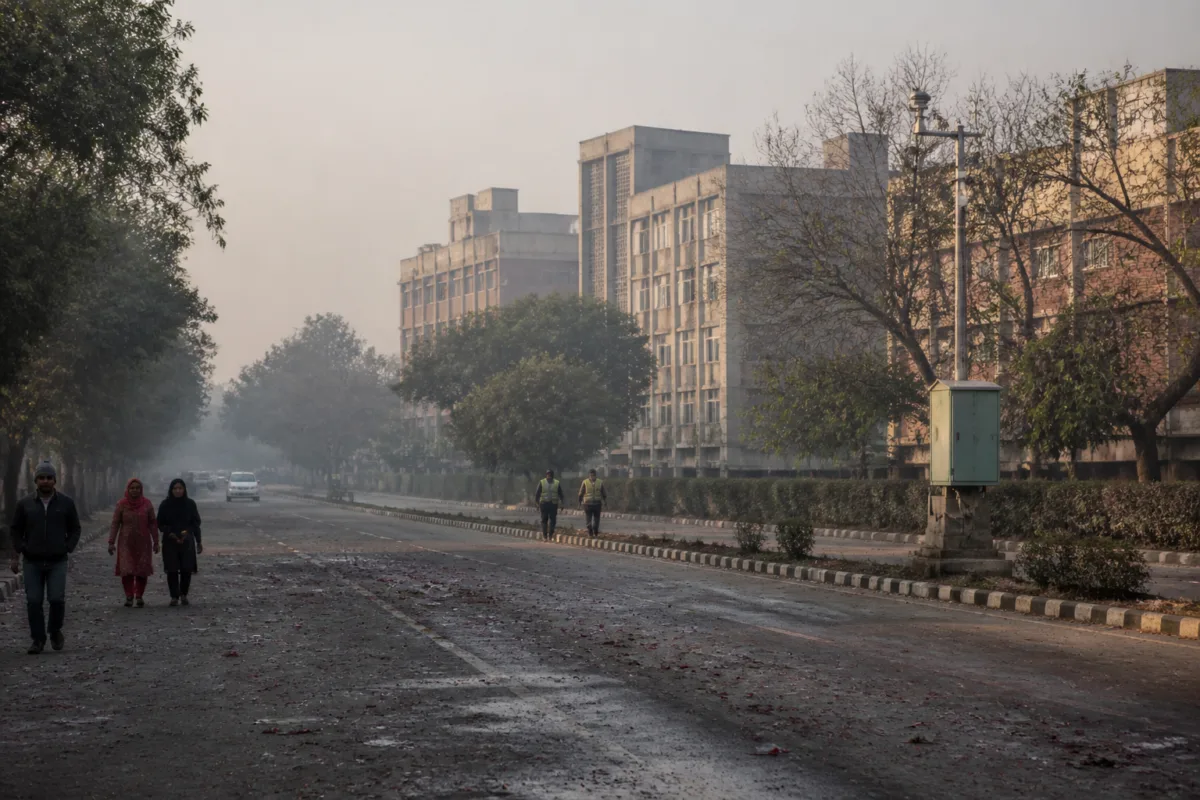
Chandigarh air quality deteriorated through the festive period as firecrackers continued to be used despite restrictions on their timing, type and location, according to pollution data compiled by the Chandigarh Pollution Control Committee (CPCC) and complaints cited in a report by The Tribune.
The city’s average Air Quality Index (AQI) rose from 75 on Dussehra to 128 on Chhath Puja and 131 on Gurpurb. The sharpest deterioration was recorded during Diwali, when monitoring stations in several sectors reported AQI readings above 300, placing them in the very poor category.
During the permitted firecracker-bursting period on Diwali, Sector 25 recorded the highest AQI at 326. It was followed by PEC-12 at 312, IMTECH-39 at 310 and Sector 53 at 304. Sector 17 recorded an AQI of 170, while Sector 22 recorded 158.
The administration had allowed only certified green crackers to be used between 8 pm and 10 pm on Diwali. For Gurpurb, the permitted periods were 4 am to 5 am and 9 pm to 10 pm. Residents, however, reported that firecrackers continued to be burst during the day and late into the night.
The restrictions were issued under an order of the District Magistrate. Only green crackers certified by the Council of Scientific and Industrial Research-National Environmental Engineering Research Institute (CSIR-NEERI) were permitted. Joined firecrackers and ‘laris’ were prohibited, while firecracker use within 100 metres of hospitals, educational institutions, courts and religious places was also banned. Violations are punishable under Section 223 of the Bharatiya Nyaya Sanhita.
The reported pollution increase coincided with a significant health burden. The report said 303 people sustained firecracker-related injuries in Chandigarh during Diwali, while 15 patients at the Postgraduate Institute of Medical Education and Research (PGIMER) required emergency eye surgeries.
Enforcement has emerged as the principal implementation concern. Deputy Commissioner Nishant Kumar Yadav told The Tribune that officers had been directed to monitor compliance and take action against violators. On Diwali night, police received nearly 500 festival-related calls, including more than 200 complaints concerning firecrackers. The report said no First Information Report had been registered for violations by the time it was filed.
The Chandigarh episode highlights the limits of time-bound restrictions when compliance monitoring and enforcement capacity do not match the scale of festive activity. The AQI readings also show that pollution exposure was not uniform across the city, with sector-level readings ranging from 158 in Sector 22 to 326 in Sector 25 during the permitted Diwali period.
For residents, the issue extends beyond a single festival night. The reported rise in AQI across successive celebrations, alongside complaints about daytime and late-night bursting, points to the need for effective implementation of existing restrictions and timely action against prohibited use. The available report does not provide details of subsequent prosecutions, penalties or enforcement outcomes.

