


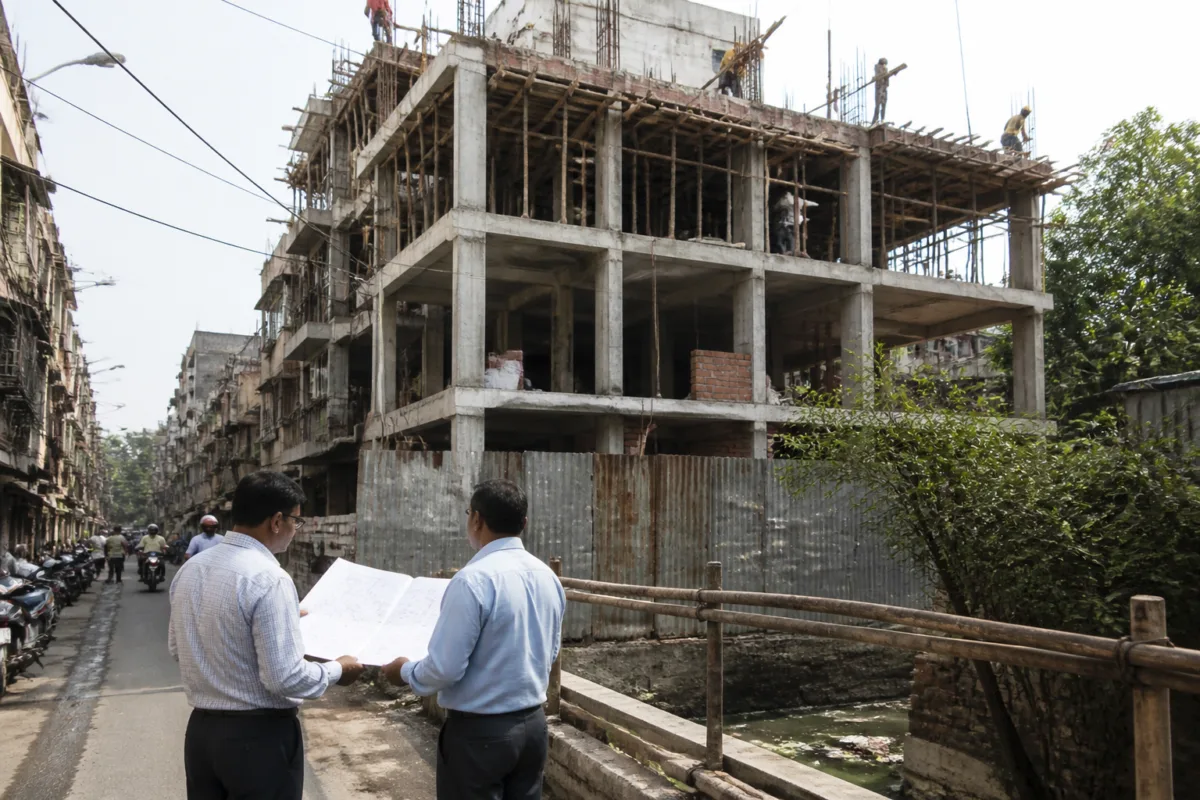
The Supreme Court has sought affidavits from all states and Union Territories on measures to prevent illegal construction, placing municipal administrations and building regulators under renewed scrutiny, according to a report by Pratibadi Kalam.
The proceeding is examining more than whether a building received initial permission. The court is also considering whether construction follows sanctioned plans, whether officials supervise work while it is underway and whether inspections are conducted after completion, the report said.
A bench comprising Justice B.V. Nagarathna and Justice Sanjeev Sachdeva has asked states and Union Territories to submit practical recommendations through affidavits filed by responsible officials. Municipal corporations have been directed to prepare proposals in coordination with municipal commissioners and state government departments, according to the report.
The court’s intervention places responsibility on authorities as well as builders and developers. It raises questions about how unauthorised floors, extensions, encroachments and multi-storey buildings continue to be built despite planning rules and regulatory systems.
The issue has implications beyond individual properties. Unauthorised construction can affect road capacity, drainage, traffic movement, open spaces, fire-safety arrangements, emergency access, water supply and other civic infrastructure. The court has reportedly observed that a city is not merely a collection of privately owned properties, because the effects of an unauthorised multi-storey building can extend across an entire locality.
The proceedings are particularly significant for Kolkata, where allegations of unauthorised construction and extensions beyond sanctioned plans have continued for years. Several cases concerning unauthorised multi-storey buildings are pending before the Calcutta High Court, the report said.
In March 2024, the collapse of an illegally constructed building under construction in Kolkata’s Garden Reach area killed nine people. The incident raised questions about construction practices and administrative supervision. In January 2025, a Calcutta High Court division bench ordered the demolition of illegal structures at eight addresses in the city, according to the report.
The report also said that in September 2026, the High Court directed the Central Bureau of Investigation to conduct a preliminary inquiry into alleged financial transactions linked to about 52 unauthorised multi-storey buildings. The Kolkata Municipal Corporation was instructed to prepare a time-bound roadmap for demolishing the structures.
Kolkata Municipal Corporation’s 2025-26 budget documents reportedly record the demolition of nearly 1,000 illegal constructions during the preceding year. That figure has renewed questions about whether violations are being detected early enough or only after construction is complete.
The Supreme Court has also cautioned against regularising unauthorised construction through exemptions, particularly before elections, the report said. Such measures can weaken enforcement and disadvantage residents and developers who comply with approved rules.
The affidavits sought from states and Union Territories could provide a broader picture of how building permissions, construction-stage inspections, completion certificates and post-construction monitoring are handled. The immediate question is whether the submissions will lead to stronger supervision and clearly assigned accountability, rather than becoming a paper exercise.
For cities, the issue extends beyond demolition. Effective enforcement would require transparent approval systems, regular inspections, reliable records and action against violations while work is still at an early stage. The Supreme Court’s proceedings have brought those institutional responsibilities into focus, but the recommendations submitted by states and the eventual directions in the case will determine their practical impact.

