


The Yamuna Expressway Industrial Development Authority (YEIDA) has approved a set of measures covering industrial land, private business parks, farmer compensation, residential plot development, road repairs, waste regulation and public infrastructure, as its reported income rose to ₹7,071.48 crore during the current financial year up to October 30.
The decisions were taken at YEIDA’s 94th board meeting, chaired by Alok Kumar, Uttar Pradesh’s infrastructure and industrial development commissioner and YEIDA chairman. Chief executive officer Rakesh Kumar Singh presented the proposals to the board.
YEIDA’s income during the period was reported at ₹7,071.48 crore, compared with ₹1,746.38 crore during the corresponding period of the previous financial year. The authority has provided ₹8,000 crore for land purchase and acquisition in the current financial year and had spent ₹4,985.47 crore by October 30. This included ₹565.15 crore for land acquisition related to the Jewar airport project.
The authority also reported expenditure of ₹383 crore on construction and development activities. A further ₹555.38 crore was transferred to the National Highways Authority of India for special projects, according to the report.
The board gave in-principle approval to the Uttar Pradesh Private Business Park Development Scheme, 2025. YEIDA will identify suitable sectors before preparing a land scheme and issuing a brochure. The stated objective is to attract private investment and provide infrastructure for commercial activity in the authority’s area.
Industrial plots will also be made available in Sectors 4 and 8E on the basis of land facilitation letters received through Invest UP and proposals submitted on the Nivesh Sarathi portal. The report said land would be acquired from farmers through mutual consent to facilitate allotment to entrepreneurs seeking industrial sites.
For residential plot allottees, the board extended the free building-construction period from December 31, 2026, to December 31, 2027. The extension applies to allottees whose lease deeds have been completed and who were affected by disputes with farmers, court stay orders or the unavailability of land. In some residential sectors, road, civil and electrical development works remain incomplete, according to the report.
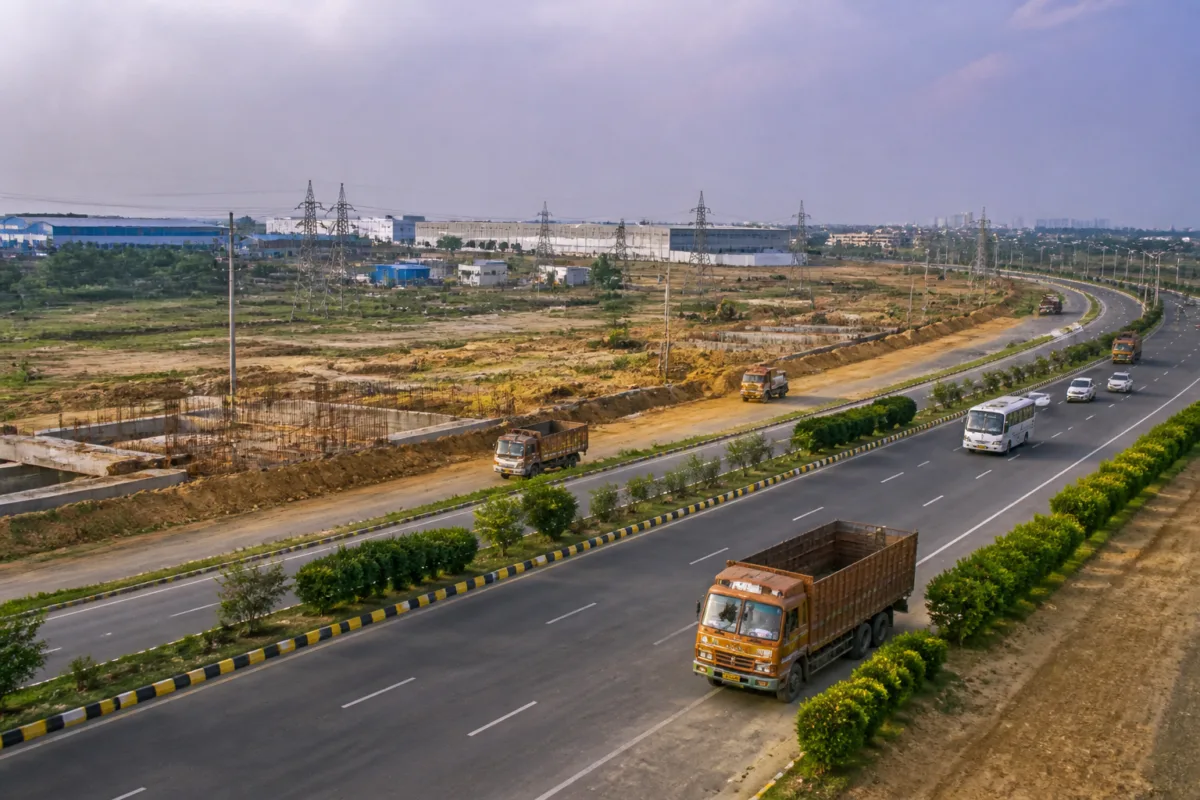
The board also approved repairs to the damaged Hall Road along the Yamuna Expressway, between Jikarpur and the Tappal cut. The road, earlier built by the concessionaire, connects Jikarpur directly with the Aligarh-Palwal highway. The estimated repair cost is ₹665.64 lakh, or about ₹6.65 crore.
Waste management and aviation safety were addressed through approval of the draft gazette notification for the YEIDA Waste Management (Regulation and Control) Bye-Laws, 2026. The report linked the proposed rules to better waste management in the authority’s area and compliance with aviation safety requirements.
The board also approved rooftop solar plants at institutions under YEIDA through the Renewable Energy Service Company model. Under the RESCO model, a service provider generally develops and operates the installation, enabling the institution to use generated solar power without undertaking the entire upfront investment. The report did not provide details of the proposed installations or their capacity.
YEIDA’s Service Master Plan-2041 was presented to the board with provisions for future water-supply and sewerage requirements. The draft report and land-use map for the Agra Urban Centre Master Plan-2041 were also approved for submission to the Uttar Pradesh government.
The authority adopted the Model Building Regulations-2026 issued under a Uttar Pradesh government order dated October 12, 2026. This is intended to provide a common framework for building construction and planning regulations within the authority’s jurisdiction.
Farmer-related matters formed another major part of the meeting. YEIDA has issued publications for allotting seven per cent abadi plots to 14,281 farmers, and reservation letters have been issued to 11,229 of them. A total of 5,147 plots have been planned across different sectors.
Under the No Litigation Incentive scheme, the authority has paid about ₹3,183.13 crore as additional compensation equivalent to 64.7 per cent to eligible farmers, the report said. The scheme is intended to help resolve disputes involving pending compensation and litigation linked to land acquisition.
The board also decided to frame rules for the use of YEIDA’s corpus fund. The proposed rules will cover one-time lease rent, transfer charges, restoration charges, extension charges, plan-processing fees, late-payment penalties, completion fees and water and sewer connection charges.
Taken together, the decisions connect YEIDA’s improved receipts with a broad development programme: land assembly for industrial activity, relief for delayed residential construction, settlement of farmer claims, road rehabilitation and long-term planning for water, sewerage and land use. Their practical impact will depend on the authority’s subsequent land acquisition, project execution, regulatory and state-government approval processes.

