


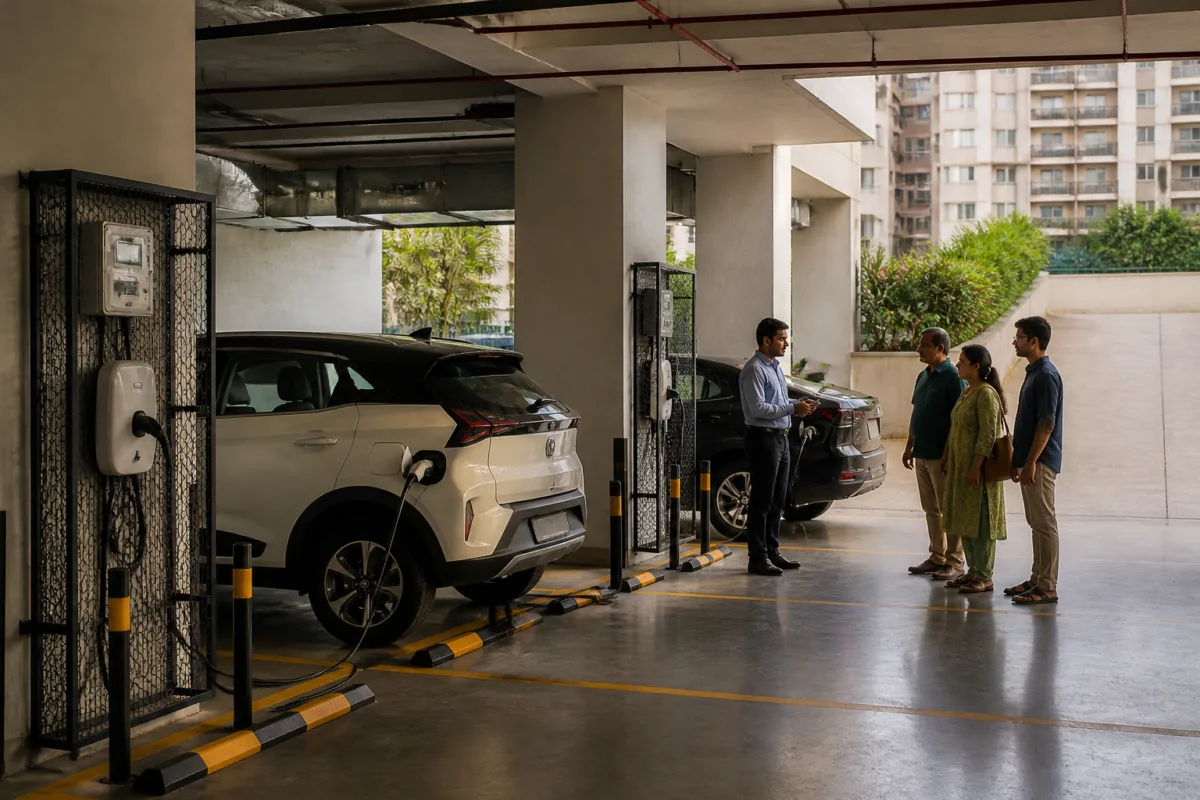
Dedicated building bye-laws for EV charger installations in Hyderabad apartments have been recommended by the Administrative Staff College of India (ASCI), with the proposed rules aimed at speeding up approvals while setting safety and metering requirements for resident welfare associations (RWAs).
The recommendations are part of ‘Powering Vision 2047: EV Adoption and Grid Readiness in Hyderabad’, a report jointly launched by ASCI and the Natural Resources Defense Council (NRDC) India at Bella Vista in Hyderabad on Thursday. The Centre for Energy Studies at ASCI and NRDC India examined EV adoption trends, charging demand and the implications for distribution-network planning through FY 2034-35.
The report proposes that RWAs and apartment owners issue no-objection certificates for charger installations within five days. It also recommends common-area charging facilities and individual sub-metering so that electricity used for vehicle charging is not added to common maintenance bills.
For fire safety, the recommendations include charging arrangements on ground floors and in first basements, with proper enclosures and certified cables. Charging in automated or stacked parking areas would be restricted under the proposed approach, according to B.T. Srinivasan, general secretary of the Confederation of All India Residents Welfare Associations (CoRWA).
Srinivasan said Hyderabad accounted for nearly 70% of Telangana’s new EV registrations, while homes were expected to generate nearly 58% of future charging demand. These figures were presented in the context of the study’s assessment of future charging and grid requirements.
The report also proposes Time-of-Day tariffs for domestic connections and bulk procurement of affordable smart home chargers for RWAs. The measures are intended to reduce pressure on the electricity grid during the 5 pm to 8 pm period.
A pilot involving 15 to 20 Hyderabad RWAs has been proposed to develop an apartment charging model. The report’s recommendations would require implementation through the relevant building-approval, electricity-supply and apartment-management mechanisms before they become applicable requirements.

