


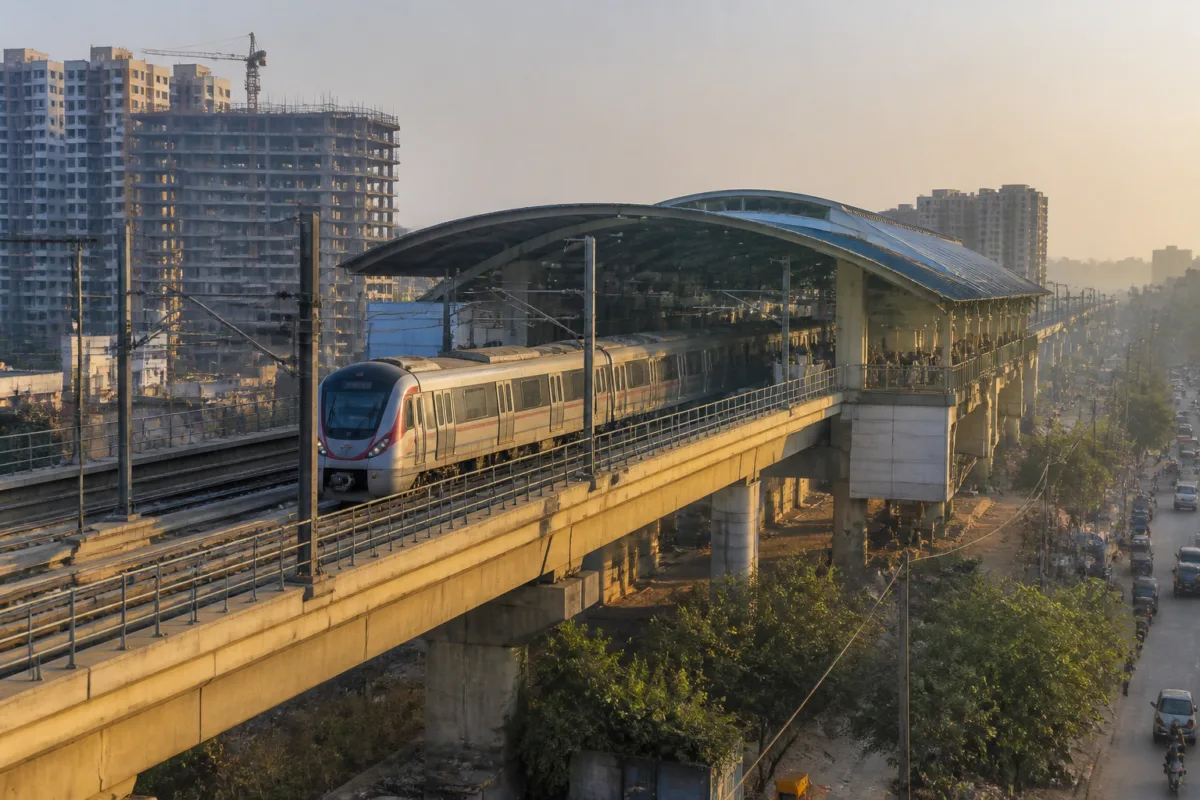
Ghaziabad is being positioned as a potential Namo Bharat interchange for future regional links to Jewar airport, Hapur and Khurja, alongside the operational Delhi-Ghaziabad-Meerut corridor. The proposed network could widen rapid-transit access across eastern and southern parts of the National Capital Region, although three of the four routes remain at planning or appraisal stages.
According to the report, the existing Delhi-Ghaziabad-Meerut corridor is 82.15 km long and became fully operational in February 2026. It connects Sarai Kale Khan in Delhi with Modipuram in Meerut, with stations including Anand Vihar, Sahibabad, Ghaziabad, Duhai and Meerut South. NCRTC operates Namo Bharat services on the corridor, while Meerut Metro shares part of the infrastructure.
The most advanced of the proposed extensions is the 72.45-km Ghaziabad-Jewar Airport corridor. The reported alignment could pass through Siddharth Vihar, Char Murti Chowk, Greater Noida West, Knowledge Park 5, Surajpur, Pari Chowk, Kasna and Dankaur. The proposal reportedly includes 22 stations, comprising 12 rapid rail stations and 10 local Metro stations. A journey between Ghaziabad and Noida International Airport at Jewar has been estimated at about 60 to 70 minutes.
However, the project is not yet under construction. The report cites NCRTC’s latest annual report as placing the corridor under central government appraisal. A 2030 completion target has been mentioned in reports, but no opening date has been confirmed. Route details, station locations and construction schedules could change after further surveys and approvals.
Two other corridors remain future proposals. The approximately 57-km Ghaziabad-Hapur route is intended to improve connections between the three cities and could serve commuters, traders and students. The proposed Ghaziabad-Khurja corridor, estimated at around 83 km, would extend rapid rail access towards Bulandshahr and Khurja. The report says the Khurja proposal may include four major rapid rail stations, while the Hapur plan includes three main stations. Detailed alignments, costs, construction dates and final station plans have not been confirmed.
If implemented, the three proposed links would extend the reach of Ghaziabad’s existing regional transport network beyond the Delhi-Meerut axis. The likely urban effect would depend on more than station construction. Interchange design, feeder buses, walking access, parking controls and last-mile links would determine whether residents in surrounding neighbourhoods can use the system reliably.
The report also links the proposed corridors to housing demand in areas along the possible alignments. It identifies Siddharth Vihar and the Sahibabad belt near existing or proposed connections, as well as Greater Noida West, Knowledge Park 5, Surajpur and Pari Chowk along the possible Jewar route. It reports average apartment prices of about Rs 9,300 per sq ft in Siddharth Vihar, Rs 8,650 to Rs 8,900 per sq ft in Greater Noida West and about Rs 8,200 per sq ft around Pari Chowk. These are reported market figures, not official valuations, and should not be treated as evidence that a future corridor has been approved.
The report separately places ready two-bedroom flats in Raj Nagar Extension at about Rs 55 lakh to Rs 65 lakh, while noting that housing demand in Hapur, Bulandshahr and Khurja is more focused on plots and independent houses. Such market interest may reflect expectations around connectivity, but the strength and timing of any land-use impact will depend on approvals, alignment decisions and eventual construction.
For now, Ghaziabad’s role as a regional rail hub is established through the operational Delhi-Meerut line. Its proposed links to Jewar airport, Hapur and Khurja remain a planning proposition rather than a committed four-corridor network. The next material milestones will be formal approvals, published alignments, station plans, funding decisions and construction schedules.

